FINISHED! EVERY YEAR 11 RESOURCE IS NOW AVAILABLE.
VCE Methods Integral Calculus Application Task 14
Adapted for Year 11. Unit 1 & 2.
Number of marks: 5
Reading time: 1 minute
Writing time: 8 minutes
Section B – Calculator Allowed
Instructions
• Answer all questions in the spaces provided.
• Write your responses in English.
• In questions where a numerical answer is required, an exact value must be given unless otherwise specified.
• In questions where more than one mark is available, appropriate working must be shown.
• Unless otherwise indicated, the diagrams in this book are not drawn to scale.
During a telephone call, a phone uses a dual-tone frequency electrical signal to communicate with the telephone exchange.
The strength, \(f\), of a simple dual-tone frequency signal is given by the function \(f(t) = \sin\left(\frac{\pi t}{3}\right) + \sin\left(\frac{\pi t}{6}\right)\) where \(t\) is a measure of time and \(t \ge 0\).
Part of the graph of \(y = f(t)\) is shown below.
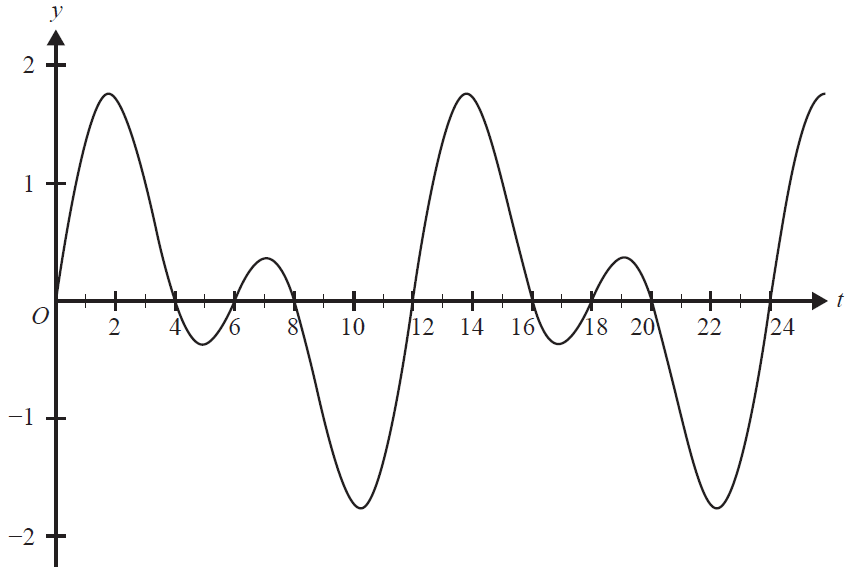
a. State the period of the function. 1 mark
b. Find the values of \(t\) where \(f(t) = 0\) for the interval \(t \in [0, 6]\). 1 mark
c. Find the maximum strength of the dual-tone frequency signal, correct to two decimal places. 1 mark
d. Find the area between the graph of \(f\) and the horizontal axis for \(t \in [0, 6]\). 2 marks
End of examination questions
VCE is a registered trademark of the VCAA. The VCAA does not endorse or make any warranties regarding this study resource. Past VCE exams and related content can be accessed directly at www.vcaa.vic.edu.au

