FINISHED! EVERY YEAR 11 RESOURCE IS NOW AVAILABLE.
2024 VCAA Maths Methods Exam 1
Adapted for Year 11. Unit 1 & 2.
This is the full VCE Maths Methods Exam with worked solutions. You can also try Mini-Tests, which are official VCAA exams split into short tests you can do anytime.
Number of marks: 24
Reading time: 10 minutes
Writing time: 35 minutes
Instructions
• Answer all questions in the spaces provided.
• Write your responses in English.
• In all questions where a numerical answer is required, an exact value must be given unless
otherwise specified.
• In questions where more than one mark is available, appropriate working must be shown.
• Unless otherwise indicated, the diagrams in this book are not drawn to scale.
Consider the simultaneous linear equations
\( 3k x - 2y = k + 4 \)
\( (k - 4)x + ky = -k \)
where \( x, y \in \mathbb{R} \) and \( k \) is a real constant.
Determine the value of \( k \) for which the system of equations has no real solution. 3 marks
Let \( g : \mathbb{R} \setminus \{-3\} \rightarrow \mathbb{R},\ g(x) = \frac{1}{x + 3} - 2 \).
a. On the axes below, sketch the graph of \( y = g(x) \), labelling all asymptotes with their equations and axis intercepts with their coordinates. 2 marks
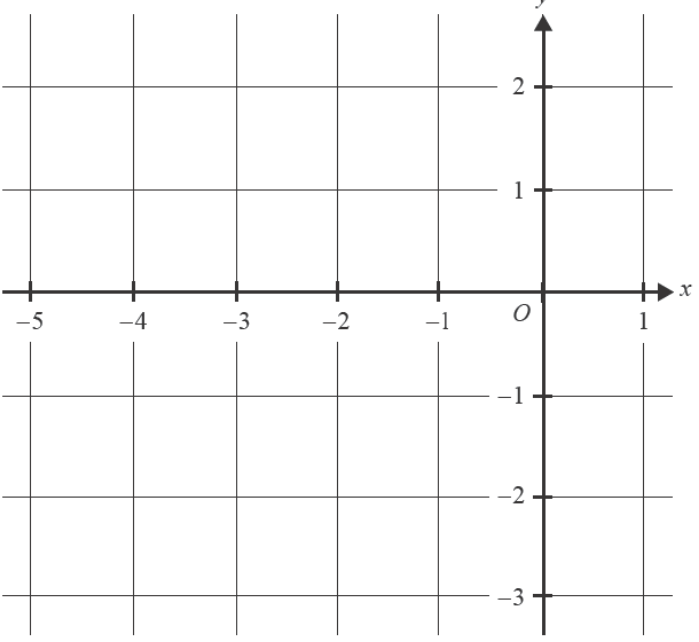
b. Determine the area of the region bounded by the line \( x = -2 \), the x-axis, the y-axis and the graph of \( y = g(x) \). 3 marks
Let \( X \) be a binomial random variable where \( X \sim \text{Bi}\left(4, \frac{9}{10}\right) \).
a. [Not applicable for Year 11 students]. 1 mark
b. Find \( \Pr(X < 2) \). 2 marks
The function \( h : [0, \infty) \rightarrow \mathbb{R},\ h(t) = \frac{3000}{t + 1} \) models the population of a town after \( t \) years.
a. Use the model \( h(t) \) to predict the population of the town after four years. 1 mark
b. A new function, \( h_1 \), models a population where \( h_1(0) = h(0) \) but \( h_1 \) decreases at half the rate of \( h \) at any point in time.
State a sequence of two transformations that maps \( h \) to this new model \( h_1 \). 2 marks
c. Not applicable for Year 11 students
Solve \( 2\log_3(x - 4) + \log_3(x) = 2 \) for \( x \). 4 marks
Let \( g : \mathbb{R} \rightarrow \mathbb{R}, \quad g(x) = \sqrt[3]{x - k}+ m, \quad \text{where } k \in \mathbb{R} \setminus \{0\} \text{ and } m \in \mathbb{R} \).
Let the point \( P \) be the y-intercept of the graph of \( y = g(x) \).
a. Find the coordinates of \( P \), in terms of \( k \) and \( m \). 1 mark
b. Find the gradient of \( g \) at \( P \), in terms of \( k \). 2 marks
c. Given that the graph of \( y = g(x) \) passes through the origin, express \( k \) in terms of \( m \). 1 mark
d. Let the point \( Q \) be a point different from the point \( P \), such that the gradient of \( g \) at points \( P \) and \( Q \) are equal.
Given that the graph of \( y = g(x) \) passes through the origin, find the coordinates of \( Q \) in terms of \( m \). 3 marks
End of examination questions
VCE is a registered trademark of the VCAA. The VCAA does not endorse or make any warranties regarding this study resource. Past VCE exams and related content can be accessed directly at www.vcaa.vic.edu.au

