FINISHED! EVERY YEAR 11 RESOURCE IS NOW AVAILABLE.
2020 VCAA Maths Methods Exam 1
Adapted for Year 11. Unit 1 & 2.
This is the full VCE Maths Methods Exam with worked solutions. You can also try Mini-Tests, which are official VCAA exams split into short tests you can do anytime.
Number of marks: 26
Reading time: 10 minutes
Writing time: 40 minutes
Instructions
• Answer all questions in the spaces provided.
• Write your responses in English.
• In all questions where a numerical answer is required, an exact value must be given unless
otherwise specified.
• In questions where more than one mark is available, appropriate working must be shown.
• Unless otherwise indicated, the diagrams in this book are not drawn to scale.
Shown below is part of the graph of a period of the function of the form \(y = \tan(ax+b)\).
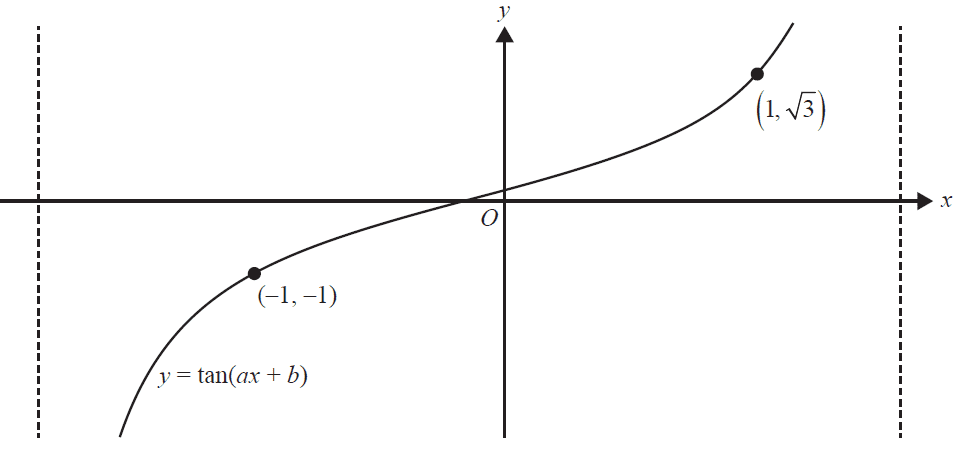
The graph is continuous for \(x \in [-1, 1]\).
Find the value of \(a\) and the value of \(b\), where \(a > 0\) and \(0 < b < 1\). 3 marks
Solve the equation \(2\log_2(x+5) - \log_2(x+9) = 1\). 3 marks
For a certain population the probability of a person being born with the specific gene SPGE1 is \(\frac{3}{5}\).
The probability of a person having this gene is independent of any other person in the population having this gene.
a. In a randomly selected group of four people, what is the probability that three or more people have the SPGE1 gene? 2 marks
b. In a randomly selected group of four people, what is the probability that exactly two people have the SPGE1 gene, given that at least one of those people has the SPGE1 gene? Express your answer in the form \(\frac{a^3}{b^4 - c^4}\), where \(a, b, c \in Z^+\). 2 marks
Let \(f: [0, 2] \to \mathbb{R}\), where \(f(x) = \frac{1}{\sqrt{2}}\sqrt{x}\).
a. Find the domain and the rule for \(f^{-1}\), the inverse function of \(f\). 2 marks
The graph of \(y = f(x)\), where \(x \in [0, 2]\), is shown on the axes below.
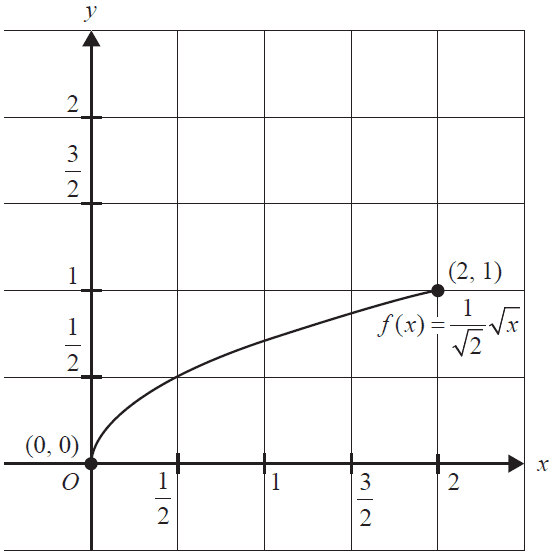
b. On the axes above, sketch the graph of \(f^{-1}\) over its domain. Label the endpoints and point(s) of intersection with the function \(f\), giving their coordinates. 2 marks
c. Find the total area of the two regions: one region bounded by the functions \(f\) and \(f^{-1}\), and the other region bounded by \(f\), \(f^{-1}\) and the line \(x=1\). Give your answer in the form \(\frac{a-b\sqrt{b}}{6}\), where \(a, b \in Z^+\). 4 marks
Consider the function \(f(x) = x^2 + 3x + 5\) and the point \(P(1, 0)\). Part of the graph of \(y = f(x)\) is shown below.
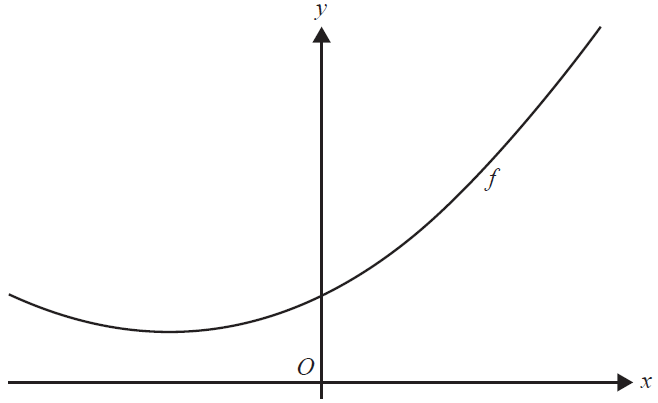
a. Show that point \(P\) is not on the graph of \(y = f(x)\). 1 mark
b. Consider a point \(Q(a, f(a))\) to be a point on the graph of \(f\).
i. Find the slope of the line connecting points \(P\) and \(Q\) in terms of \(a\). 1 mark
ii. Find the slope of the tangent to the graph of \(f\) at point \(Q\) in terms of \(a\). 1 mark
iii. Let the tangent to the graph of \(f\) at \(x=a\) pass through point \(P\).
Find the values of \(a\). 2 marks
iv. Give the equation of one of the lines passing through point \(P\) that is tangent to the graph of \(f\). 1 mark
c. Find the value, \(k\), that gives the shortest possible distance between the graph of the function of \(y = f(x-k)\) and point \(P\). 2 marks
End of examination questions
VCE is a registered trademark of the VCAA. The VCAA does not endorse or make any warranties regarding this study resource. Past VCE exams and related content can be accessed directly at www.vcaa.vic.edu.au

