FINISHED! EVERY YEAR 11 RESOURCE IS NOW AVAILABLE.
2019 VCAA Maths Methods Exam 1
Adapted for Year 11. Unit 1 & 2.
This is the full VCE Maths Methods Exam with worked solutions. You can also try Mini-Tests, which are official VCAA exams split into short tests you can do anytime.
Number of marks: 25
Reading time: 10 minutes
Writing time: 40 minutes
Instructions
• Answer all questions in the spaces provided.
• Write your responses in English.
• In all questions where a numerical answer is required, an exact value must be given unless
otherwise specified.
• In questions where more than one mark is available, appropriate working must be shown.
• Unless otherwise indicated, the diagrams in this book are not drawn to scale.
Let \(f: (\frac{1}{3}, \infty) \to \mathbb{R}\), \(f(x) = \frac{1}{3x-1}\).
a.
i. Find \(f'(x)\). 1 mark
ii. Not applicable for Year 11 students. 1 mark
b. Not applicable for Year 11 students. 2 marks
a. Let \(f: \mathbb{R}\setminus\{\frac{1}{3}\} \to \mathbb{R}\), \(f(x) = \frac{1}{3x-1}\).
Find the rule of \(f^{-1}\). 2 marks
b. State the domain of \(f^{-1}\). 1 mark
c. Let \(g\) be the function obtained by applying the transformation \(T\) to the function \(f\), where
\(T\left(\begin{bmatrix} x \\ y \end{bmatrix}\right) = \begin{bmatrix} x \\ y \end{bmatrix} + \begin{bmatrix} c \\ d \end{bmatrix}\)
and \(c, d \in \mathbb{R}\).
Find the values of \(c\) and \(d\) given that \(g = f^{-1}\). 1 mark
The only possible outcomes when a coin is tossed are a head or a tail. When an unbiased coin is tossed, the probability of tossing a head is the same as the probability of tossing a tail.
Jo has three coins in her pocket; two are unbiased and one is biased. When the biased coin is tossed, the probability of tossing a head is \(\frac{1}{3}\).
Jo randomly selects a coin from her pocket and tosses it.
a. Find the probability that she tosses a head. 2 marks
b. Find the probability that she selected an unbiased coin, given that she tossed a head. 1 mark
a. Solve \(1 - \cos(\frac{x}{2}) = \cos(\frac{x}{2})\) for \(x \in [-2\pi, \pi]\). 2 marks
b. The function \(f: [-2\pi, \pi] \to \mathbb{R}\), \(f(x) = \cos(\frac{x}{2})\) is shown on the axes below.
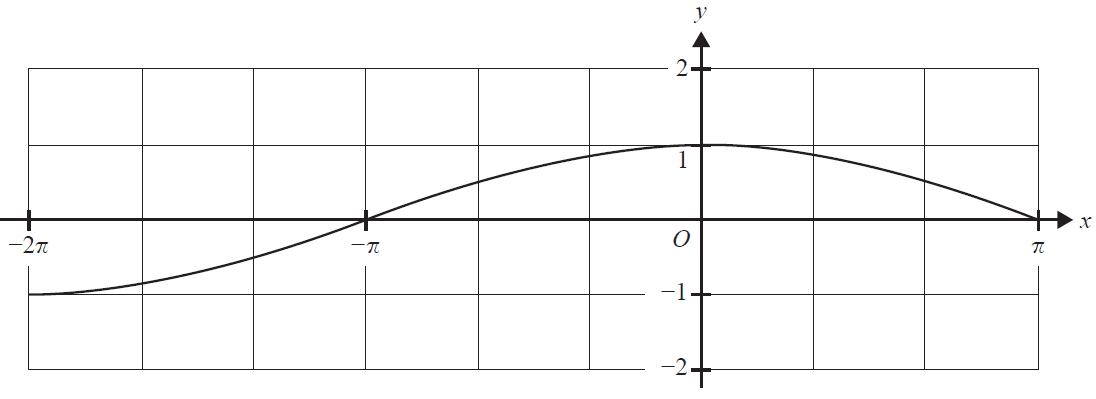
Let \(g: [-2\pi, \pi] \to \mathbb{R}\), \(g(x) = 1 - f(x)\).
Sketch the graph of \(g\) on the axes above. Label all points of intersection of the graphs of \(f\) and \(g\), and the endpoints of \(g\), with their coordinates. 2 marks
Let \(f: \mathbb{R}\setminus\{1\} \to \mathbb{R}\), \(f(x) = \frac{2}{(x-1)^2} + 1\).
a.
i. Evaluate \(f(-1)\). 1 mark
ii. Sketch the graph of \(f\) on the axes below, labelling all asymptotes with their equations. 2 marks
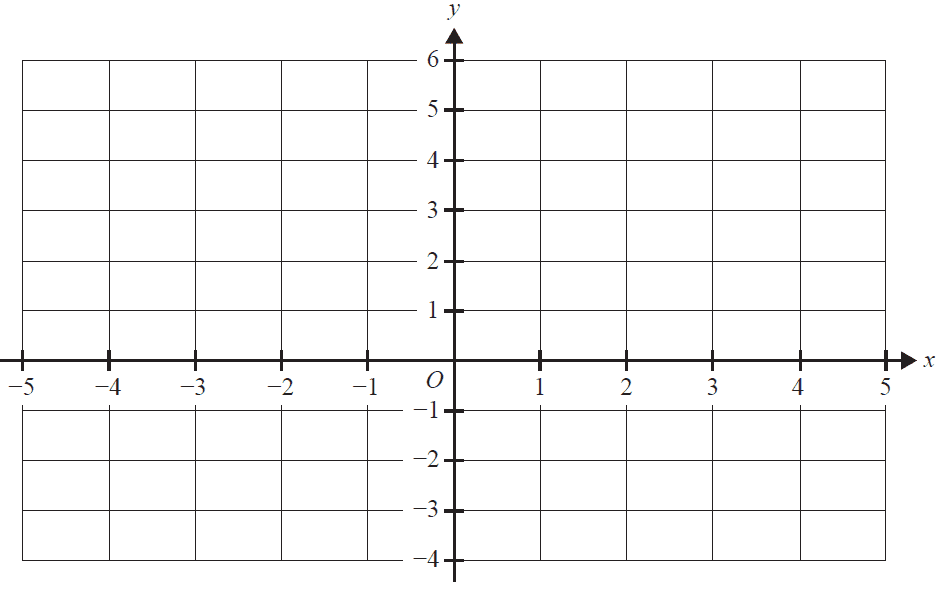
b. Find the area bounded by the graph of \(f\), the \(x\)-axis, the line \(x=-1\) and the line \(x=0\). 2 marks
The graph of the relation \(y = \sqrt{1-x^2}\) is shown on the axes below. \(P\) is a point on the graph of this relation, \(A\) is the point \((-1, 0)\) and \(B\) is the point \((x, 0)\).
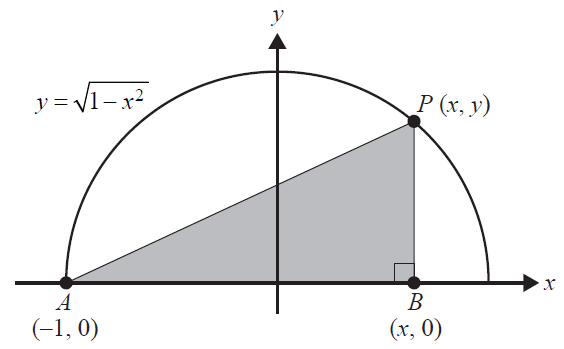
a. Find an expression for the length \(PB\) in terms of \(x\) only. 1 mark
b. Find the maximum area of the triangle \(ABP\). 3 marks
The function \(f: \mathbb{R} \to \mathbb{R}\), \(f(x)\) is a polynomial function of degree 4. Part of the graph of \(f\) is shown below.
The graph of \(f\) touches the \(x\)-axis at the origin.
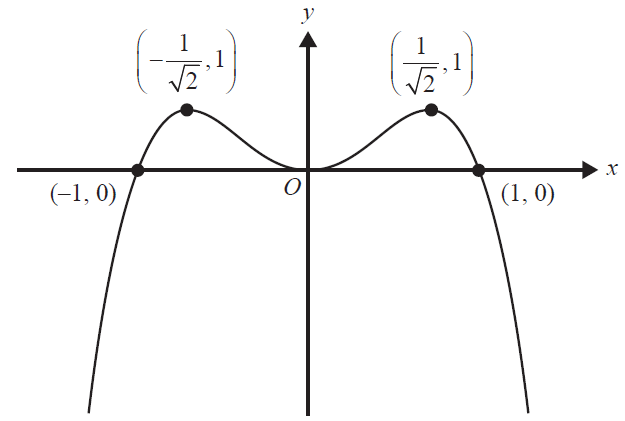
a. Find the rule of \(f\). 1 mark
b. Not applicable for Year 11 students 1 mark
c. Not applicable for Year 11 students. 2 marks
Consider the functions \(f: \mathbb{R} \to \mathbb{R}\), \(f(x) = 3+2x-x^2\) and \(g: \mathbb{R} \to \mathbb{R}\), \(g(x) = e^x\).
a. State the rule of \(g(f(x))\). 1 mark
b. Not applicable for Year 11 students. 2 marks
c. State the rule of \(f(g(x))\). 1 mark
d. Solve \(f(g(x)) = 0\). 2 marks
e. Not applicable for Year 11 students. 2 marks
f. Not applicable for Year 11 students. 1 mark
End of examination questions
VCE is a registered trademark of the VCAA. The VCAA does not endorse or make any warranties regarding this study resource. Past VCE exams and related content can be accessed directly at www.vcaa.vic.edu.au

