FINISHED! EVERY YEAR 11 RESOURCE IS NOW AVAILABLE.
2016 VCAA Maths Methods Exam 2
Adapted for Year 11. Unit 1 & 2.
This is the full VCE Maths Methods Exam with worked solutions. You can also try Mini-Tests, which are official VCAA exams split into short tests you can do anytime.
Number of marks: 59
Reading time: 10 minutes
Writing time: 90 minutes
Section A – Multiple-choice questions
Instructions
• Answer all questions in pencil on your Multiple-Choice Answer Sheet.
• Choose the response that is correct for the question.
• A correct answer scores 1; an incorrect answer scores 0.
• Marks will not be deducted for incorrect answers.
• No marks will be given if more than one answer is completed for any question.
• Unless otherwise indicated, the diagrams in this book are not drawn to scale.
The linear function \(f: D \to R, f(x) = 5 - x\) has range \([-4, 5)\).
The domain \(D\) is
- A. \((0, 9]\)
- B. \((0, 1]\)
- C. \([5, -4)\)
- D. \([-9, 0)\)
- E. \([1, 9)\)
Let \(f: R \to R, f(x) = 1 - 2\cos\left(\frac{\pi x}{2}\right)\).
The period and range of this function are respectively
- A. 4 and \([-2, 2]\)
- B. 4 and \([-1, 3]\)
- C. 1 and \([-1, 3]\)
- D. \(4\pi\) and \([-1, 3]\)
- E. \(4\pi\) and \([-2, 2]\)
Part of the graph \(y = f(x)\) of the polynomial function \(f\) is shown below.
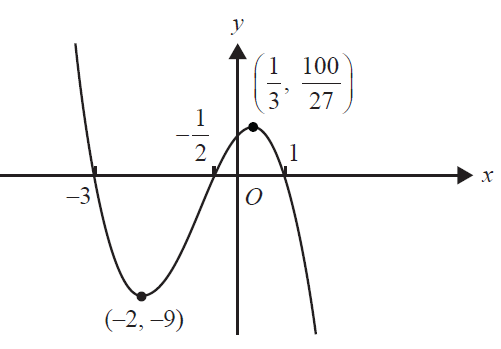
\(f'(x) < 0\) for
- A. \(x \in (-2, 0) \cup (\frac{1}{3}, \infty)\)
- B. \(x \in (-9, \frac{100}{27})\)
- C. \(x \in (-\infty, -2) \cup (\frac{1}{3}, \infty)\)
- D. \(x \in (-2, \frac{1}{3})\)
- E. \(x \in (-\infty, -2] \cup (1, \infty)\)
The average rate of change of the function \(f\) with rule \(f(x) = 3x^2 - 2\sqrt{x+1}\), between \(x=0\) and \(x=3\), is
- A. 8
- B. 25
- C. \(\frac{53}{9}\)
- D. \(\frac{25}{3}\)
- E. \(\frac{13}{9}\)
Which one of the following is the inverse function of \(g: [3, \infty) \to R, g(x) = \sqrt{2x-6}\)?
- A. \(g^{-1}: [3, \infty) \to R, g^{-1}(x) = \frac{x^2+6}{2}\)
- B. \(g^{-1}: [0, \infty) \to R, g^{-1}(x) = (2x-6)^2\)
- C. \(g^{-1}: [0, \infty) \to R, g^{-1}(x) = \sqrt{\frac{x}{2}+6}\)
- D. \(g^{-1}: [0, \infty) \to R, g^{-1}(x) = \frac{x^2+6}{2}\)
- E. \(g^{-1}: R \to R, g^{-1}(x) = \frac{x^2+6}{2}\)
Consider the graph of the function defined by \(f: [0, 2\pi] \to R, f(x) = \sin(2x)\).
The square of the length of the line segment joining the points on the graph for which \(x = \frac{\pi}{4}\) and \(x = \frac{3\pi}{4}\) is
- A. \(\frac{\pi^2+16}{4}\)
- B. \(\pi+4\)
- C. 4
- D. \(\frac{3\pi^2+16\pi}{4}\)
- E. \(\frac{10\pi^2}{16}\)
The number of pets, \(X\), owned by each student in a large school is a random variable with the following discrete probability distribution.
| \(x\) | 0 | 1 | 2 | 3 |
| \(\Pr(X=x)\) | 0.5 | 0.25 | 0.2 | 0.05 |
If two students are selected at random, the probability that they own the same number of pets is
- A. 0.3
- B. 0.305
- C. 0.355
- D. 0.405
- E. 0.8
The UV index, \(y\), for a summer day in Melbourne is illustrated in the graph below, where \(t\) is the number of hours after 6 am.
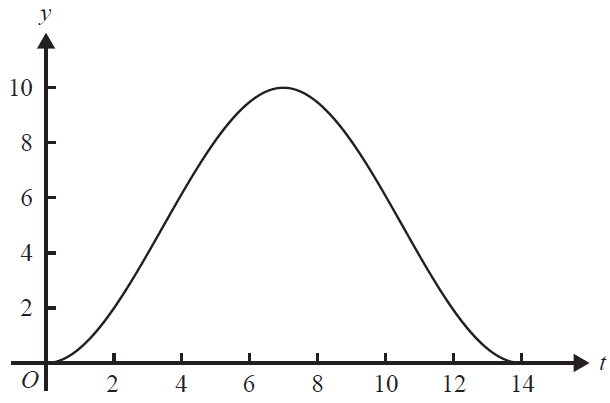
The graph is most likely to be the graph of
- A. \(y = 5 + 5\cos\left(\frac{\pi t}{7}\right)\)
- B. \(y = 5 - 5\cos\left(\frac{\pi t}{7}\right)\)
- C. \(y = 5 + 5\cos\left(\frac{\pi t}{14}\right)\)
- D. \(y = 5 - 5\cos\left(\frac{\pi t}{14}\right)\)
- E. \(y = 5 + 5\sin\left(\frac{\pi t}{14}\right)\)
For the curve \(y = x^2 - 5\), the tangent to the curve will be parallel to the line connecting the positive \(x\)-intercept and the \(y\)-intercept when \(x\) is equal to
- A. \(\sqrt{5}\)
- B. 5
- C. -5
- D. \(\frac{\sqrt{5}}{2}\)
- E. \(\frac{1}{\sqrt{5}}\)
The function \(f\) has the property \(f(x) - f(y) = (y-x)f(xy)\) for all non-zero real numbers \(x\) and \(y\).
Which one of the following is a possible rule for the function?
- A. \(f(x) = x^2\)
- B. \(f(x) = x^2 + x^4\)
- C. \(f(x) = x\log_e(x)\)
- D. \(f(x) = \frac{1}{x}\)
- E. \(f(x) = \frac{1}{x^2}\)
The graph of a function \(f\) is obtained from the graph of the function \(g\) with rule \(g(x) = \sqrt{2x-5}\) by a reflection in the \(x\)-axis followed by a dilation from the \(y\)-axis by a factor of \(\frac{1}{2}\).
Which one of the following is the rule for the function \(f\)?
- A. \(f(x) = \sqrt{5-4x}\)
- B. \(f(x) = -\sqrt{x-5}\)
- C. \(f(x) = \sqrt{x+5}\)
- D. \(f(x) = -\sqrt{4x-5}\)
- E. \(f(x) = -\sqrt{4x-10}\)
Consider the graphs of the functions \(f\) and \(g\) shown below.
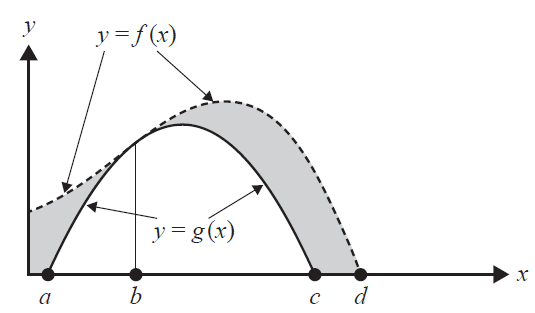
The area of the shaded region could be represented by
- A. \(\int_a^d (f(x)-g(x))dx\)
- B. \(\int_0^d (f(x)-g(x))dx\)
- C. \(\int_0^b (f(x)-g(x))dx + \int_b^c (f(x)-g(x))dx\)
- D. \(\int_0^a f(x)dx + \int_a^c (f(x)-g(x))dx+\int_b^d f(x)dx \)
- E. \(\int_0^d f(x)dx - \int_a^c g(x)dx\)
A rectangle is formed by using part of the coordinate axes and a point \((u, v)\), where \(u > 0\) on the parabola \(y = 4-x^2\).
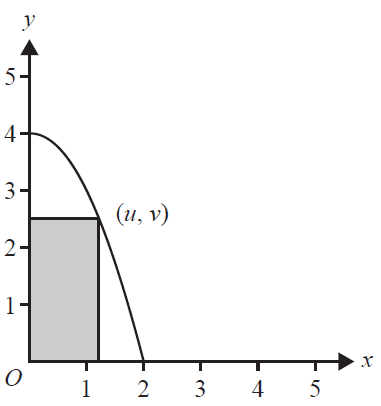
Which one of the following is the maximum area of the rectangle?
- A. 4
- B. \(\frac{2\sqrt{3}}{3}\)
- C. \(\frac{8\sqrt{3}-4}{3}\)
- D. \(\frac{8}{3}\)
- E. \(\frac{16\sqrt{3}}{9}\)
A box contains six red marbles and four blue marbles. Two marbles are drawn from the box, without replacement.
The probability that they are the same colour is
- A. \(\frac{1}{2}\)
- B. \(\frac{28}{45}\)
- C. \(\frac{7}{15}\)
- D. \(\frac{3}{5}\)
- E. \(\frac{1}{3}\)
End of Section A
Section B
Instructions
• Answer all questions in the spaces provided.
• Write your responses in English.
• In questions where a numerical answer is required, an exact value must be given unless otherwise specified.
• In questions where more than one mark is available, appropriate working must be shown.
• Unless otherwise indicated, the diagrams in this book are not drawn to scale.
Let \(f: [0, 8\pi] \to R, f(x) = 2\cos\left(\frac{x}{2}\right) + \pi\).
a. Find the period and range of \(f\). 2 marks
b. State the rule for the derivative function \(f'\). 1 mark
c. Find the equation of the tangent to the graph of \(f\) at \(x = \pi\). 1 mark
d. Find the equations of the tangents to the graph of \(f: [0, 8\pi] \to R, f(x) = 2\cos\left(\frac{x}{2}\right) + \pi\) that have a gradient of 1. 2 marks
e. The rule of \(f'\) can be obtained from the rule of \(f\) under a transformation \(T\), such that \(T: R^2 \to R^2, T\left(\begin{bmatrix} x \\ y \end{bmatrix}\right) = \begin{bmatrix} 1 & 0 \\ 0 & a \end{bmatrix}\begin{bmatrix} x \\ y \end{bmatrix} + \begin{bmatrix} -\pi \\ b \end{bmatrix} \) Find the value of \(a\) and the value of \(b\). 3 marks
f. Find the values of \(x, 0 \le x \le 8\pi\), such that \(f(x) = 2f'(x) + \pi\). 2 marks
Consider the function \(f(x) = -\frac{1}{3}(x+2)(x-1)^2\).
a.
i. Given that \(g'(x) = f(x)\) and \(g(0) = 1\), show that \(g(x) = -\frac{x^4}{12} + \frac{x^2}{2} - \frac{2x}{3} + 1\). 1 mark
ii. Find the values of \(x\) for which the graph of \(y = g(x)\) has a stationary point. 1 mark
b. The diagram below shows part of the graph of \(y = g(x)\), the tangent to the graph at \(x = 2\) and a straight line drawn perpendicular to the tangent to the graph at \(x = 2\). The equation of the tangent at the point \(A\) with coordinates \((2, g(2))\) is \(y = 3 - \frac{4x}{3}\).
The tangent cuts the \(y\)-axis at \(B\). The line perpendicular to the tangent cuts the \(y\)-axis at \(C\).
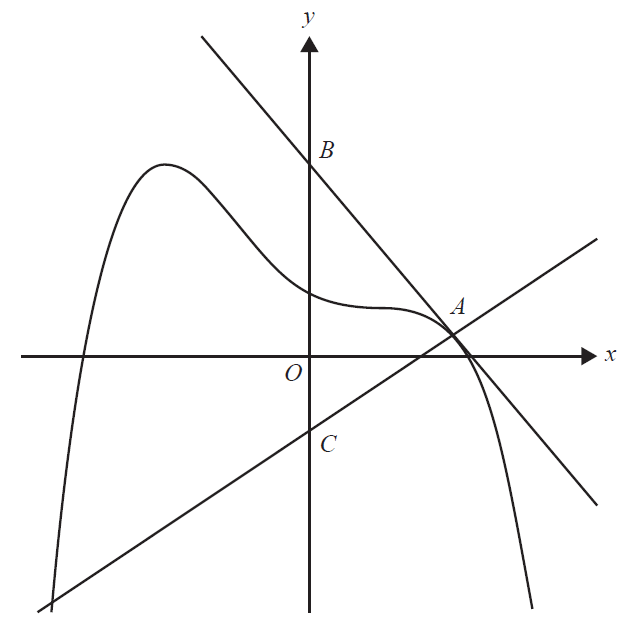
i. Find the coordinates of \(B\). 1 mark
ii. Find the equation of the line that passes through \(A\) and \(C\) and, hence, find the coordinates of \(C\). 2 marks
iii. Find the area of triangle \(ABC\). 2 marks
c. The tangent at \(D\) is parallel to the tangent at \(A\). It intersects the line passing through \(A\) and \(C\) at \(E\).
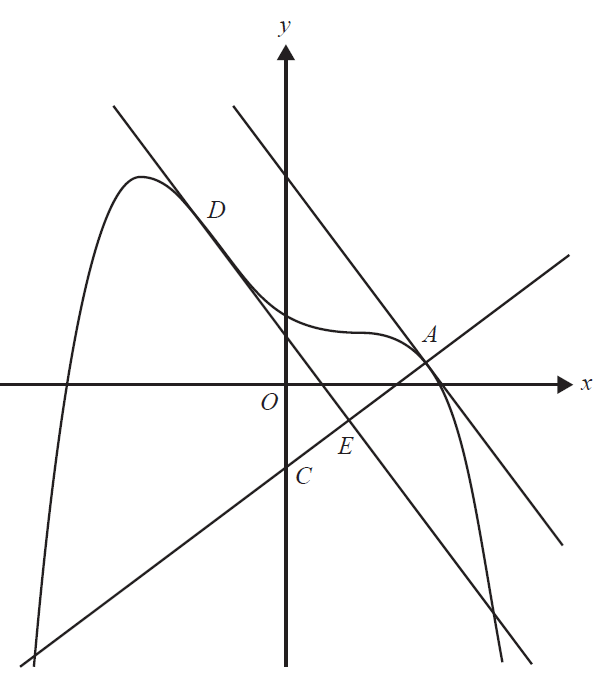
i. Find the coordinates of \(D\). 2 marks
ii. Find the length of \(AE\). 3 marks
A school has a class set of 22 new laptops kept in a recharging trolley. Provided each laptop is correctly plugged into the trolley after use, its battery recharges.
On a particular day, a class of 22 students uses the laptops. All laptop batteries are fully charged at the start of the lesson. Each student uses and returns exactly one laptop. The probability that a student does not correctly plug their laptop into the trolley at the end of the lesson is 10%. The correctness of any student's plugging-in is independent of any other student's correctness.
a. Determine the probability that at least one of the laptops is not correctly plugged into the trolley at the end of the lesson. Give your answer correct to four decimal places. 2 marks
b. A teacher observes that at least one of the returned laptops is not correctly plugged into the trolley.
Given this, find the probability that fewer than five laptops are not correctly plugged in. Give your answer correct to four decimal places. 2 marks
c. Not applicable for Year 11 students. 2 marks
a. Express \(\frac{2x+1}{x+2}\) in the form \(a + \frac{b}{x+2}\), where \(a\) and \(b\) are non-zero integers. 2 marks
b. Let \(f: R \setminus \{-2\} \to R, f(x) = \frac{2x+1}{x+2}\).
i. Find the rule and domain of \(f^{-1}\), the inverse function of \(f\). 2 marks
ii. Part of the graphs of \(f\) and \(y = x\) are shown in the diagram below.
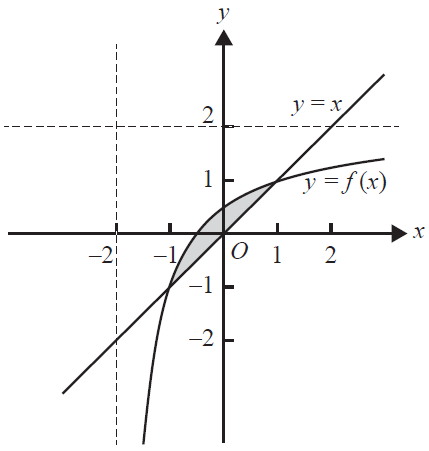
Find the area of the shaded region. 1 mark
iii. Part of the graphs of \(f\) and \(f^{-1}\) are shown in the diagram below.
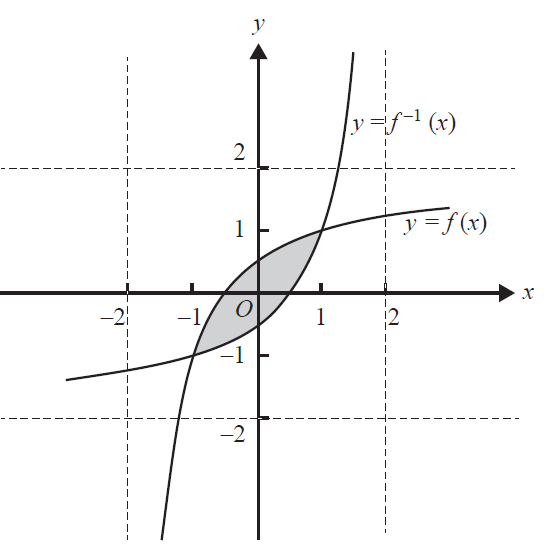
Find the area of the shaded region. 1 mark
c. Part of the graph of \(f\) is shown in the diagram below.
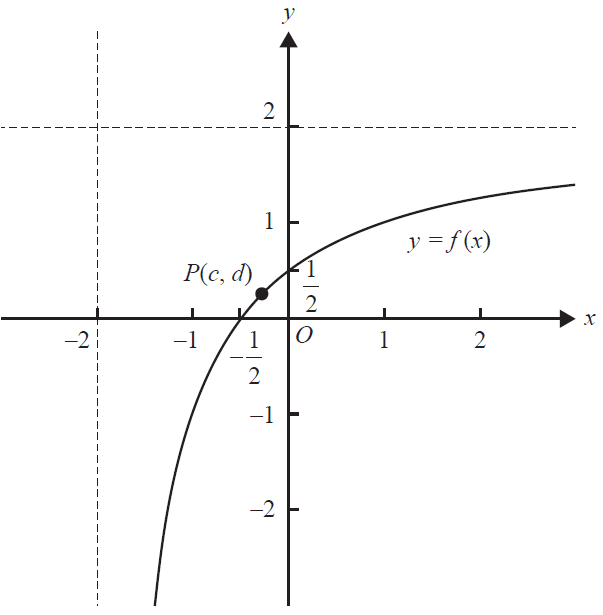
The point \(P(c, d)\) is on the graph of \(f\).
Find the exact values of \(c\) and \(d\) such that the distance of this point to the origin is a minimum, and find this minimum distance. 3 marks
d. Let \(g: (-k, \infty) \to R, g(x) = \frac{kx+1}{x+k}\), where \(k > 1\).
Show that \(x_1 < x_2\) implies that \(g(x_1) < g(x_2)\), where \(x_1 \in (-k, \infty)\) and \(x_2 \in (-k, \infty)\). 2 marks
e.
i. Let \(X\) be the point of intersection of the graphs of \(y = g(x)\) and \(y = -x\).
Find the coordinates of \(X\) in terms of \(k\). 2 marks
ii. Find the value of \(k\) for which the coordinates of \(X\) are \((-\frac{1}{2}, \frac{1}{2})\). 2 marks
iii. Let \(Z(-1, -1)\), \(Y(1, 1)\) and \(X\) be the vertices of the triangle \(XYZ\). Let \(s(k)\) be the square of the area of triangle \(XYZ\).
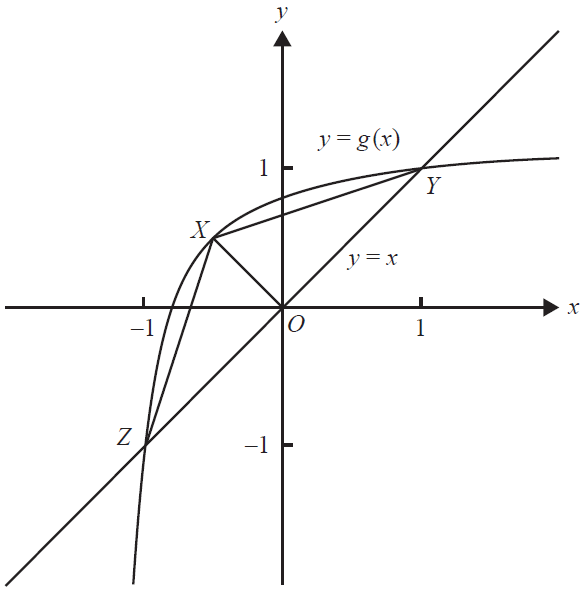
Find the values of \(k\) such that \(s(k) \ge 1\). 2 marks
f. The graph of \(g\) and the line \(y = x\) enclose a region of the plane. The region is shown shaded in the diagram below.
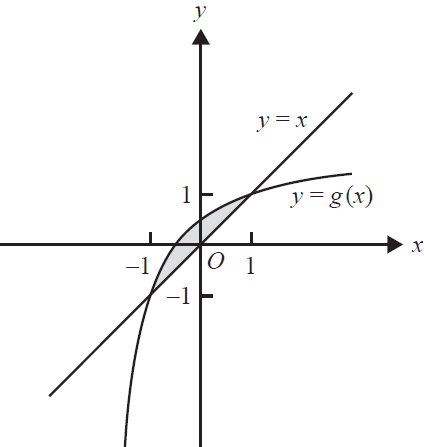
Let \(A(k)\) be the rule of the function \(A\) that gives the area of this enclosed region. The domain of \(A\) is \((1, \infty)\).
i. Give the rule for \(A(k)\). 2 marks
ii. Show that \(0 < A(k) < 2\) for all \(k > 1\). 2 marks
End of examination questions
VCE is a registered trademark of the VCAA. The VCAA does not endorse or make any warranties regarding this study resource. Past VCE exams and related content can be accessed directly at www.vcaa.vic.edu.au

