FINISHED! EVERY YEAR 11 RESOURCE IS NOW AVAILABLE.
VCE Maths Methods Integral Calculus Mini Test 5
Adapted for Year 11. Unit 1 & 2.
Number of marks: 6
Reading time: 1 minute
Writing time: 9 minutes
Instructions – No Calculator
• Answer all questions in the spaces provided.
• Write your responses in English.
• In questions where a numerical answer is required, an exact value must be given unless otherwise specified.
• In questions where more than one mark is available, appropriate working must be shown.
• Unless otherwise indicated, the diagrams in this book are not drawn to scale.
A tilemaker wants to make square tiles of size 20 cm × 20 cm. The front surface of the tiles is to be painted with two different colours that meet the following conditions:
- • Condition 1 – Each colour covers half the front surface of a tile.
- • Condition 2 – The tiles can be lined up in a single horizontal row so that the colours form a continuous pattern.
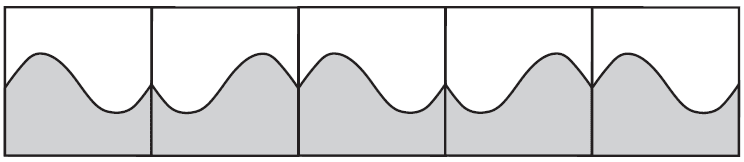
There are two types of tiles: Type A and Type B.
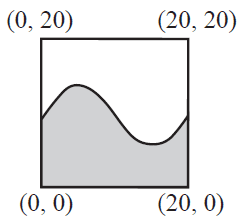
For Type A, the colours on the tiles are divided using the rule \( f(x) = 4 \sin\left(\frac{\pi x}{10}\right) + a \), where \( a \in \mathbb{R} \). The corners of each tile have the coordinates (0, 0), (20, 0), (20, 20) and (0, 20), as shown below.
a. Not applicable for Year 11 students.
ii. Find the value of \(a\) so that a Type A tile meets Condition 1. 1 mark
Type B tiles, an example of which is shown below, are divided using the rule \( g(x) = -\frac{1}{100}x^3 + \frac{3}{10}x^2 - 2x + 10 \).
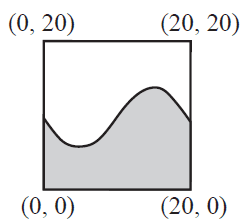
b. Show that a Type B tile meets Condition 1. 3 marks
c. Determine the endpoints of \(f(x)\) and \(g(x)\) on each tile. Hence, use these values to confirm that Type A and Type B tiles can be placed in any order to produce a continuous pattern in order to meet Condition 2. 2 marks
End of examination questions
VCE is a registered trademark of the VCAA. The VCAA does not endorse or make any warranties regarding this study resource. Past VCE exams and related content can be accessed directly at www.vcaa.vic.edu.au

