FINISHED! EVERY YEAR 11 RESOURCE IS NOW AVAILABLE.
2023 VCAA Maths Methods Sample Exam 1
Adapted for Year 11. Unit 1 & 2.
This is the full VCE Maths Methods Exam with worked solutions. You can also try Mini-Tests, which are official VCAA exams split into short tests you can do anytime.
Number of marks: 22
Reading time: 10 minutes
Writing time: 45 minutes
Instructions
• Answer all questions in the spaces provided.
• Write your responses in English.
• In all questions where a numerical answer is required, an exact value must be given unless
otherwise specified.
• In questions where more than one mark is available, appropriate working must be shown.
• Unless otherwise indicated, the diagrams in this book are not drawn to scale.
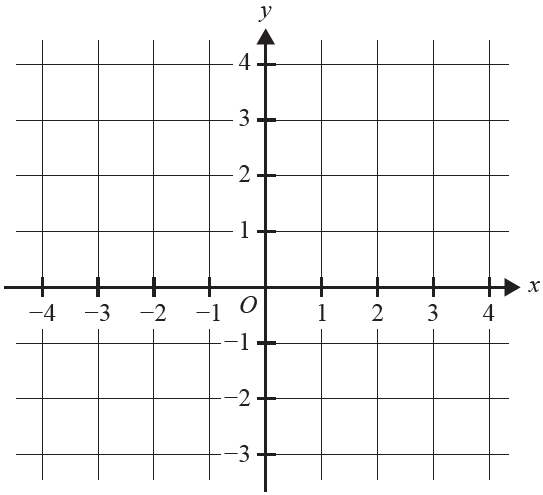
Let \(f: [-3, -2) \cup (-2, \infty) \to \mathbb{R}, f(x) = 1 + \frac{1}{x+2}\).
a. On the axes below, sketch the graph of \(f\). Label any asymptotes with their equations, and endpoints and axial intercepts with their coordinates. 3 marks
b. Find the values of \(x\) for which \(f(x) \le 2\). 2 marks
Consider the functions \(f\) and \(g\), where
\(f : \mathbb{R} \to \mathbb{R}, f(x) = x^2 - 9\)
\(g : [0, \infty) \to \mathbb{R}, g(x) = \sqrt{x}\)
a. State the range of \(f\). 1 mark
b. Not applicable for Year 11 students.
c. Not applicable for Year 11 students.
Find the general solution for \(2\sin(x) = \tan(x)\) for \(x \in \mathbb{R}\). 3 marks
Consider the simultaneous equations below, where \(a\) and \(b\) are real constants.
\((a+3)x + 9y = 3b\)
\(2x + ay = 5\)
Find the values of \(a\) and \(b\) for which the simultaneous equations have no solutions. 4 marks
Let \(f: \mathbb{R} \to \mathbb{R}\), where \(f(x) = 2 - x^2\).
a. Calculate the average rate of change of \(f\) between \(x = -1\) and \(x = 1\). 1 mark
b. Calculate the average value of \(f\) between \(x = -1\) and \(x = 1\). 2 marks
c. Four trapeziums of equal width are used to approximate the area between the functions \(f(x) = 2 - x^2\) and the x-axis from \(x = -1\) to \(x = 1\).
The heights of the left and right edges of each trapezium are the values of \(y = f(x)\), as shown in the graph below.
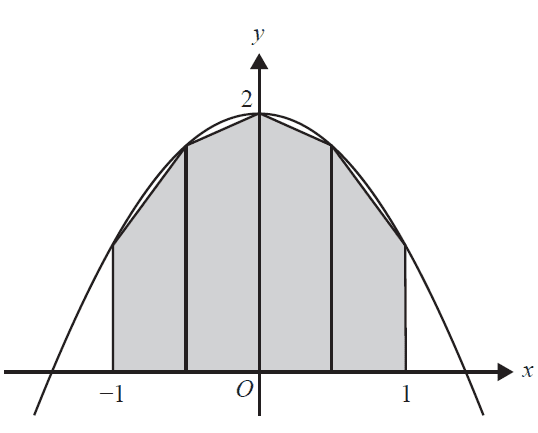
Find the total area of the four trapeziums. 3 marks
Newton's method is used to estimate the x-intercept of the function \(f(x) = \frac{1}{3}x^3 + 2x + 4\).
a. Verify that \(f(-1) > 0\) and \(f(-2) < 0\). 1 mark
b. Using an initial estimate of \(x_0 = -1\), find the value of \(x_1\). 2 marks
End of examination questions
VCE is a registered trademark of the VCAA. The VCAA does not endorse or make any warranties regarding this study resource. Past VCE exams and related content can be accessed directly at www.vcaa.vic.edu.au

