FINISHED! EVERY YEAR 11 RESOURCE IS NOW AVAILABLE.
2018 VCAA Maths Methods Exam 2
Adapted for Year 11. Unit 1 & 2.
This is the full VCE Maths Methods Exam with worked solutions. You can also try Mini-Tests, which are official VCAA exams split into short tests you can do anytime.
Number of marks: 65
Reading time: 10 minutes
Writing time: 95 minutes
Section A – Multiple-choice questions
Instructions
• Answer all questions in pencil on your Multiple-Choice Answer Sheet.
• Choose the response that is correct for the question.
• A correct answer scores 1; an incorrect answer scores 0.
• Marks will not be deducted for incorrect answers.
• No marks will be given if more than one answer is completed for any question.
• Unless otherwise indicated, the diagrams in this book are not drawn to scale.
Let \(f:R \to R\), \(f(x) = 4\cos\left(\frac{2\pi x}{3}\right) + 1\).
The period of this function is
- A. 1
- B. 2
- C. 3
- D. 4
- E. 5
The maximal domain of the function \(f\) is \(R\setminus\{1\}\).
A possible rule for \(f\) is
- A. \(f(x) = \frac{x^2 - 5}{x-1}\)
- B. \(f(x) = \frac{x+4}{x-5}\)
- C. \(f(x) = \frac{x^2+x+4}{x^2+1}\)
- D. \(f(x) = \frac{5-x^2}{1+x}\)
- E. \(f(x) = \sqrt{x-1}\)
Consider the function \(f:[a, b) \to R, f(x) = \frac{1}{x}\), where \(a\) and \(b\) are positive real numbers.
The range of \(f\) is
- A. \(\left[\frac{1}{a}, \frac{1}{b}\right)\)
- B. \(\left(\frac{1}{b}, \frac{1}{a}\right]\)
- C. \(\left[\frac{1}{b}, \frac{1}{a}\right)\)
- D. \(\left(\frac{1}{b}, \frac{1}{a}\right)\)
- E. \([a, b)\)
The point \(A(3, 2)\) lies on the graph of the function \(f\). A transformation maps the graph of \(f\) to the graph of \(g\), where \(g(x) = \frac{1}{2}f(x-1)\). The same transformation maps the point \(A\) to the point \(P\).
The coordinates of the point \(P\) are
- A. \((2, 1)\)
- B. \((2, 4)\)
- C. \((4, 1)\)
- D. \((4, 2)\)
- E. \((4, 4)\)
Consider \(f(x) = x^2 + \frac{p}{x}, x \neq 0, p \in R\).
There is a stationary point on the graph of \(f\) when \(x = -2\).
The value of \(p\) is
- A. \(-16\)
- B. \(-8\)
- C. \(2\)
- D. \(8\)
- E. \(16\)
Let \(f\) and \(g\) be two functions such that \(f(x) = 2x\) and \(g(x+2) = 3x+1\).
The function \(f(g(x))\) is
- A. \(6x-5\)
- B. \(6x+1\)
- C. \(6x^2+1\)
- D. \(6x-10\)
- E. \(6x+2\)
Let \(f: R^+ \to R, f(x) = k\log_2(x), k \in R\).
Given that \(f^{-1}(1) = 8\), the value of \(k\) is
- A. \(0\)
- B. \(\frac{1}{3}\)
- C. \(3\)
- D. \(8\)
- E. \(12\)
If \(\int_1^{12} g(x)dx = 5\) and \(\int_{12}^{5} g(x)dx = -6\), then \(\int_1^{5} g(x)dx\) is equal to
- A. \(-11\)
- B. \(-1\)
- C. \(1\)
- D. \(3\)
- E. \(11\)
A tangent to the graph of \(y = \log_e(2x)\) has a gradient of 2.
This tangent will cross the y-axis at
- A. \(0\)
- B. \(-0.5\)
- C. \(-1\)
- D. \(-1 - \log_e(2)\)
- E. \(-2\log_e(2)\)
The function \(f\) has the property \(f(x + f(x)) = f(2x)\) for all non-zero real numbers \(x\).
Which one of the following is a possible rule for the function?
- A. \(f(x) = 1-x\)
- B. \(f(x) = x-1\)
- C. \(f(x) = x\)
- D. \(f(x) = \frac{x}{2}\)
- E. \(f(x) = \frac{1-x}{2}\)
The graph of \(y = \tan(ax)\), where \(a \in R^+\), has a vertical asymptote \(x = 3\pi\) and has exactly one \(x\)-intercept in the region \((0, 3\pi)\).
The value of \(a\) is
- A. \(\frac{1}{6}\)
- B. \(\frac{1}{3}\)
- C. \(\frac{1}{2}\)
- D. \(1\)
- E. \(2\)
In a particular scoring game, there are two boxes of marbles and a player must randomly select one marble from each box. The first box contains four white marbles and two red marbles. The second box contains two white marbles and three red marbles. Each white marble scores \(-2\) points and each red marble scores \(+3\) points. The points obtained from the two marbles randomly selected by a player are added together to obtain a final score.
What is the probability that the final score will equal \(+1\)?
- A. \(\frac{2}{3}\)
- B. \(\frac{1}{5}\)
- C. \(\frac{2}{5}\)
- D. \(\frac{2}{15}\)
- E. \(\frac{8}{15}\)
Two events, \(A\) and \(B\), are independent, where \(\Pr(B) = 2\Pr(A)\) and \(\Pr(A \cup B) = 0.52\)
\(\Pr(A)\) is equal to
- A. \(0.1\)
- B. \(0.2\)
- C. \(0.3\)
- D. \(0.4\)
- E. \(0.5\)
Jamie approximates the area between the \(x\)-axis and the graph of \(y = 2\cos(2x) + 3\), over the interval \(\left[0, \frac{\pi}{2}\right]\) using the three rectangles shown below.
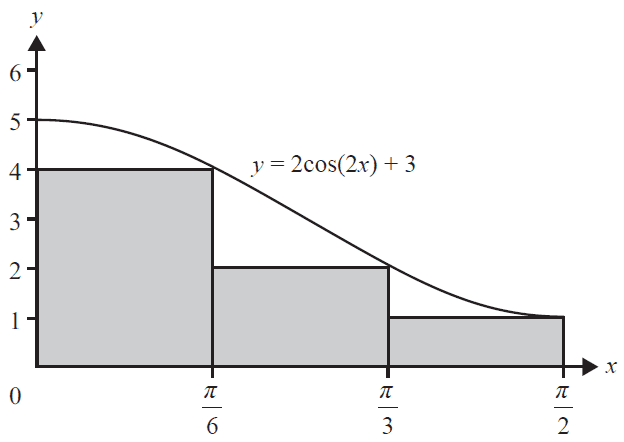
Jamie's approximation as a fraction of the exact area is
- A. \(\frac{5}{9}\)
- B. \(\frac{7}{9}\)
- C. \(\frac{9}{11}\)
- D. \(\frac{11}{18}\)
- E. \(\frac{7}{3}\)
The turning point of the parabola \(y = x^2 - 2bx + 1\) is closest to the origin when
- A. \(b=0\)
- B. \(b = -1\) or \(b=1\)
- C. \(b = -\frac{1}{\sqrt{2}}\) or \(b = \frac{1}{\sqrt{2}}\)
- D. \(b = \frac{1}{2}\) or \(b = -\frac{1}{2}\)
- E. \(b = \frac{1}{4}\) or \(b = -\frac{1}{4}\)
Consider the functions \(f:\mathbb{R}^+ \to \mathbb{R},\ f(x) = x^{\frac{p}{q}}\) and \(g:\mathbb{R}^+ \to \mathbb{R},\ g(x) = x^{\frac{m}{n}}\), where \(p, q, m\) and \(n\) are positive integers, and \(\frac{p}{q}\) and \(\frac{m}{n}\) are fractions in simplest form.
If \(\{x : f(x) > g(x)\} = (0, 1)\) and \(\{x : g(x) > f(x)\} = (1, \infty)\), which of the following must be false?
- A. \(q > n\) and \(p = m\)
- B. \(m > p\) and \(q = n\)
- C. \(pn < qm\)
- D. \(f'(c) = g'(c)\) for some \(c \in (0, 1)\)
- E. \(f'(d) = g'(d)\) for some \(d \in (1, \infty)\)
The graphs \(f: R \to R, f(x) = \cos\left(\frac{\pi x}{2}\right)\) and \(g: R \to R, g(x) = \sin(\pi x)\) are shown in the diagram below.
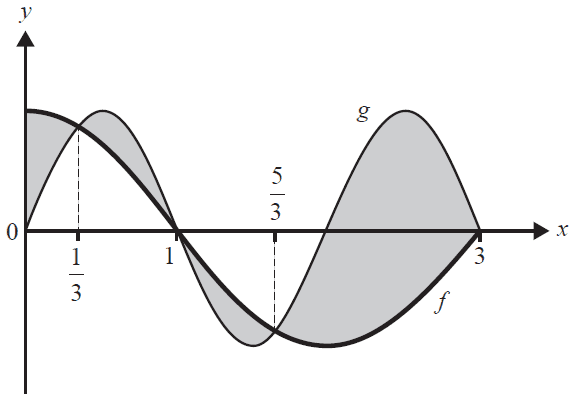
An integral expression that gives the total area of the shaded regions is
- A. \(\int_0^3 \left(\sin(\pi x) - \cos\left(\frac{\pi x}{2}\right)\right)dx\)
- B. \(2\int_\frac{5}{3}^{3} \left(\sin(\pi x) - \cos\left(\frac{\pi x}{2}\right)\right)dx\)
- C. \(\int_0^\frac{1}{3} \left(\cos\left(\frac{\pi x}{2}\right) - \sin(\pi x)\right)dx - 2\int_\frac{1}{3}^1 \left(\cos\left(\frac{\pi x}{2}\right) - \sin(\pi x)\right)dx - \int_\frac{5}{3}^3 \left(\cos\left(\frac{\pi x}{2}\right) - \sin(\pi x)\right)dx\)
- D. \(2\int_0^\frac{5}{3} \left(\cos\left(\frac{\pi x}{2}\right) - \sin(\pi x)\right)dx - 2\int_\frac{5}{3}^{3} \left(\cos\left(\frac{\pi x}{2}\right) - \sin(\pi x)\right)dx\)
- E. \(\int_0^\frac{1}{3} \left(\cos\left(\frac{\pi x}{2}\right) - \sin(\pi x)\right)dx + 2\int_\frac{1}{3}^1 \left(\sin(\pi x) - \cos\left(\frac{\pi x}{2}\right)\right)dx + \int_\frac{5}{3}^1 \left(\cos\left(\frac{\pi x}{2}\right) - \sin(\pi x)\right)dx\)
The differentiable function \(f: R \to R\) is a probability density function. It is known that the median of the probability density function \(f\) is at \(x=0\) and \(f'(0) = 4\).
The transformation \(T: R^2 \to R^2\) maps the graph of \(f\) to the graph of \(g\), where \(g: R \to R\) is a probability density function with a median at \(x=0\) and \(g'(0) = -1\).
The transformation \(T\) could be given by
- A. \(T\begin{pmatrix} x \\ y \end{pmatrix} = \begin{pmatrix} -2 & 0 \\ 0 & \frac{1}{2} \end{pmatrix} \begin{pmatrix} x \\ y \end{pmatrix}\)
- B. \(T\begin{pmatrix} x \\ y \end{pmatrix} = \begin{pmatrix} 2 & 0 \\ 0 & -\frac{1}{2} \end{pmatrix} \begin{pmatrix} x \\ y \end{pmatrix}\)
- C. \(T\begin{pmatrix} x \\ y \end{pmatrix} = \begin{pmatrix} 2 & 0 \\ \frac{1}{2} & 0 \end{pmatrix} \begin{pmatrix} x \\ y \end{pmatrix}\)
- D. \(T\begin{pmatrix} x \\ y \end{pmatrix} = \begin{pmatrix} \frac{1}{2} & 0 \\ -\frac{1}{2} & \frac{1}{2} \end{pmatrix} \begin{pmatrix} x \\ y \end{pmatrix}\)
- E. \(T\begin{pmatrix} x \\ y \end{pmatrix} = \begin{pmatrix} \frac{1}{2} & 0 \\ 0 & -2 \end{pmatrix} \begin{pmatrix} x \\ y \end{pmatrix}\)
End of Section A
Section B
Instructions
• Answer all questions in the spaces provided.
• Write your responses in English.
• In questions where a numerical answer is required, an exact value must be given unless otherwise specified.
• In questions where more than one mark is available, appropriate working must be shown.
• Unless otherwise indicated, the diagrams in this book are not drawn to scale.
Consider the quartic \( f : \mathbb{R} \rightarrow \mathbb{R}, f(x) = 3x^4 + 4x^3 - 12x^2 \) and part of the graph of \(y = f(x)\) below.
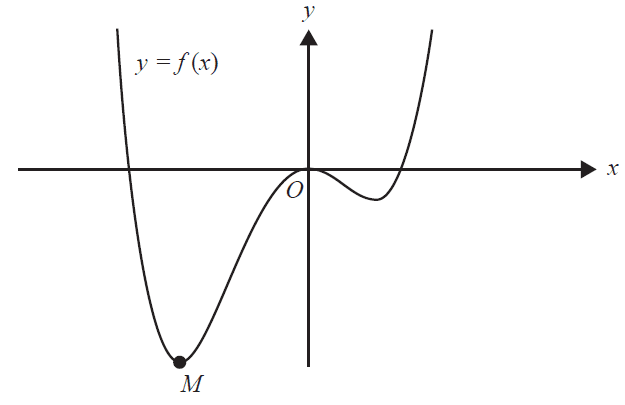
a. Find the coordinates of the point \(M\), at which the minimum value of the function \(f\) occurs. 1 mark
b. State the values of \(b \in \mathbb{R}\) for which the graph of \(y = f(x) + b\) has no x-intercepts. 1 mark
Part of the tangent, \(l\), to \(y = f(x)\) at \(x = -\frac{1}{3}\) is shown below.
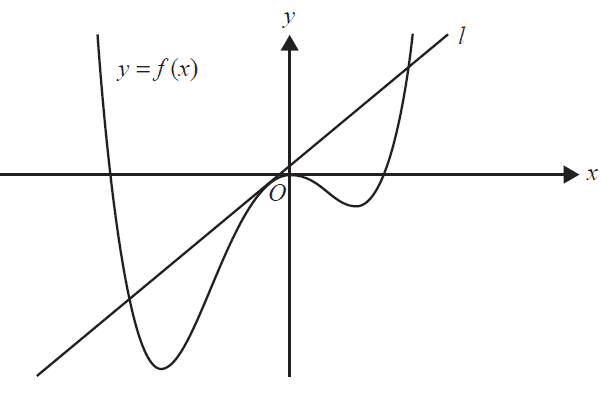
c. Find the equation of the tangent \(l\). 1 mark
d. The tangent \(l\) intersects \(y = f(x)\) at \(x = -\frac{1}{3}\) and at two other points.
State the x-values of the two other points of intersection. Express your answers in the form \(\frac{a \pm \sqrt{b}}{c}\), where \(a, b\) and \(c\) are integers. 2 marks
e. Find the total area of the regions bounded by the tangent \(l\) and \(y = f(x)\). Express your answer in the form \(\frac{a\sqrt{b}}{c}\), where \(a, b\) and \(c\) are positive integers. 2 marks
Let \( p : \mathbb{R} \rightarrow \mathbb{R}, p(x) = 3x^4 + 4x^3 + 6(a-2)x^2 - 12ax + a^2, a \in \mathbb{R} \).
f. State the value of \(a\) for which \(f(x) = p(x)\) for all \(x\). 1 mark
g. Find all solutions to \(p'(x) = 0\), in terms of \(a\) where appropriate. 1 mark
h.
i. Find the values of \(a\) for which \(p\) has only one stationary point. 1 mark
ii. Find the minimum value of \(p\) when \(a = 2\). 1 mark
iii. If \(p\) has only one stationary point, find the values of \(a\) for which \(p(x) = 0\) has no solutions. 2 marks
A drug, X, comes in 500 milligram (mg) tablets.
The amount, \(b\), of drug X in the bloodstream, in milligrams, \(t\) hours after one tablet is consumed is given by the function
\( b(t) = \frac{4500}{7} \left( e^{(-\frac{t}{5})} - e^{(-\frac{9t}{10})} \right) \)
a. Find the time, in hours, it takes for drug X to reach a maximum amount in the bloodstream after one tablet is consumed. Express your answer in the form \(a \log_e(c)\), where \(a, c \in \mathbb{R}\). 2 marks
The graph of \(y = b(t)\) is shown below for \(0 \le t \le 6\).
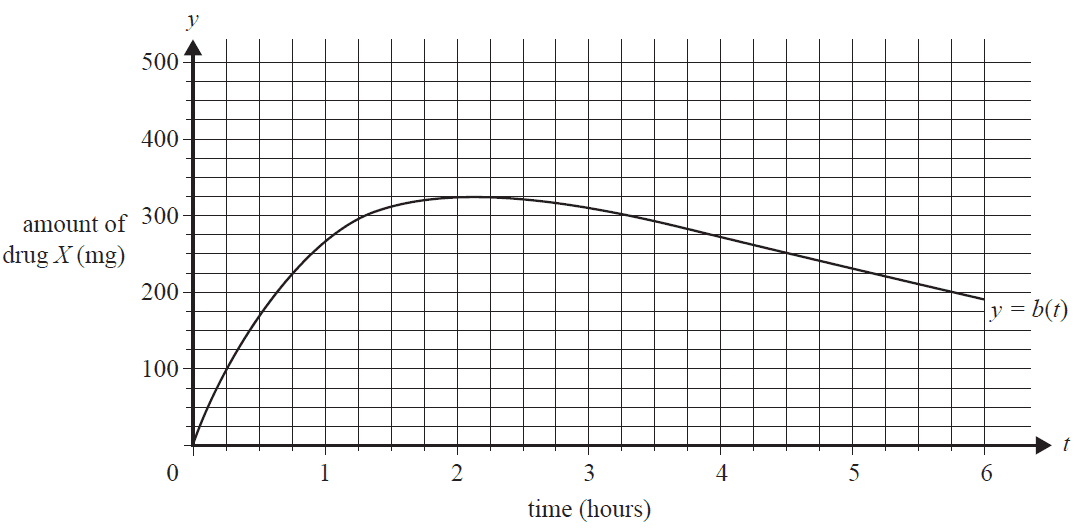
b. Find the average rate of change of the amount of drug X in the bloodstream, in milligrams per hour, over the interval [2, 6]. Give your answer correct to one decimal place. 2 marks
c. Find the average amount of drug X in the bloodstream, in milligrams, during the first six hours after one tablet is consumed. Give your answer correct to the nearest milligram. 2 marks
d. Six hours after one 500 milligram tablet of drug X is consumed (Tablet 1), a second identical tablet is consumed (Tablet 2). The amount of drug X in the bloodstream from each tablet consumed independently is shown in the graph below.
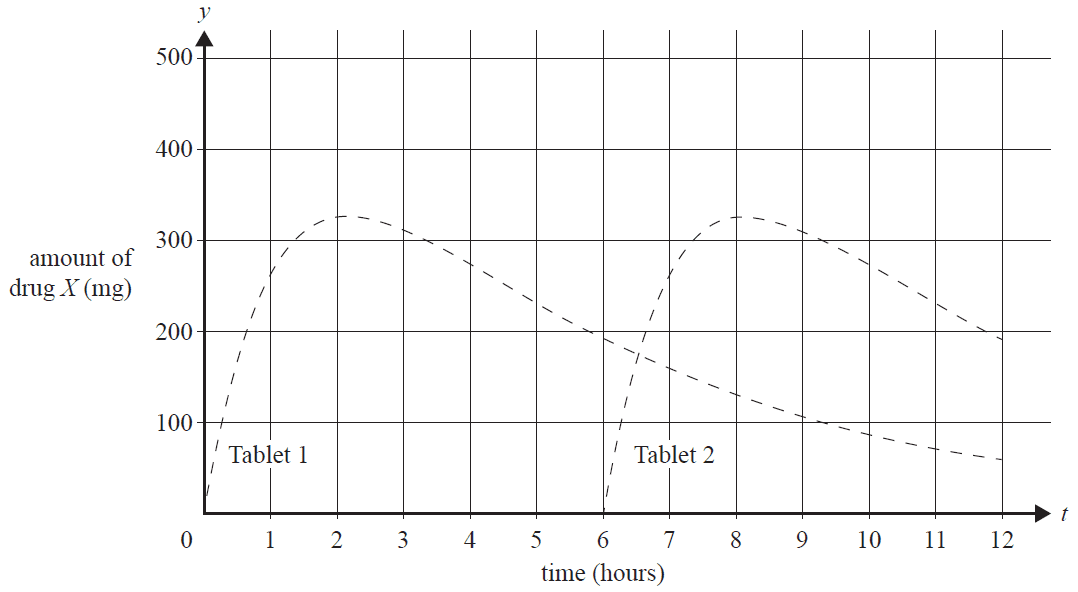
i. On the graph above, sketch the total amount of drug X in the bloodstream during the first 12 hours after Tablet 1 is consumed. 2 marks
ii. Find the maximum amount of drug X in the bloodstream in the first 12 hours and the time at which this maximum occurs. Give your answers correct to two decimal places. 2 marks
A horizontal bridge positioned 5 m above level ground is 110 m in length. The bridge also touches the top of three arches. Each arch begins and ends at ground level. The arches are 5 m apart at the base, as shown in the diagram below.
Let \(x\) be the horizontal distance, in metres, from the left side of the bridge and let \(y\) be the height, in metres, above ground level.
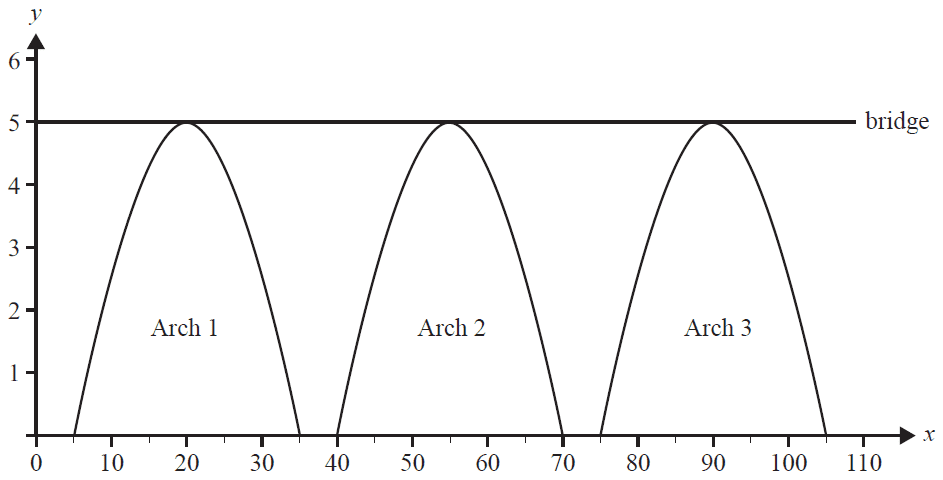
Arch 1 can be modelled by the function \( h_1 : [5, 35] \rightarrow \mathbb{R}, h_1(x) = 5\sin\left(\frac{(x-5)\pi}{30}\right) \).
Arch 2 can be modelled by the function \( h_2 : [40, 70] \rightarrow \mathbb{R}, h_2(x) = 5\sin\left(\frac{(x-40)\pi}{30}\right) \).
Arch 3 can be modelled by the function \( h_3 : [a, 105] \rightarrow \mathbb{R}, h_3(x) = 5\sin\left(\frac{(x-a)\pi}{30}\right) \).
a. State the value of \(a\), where \(a \in \mathbb{R}\). 1 mark
b. Describe the transformation that maps the graph of \(y = h_2(x)\) to \(y = h_3(x)\). 1 mark
The area above ground level between the arches and the bridge is filled with stone. The stone is represented by the shaded regions shown in the diagram below.
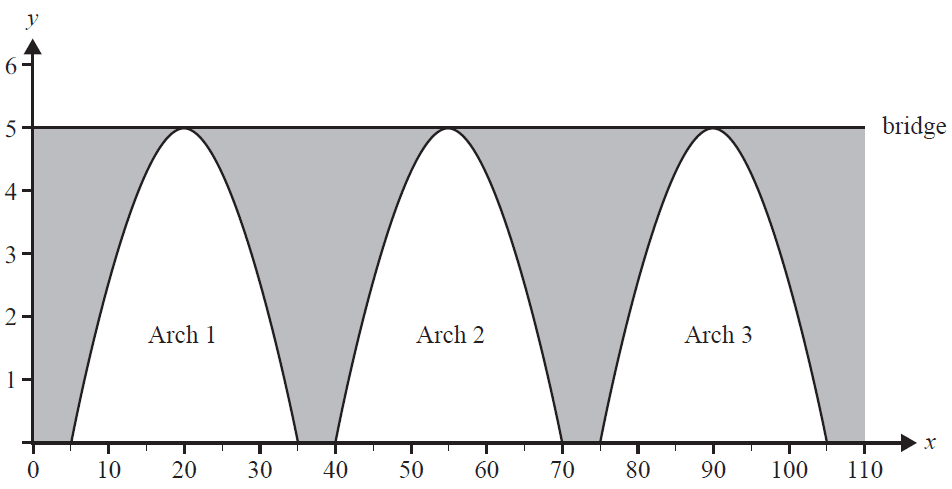
c. Not applicable for Year 11 students. 3 marks
A second bridge has a height of 5 m above the ground at its left-most point and is inclined at a constant angle of elevation of \(\frac{\pi}{90}\) radians, as shown in the diagram below. The second bridge also has three arches below it, which are identical to the arches below the first bridge, and spans a horizontal distance of 110 m.
Let \(x\) be the horizontal distance, in metres, from the left side of the second bridge and let \(y\) be the height, in metres, above ground level.
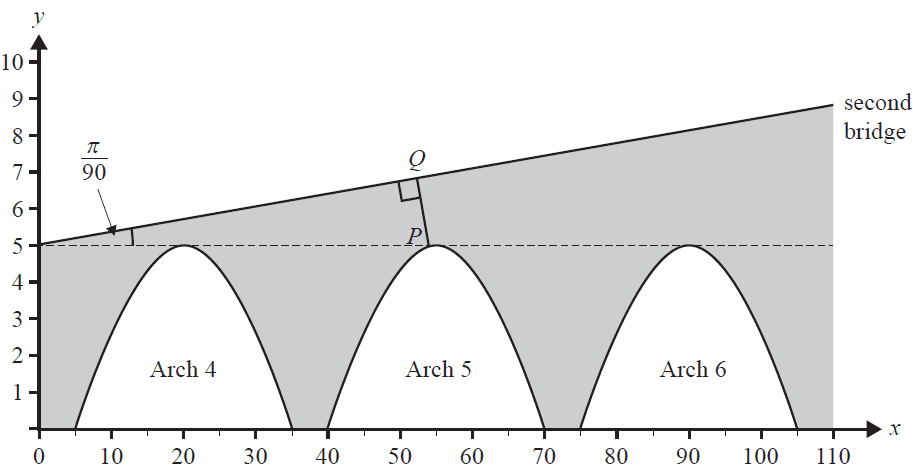
d. State the gradient of the second bridge, correct to three decimal places. 1 mark
e. Not applicable for Year 11 students. 2 marks
f. Not applicable for Year 11 students. 3 marks
Doctors are studying the resting heart rate of adults in two neighbouring towns: Mathsland and Statsville. Resting heart rate is measured in beats per minute (bpm).
The resting heart rate of adults in Mathsland is known to be normally distributed with a mean of 68 bpm and a standard deviation of 8 bpm.
a. Find the probability that a randomly selected Mathsland adult has a resting heart rate between 60 bpm and 90 bpm. Give your answer correct to three decimal places. 1 mark
The doctors consider a person to have a slow heart rate if the person's resting heart rate is less than 60 bpm. The probability that a randomly chosen Mathsland adult has a slow heart rate is 0.1587.
It is known that 29% of Mathsland adults play sport regularly.
It is also known that 9% of Mathsland adults play sport regularly and have a slow heart rate.
Let \(S\) be the event that a randomly selected Mathsland adult plays sport regularly and let \(H\) be the event that a randomly selected Mathsland adult has a slow heart rate.
b.
i. Find \(\Pr(H|S)\), correct to three decimal places. 1 mark
ii. Are the events \(H\) and \(S\) independent? Justify your answer. 1 mark
c.
i. Find the probability that a random sample of 16 Mathsland adults will contain exactly one person with a slow heart rate. Give your answer correct to three decimal places. 2 marks
d. Not applicable for Year 11 students. 2 marks
e. Not applicable for Year 11 students. 2 marks
f. Not applicable for Year 11 students. 1 mark
g. The Year 12 students at Mathsland Secondary College make up \(\frac{1}{7}\) of the total number of students at the school. Of the Year 12 students at Mathsland Secondary College, 5% are categorised as elite.
Find the probability that a randomly selected non-Year 12 student at Mathsland Secondary College is categorised as elite. Give your answer correct to four decimal places. 2 marks
Consider functions of the form
\( f : \mathbb{R} \rightarrow \mathbb{R}, f(x) = \frac{81x^2(a-x)}{4a^4} \)
and
\( h : \mathbb{R} \rightarrow \mathbb{R}, h(x) = \frac{9x}{2a^2} \)
where \(a\) is a positive real number.
a. Find the coordinates of the local maximum of \(f\) in terms of \(a\). 2 marks
b. Find the x-values of all of the points of intersection between the graphs of \(f\) and \(h\), in terms of \(a\) where appropriate. 1 mark
c. Determine the total area of the regions bounded by the graphs of \(y = f(x)\) and \(y = h(x)\). 2 marks
Consider the function \( g : \left[0, \frac{2a}{3}\right] \rightarrow \mathbb{R}, g(x) = \frac{81x^2(a-x)}{4a^4} \), where \(a\) is a positive real number.
d. Evaluate \(\frac{2a}{3} \times g\left(\frac{2a}{3}\right)\). 1 mark
e. Find the area bounded by the graph of \(g^{-1}\), the x-axis and the line \(x = g\left(\frac{2a}{3}\right)\). 2 marks
f. Find the value of \(a\) for which the graphs of \(g\) and \(g^{-1}\) have the same endpoints. 1 mark
g. Find the area enclosed by the graphs of \(g\) and \(g^{-1}\) when they have the same endpoints. 1 mark
End of examination questions
VCE is a registered trademark of the VCAA. The VCAA does not endorse or make any warranties regarding this study resource. Past VCE exams and related content can be accessed directly at www.vcaa.vic.edu.au

