FINISHED! EVERY YEAR 11 RESOURCE IS NOW AVAILABLE.
2019 VCAA Maths Methods Exam 2
Adapted for Year 11. Unit 1 & 2.
This is the full VCE Maths Methods Exam with worked solutions. You can also try Mini-Tests, which are official VCAA exams split into short tests you can do anytime.
Number of marks: 51
Reading time: 10 minutes
Writing time: 80 minutes
Section A – Multiple-choice questions
Instructions
• Answer all questions in pencil on your Multiple-Choice Answer Sheet.
• Choose the response that is correct for the question.
• A correct answer scores 1; an incorrect answer scores 0.
• Marks will not be deducted for incorrect answers.
• No marks will be given if more than one answer is completed for any question.
• Unless otherwise indicated, the diagrams in this book are not drawn to scale.
Let \(f: R \to R, f(x) = 3\sin\left(\frac{2x}{5}\right) - 2\).
The period and range of \(f\) are respectively
- A. \(5\pi\) and \([-3, 3]\)
- B. \(5\pi\) and \([-5, 1]\)
- C. \(5\pi\) and \([-1, 5]\)
- D. \(\frac{5\pi}{2}\) and \([-5, 1]\)
- E. \(\frac{5\pi}{2}\) and \([-3, 3]\)
The set of values of \(k\) for which \(x^2 + 2x - k = 0\) has two real solutions is
- A. \(\{-1, 1\}\)
- B. \((-1, \infty)\)
- C. \((-\infty, -1)\)
- D. \(\{-1\}\)
- E. \([-1, \infty)\)
Let \(f: R\setminus\{4\} \to R, f(x) = \frac{a}{x-4}\), where \(a > 0\).
The average rate of change of \(f\) from \(x=6\) to \(x=8\) is
- A. \(a\log_e(2)\)
- B. \(\frac{a}{2}\log_e(2)\)
- C. \(2a\)
- D. \(-\frac{a}{4}\)
- E. \(-\frac{a}{8}\)
Let \(f'(x) = 3x^2 - 2x\) such that \(f(4) = 0\).
The rule of \(f\) is
- A. \(f(x) = x^3 - x^2\)
- B. \(f(x) = x^3 - x^2 + 48\)
- C. \(f(x) = x^3 - x^2 - 48\)
- D. \(f(x) = 6x - 2\)
- E. \(f(x) = 6x - 24\)
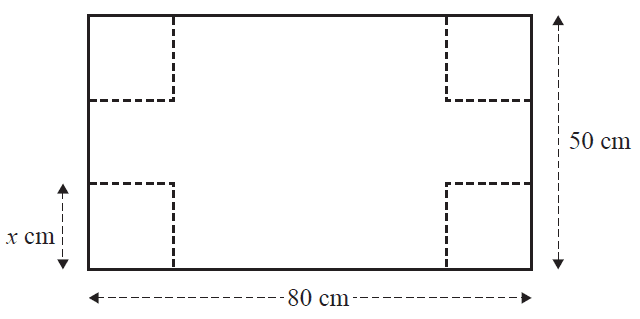
A rectangular sheet of cardboard has a length of 80 cm and a width of 50 cm. Squares, of side length \(x\) centimetres, are cut from each of the corners, as shown in the diagram below.
A rectangular box with an open top is then constructed, as shown in the diagram below.
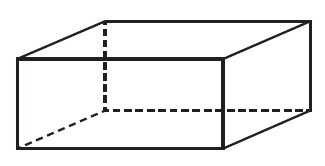
The volume of the box is a maximum when \(x\) is equal to
- A. 10
- B. 20
- C. 25
- D. \(\frac{100}{3}\)
- E. \(\frac{200}{3}\)
An archer can successfully hit a target with a probability of 0.9. The archer attempts to hit the target 80 times. The outcome of each attempt is independent of any other attempt.
Given that the archer successfully hits the target at least 70 times, the probability that the archer successfully hits the target exactly 74 times, correct to four decimal places, is
- A. 0.3635
- B. 0.8266
- C. 0.1494
- D. 0.3005
- E. 0.1701
Which one of the following statements is true for \(f: R \to R, f(x) = x + \sin(x)\)?
- A. The graph of \(f\) has a horizontal asymptote
- B. There are infinitely many solutions to \(f(x) = 4\)
- C. \(f\) has a period of \(2\pi\)
- D. \(f'(x) \ge 0\) for \(x \in R\)
- E. \(f'(x) = \cos(x)\)
\(A\) and \(B\) are events from a sample space such that \(\Pr(A) = p\), where \(p > 0\), \(\Pr(B|A) = m\) and \(\Pr(B|A') = n\).
\(A\) and \(B\) are independent events when
- A. \(m = n\)
- B. \(m = 1-p\)
- C. \(m+n = 1\)
- D. \(m = p\)
- E. \(m+n = 1-p\)
If \(\int_1^4 f(x)dx = 4\) and \(\int_2^4 f(x)dx = -2\), then \(\int_1^2 (f(x)+x)dx\) is equal to
- A. 2
- B. 6
- C. 8
- D. \(\frac{7}{2}\)
- E. \(\frac{15}{2}\)
The graph of the function \(f\) passes through the point \((-2, 7)\).
If \(h(x) = f\left(\frac{x}{2}\right) + 5\), then the graph of the function \(h\) must pass through the point
- A. \((-1, -12)\)
- B. \((-1, 19)\)
- C. \((-4, 12)\)
- D. \((-4, -14)\)
- E. \((3, 3.5)\)
Let \(f: [2, \infty) \to R, f(x) = x^2 - 4x + 2\) and \(f(5) = 7\). The function \(g\) is the inverse function of \(f\).
\(g'(7)\) is equal to
- A. \(\frac{1}{6}\)
- B. 5
- C. \(\frac{\sqrt{7}}{14}\)
- D. 6
- E. \(\frac{1}{7}\)
Part of the graph of \(y = f(x)\) is shown below.
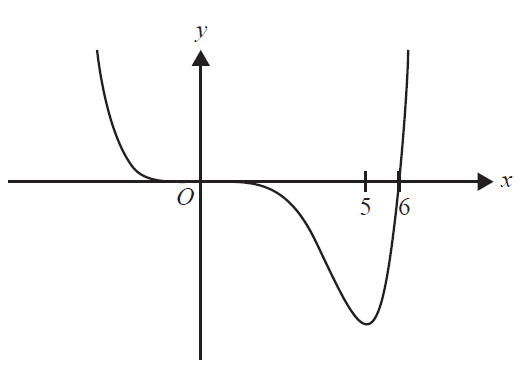
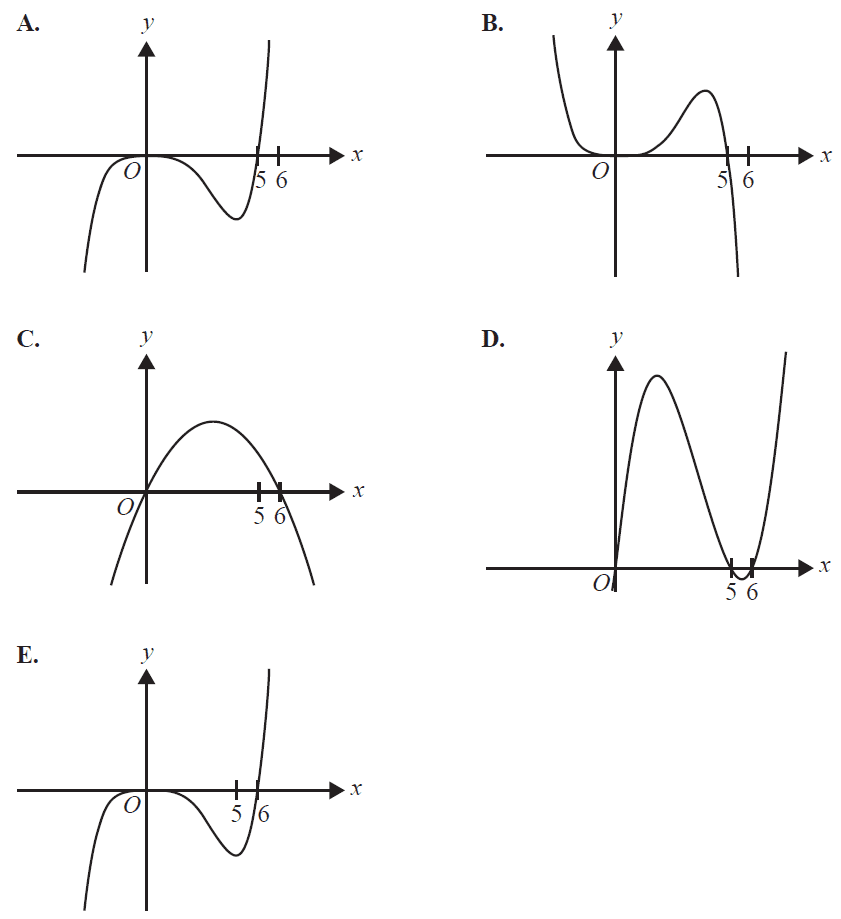
The corresponding part of the graph of \(y = f'(x)\) is best represented by
A box contains \(n\) marbles that are identical in every way except colour, of which \(k\) marbles are coloured red and the remainder of the marbles are coloured green. Two marbles are drawn randomly from the box.
If the first marble is not replaced into the box before the second marble is drawn, then the probability that the two marbles drawn are the same colour is
- A. \(\frac{k^2 + (n-k)^2}{n^2}\)
- B. \(\frac{k^2 + (n-k-1)^2}{n^2}\)
- C. \(\frac{2k(n-k-1)}{n(n-1)}\)
- D. \(\frac{k(k-1) + (n-k)(n-k-1)}{n(n-1)}\)
- E. \(^nC_2\left(\frac{k}{n}\right)^2\left(1-\frac{k}{n}\right)^{n-2}\)
Given that \(\tan(a) = d\), where \(d > 0\) and \(0 < a < \frac{\pi}{2}\), the sum of the solutions to \(\tan(2x) = d\), where \(0 < x < \frac{5\pi}{4}\), in terms of \(a\), is
- A. 0
- B. \(2a\)
- C. \(\pi + 2a\)
- D. \(\frac{\pi}{2} + a\)
- E. \(\frac{3(\pi+a)}{2}\)
The expression \(\log_x(y) + \log_y(z)\), where \(x, y\) and \(z\) are all real numbers greater than 1, is equal to
- A. \(-\frac{1}{\log_y(x)} - \frac{1}{\log_z(y)}\)
- B. \(\frac{1}{\log_x(y)} + \frac{1}{\log_y(z)}\)
- C. \(-\frac{1}{\log_x(y)} - \frac{1}{\log_y(z)}\)
- D. \(\frac{1}{\log_y(x)} + \frac{1}{\log_z(y)}\)
- E. \(\log_y(x) + \log_z(y)\)
End of Section A
Section B
Instructions
• Answer all questions in the spaces provided.
• Write your responses in English.
• In questions where a numerical answer is required, an exact value must be given unless otherwise specified.
• In questions where more than one mark is available, appropriate working must be shown.
• Unless otherwise indicated, the diagrams in this book are not drawn to scale.
Let \(f: \mathbb{R} \to \mathbb{R}\), \(f(x) = x^2e^{-x^2}\).
a. Find \(f'(x)\). 1 mark
b.
i. State the nature of the stationary point on the graph of \(f\) at the origin. 1 mark
ii. Find the maximum value of the function \(f\) and the values of \(x\) for which the maximum occurs. 2 marks
iii. Find the values of \(d \in \mathbb{R}\) for which \(f(x) + d\) is always negative. 1 mark
c.
i. Find the equation of the tangent to the graph of \(f\) at \(x = -1\). 1 mark
ii. Find the area enclosed by the graph of \(f\) and the tangent to the graph of \(f\) at \(x = -1\), correct to four decimal places. 2 marks
d. Let \(M(m, n)\) be a point on the graph of \(f\), where \(m \in [0, 1]\).
Find the minimum distance between \(M\) and the point \((0, e)\), and the value of \(m\) for which this occurs, correct to three decimal places. 3 marks
An amusement park is planning to build a zip-line above a hill on its property.
The hill is modelled by \(y = \frac{3x(x-30)^2}{2000}\), \(x \in [0, 30]\), where \(x\) is the horizontal distance, in metres, from an origin and \(y\) is the height, in metres, above this origin, as shown in the graph below.
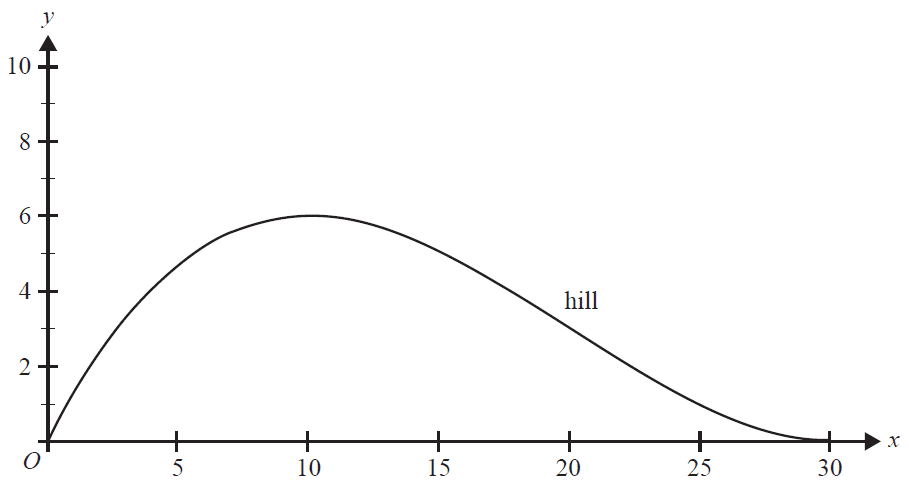
a. Find \(\frac{dy}{dx}\). 1 mark
b. State the set of values for which the gradient of the hill is strictly decreasing. 1 mark
The cable for the zip-line is connected to a pole at the origin at a height of 10 m and is straight for \(0 \le x \le a\), where \(10 \le a \le 20\). The straight section joins the curved section at \(A(a, b)\). The cable is then exactly 3 m vertically above the hill from \(a \le x \le 30\), as shown in the graph below.
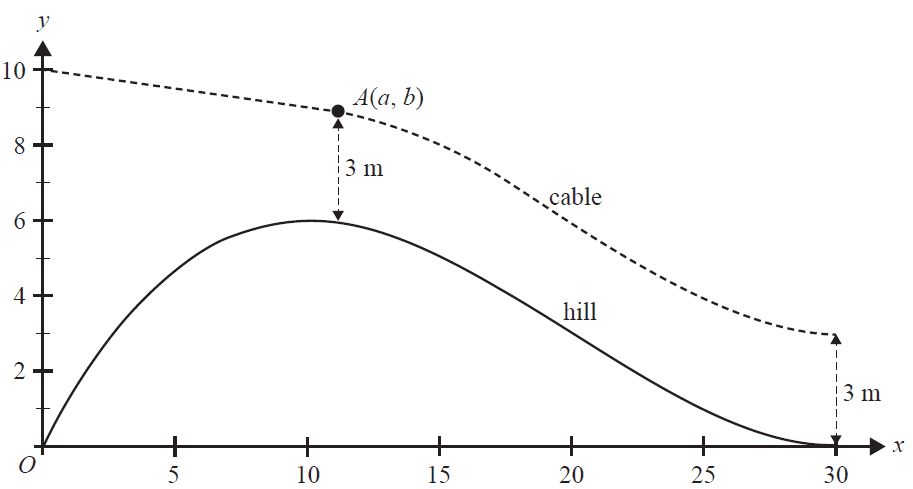
c. State the rule, in terms of \(x\), for the height of the cable above the horizontal axis for \(x \in [a, 30]\). 1 mark
d. Find the values of \(x\) for which the gradient of the cable is equal to the average gradient of the hill for \(x \in [10, 30]\). 3 marks
e. Not applicable for Year 11 students.
During a telephone call, a phone uses a dual-tone frequency electrical signal to communicate with the telephone exchange.
The strength, \(f\), of a simple dual-tone frequency signal is given by the function \(f(t) = \sin\left(\frac{\pi t}{3}\right) + \sin\left(\frac{\pi t}{6}\right)\) where \(t\) is a measure of time and \(t \ge 0\).
Part of the graph of \(y = f(t)\) is shown below.
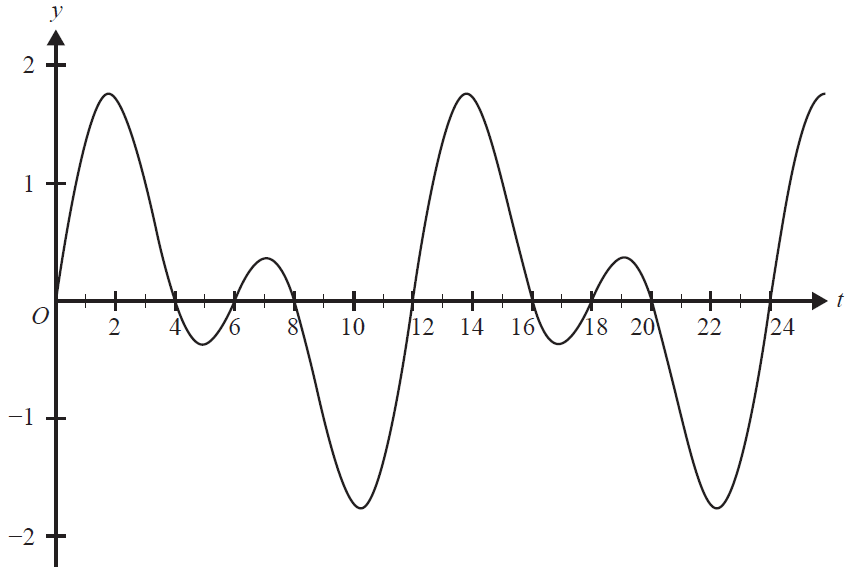
a. State the period of the function. 1 mark
b. Find the values of \(t\) where \(f(t) = 0\) for the interval \(t \in [0, 6]\). 1 mark
c. Find the maximum strength of the dual-tone frequency signal, correct to two decimal places. 1 mark
d. Find the area between the graph of \(f\) and the horizontal axis for \(t \in [0, 6]\). 2 marks
Let \(g\) be the function obtained by applying the transformation \(T\) to the function \(f\), where
\(T\begin{pmatrix} x \\ y \end{pmatrix} = \begin{pmatrix} a & 0 \\ 0 & b \end{pmatrix} \begin{pmatrix} x \\ y \end{pmatrix} + \begin{pmatrix} c \\ d \end{pmatrix}\)
and \(a, b, c\) and \(d\) are real numbers.
e. Find the values of \(a, b, c\) and \(d\) given that \(\int_0^2 g(t)dt + \int_2^6 g(t)dt\) has the same area calculated in part d. 2 marks
f. The rectangle bounded by the line \(y=k\), \(k \in \mathbb{R}^+\), the horizontal axis, and the lines \(x=0\) and \(x=12\) has the same area as the area between the graph of \(f\) and the horizontal axis for one period of the dual-tone frequency signal.
Find the value of \(k\). 2 marks
Let \(f: \mathbb{R} \to \mathbb{R}\), \(f(x) = 1 - x^3\). The tangent to the graph of \(f\) at \(x=a\), where \(0 < a < 1\), intersects the graph of \(f\) again at \(P\) and intersects the horizontal axis at \(Q\). The shaded regions shown in the diagram below are bounded by the graph of \(f\), its tangent at \(x=a\) and the horizontal axis.
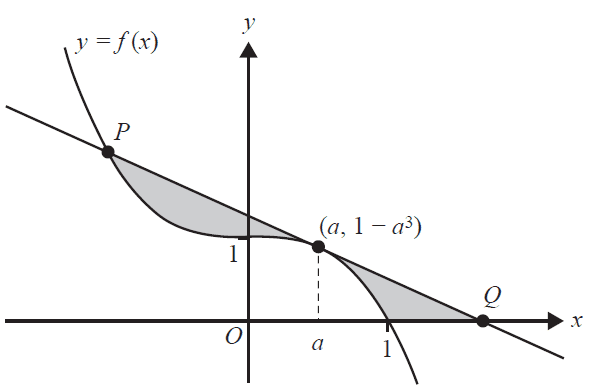
a. Find the equation of the tangent to the graph of \(f\) at \(x=a\), in terms of \(a\). 1 mark
b. Find the \(x\)-coordinate of \(Q\), in terms of \(a\). 1 mark
c. Find the \(x\)-coordinate of \(P\), in terms of \(a\). 2 marks
Let \(A\) be the function that determines the total area of the shaded regions.
d. Find the rule of \(A\), in terms of \(a\). 3 marks
e. Find the value of \(a\) for which \(A\) is a minimum. 2 marks
Consider the regions bounded by the graph of \(f^{-1}\), the tangent to the graph of \(f^{-1}\) at \(x=b\), where \(0 < b < 1\), and the vertical axis.
f. Find the value of \(b\) for which the total area of these regions is a minimum. 2 marks
g. Find the value of the acute angle between the tangent to the graph of \(f\) and the tangent to the graph of \(f^{-1}\) at \(x=1\). 1 mark
End of examination questions
VCE is a registered trademark of the VCAA. The VCAA does not endorse or make any warranties regarding this study resource. Past VCE exams and related content can be accessed directly at www.vcaa.vic.edu.au

