FINISHED! EVERY YEAR 11 RESOURCE IS NOW AVAILABLE.
2020 VCAA Maths Methods Exam 2
Adapted for Year 11. Unit 1 & 2.
This is the full VCE Maths Methods Exam with worked solutions. You can also try Mini-Tests, which are official VCAA exams split into short tests you can do anytime.
Number of marks: 61
Reading time: 10 minutes
Writing time: 90 minutes
Section A – Multiple-choice questions
Instructions
• Answer all questions in pencil on your Multiple-Choice Answer Sheet.
• Choose the response that is correct for the question.
• A correct answer scores 1; an incorrect answer scores 0.
• Marks will not be deducted for incorrect answers.
• No marks will be given if more than one answer is completed for any question.
• Unless otherwise indicated, the diagrams in this book are not drawn to scale.
Let \(f\) and \(g\) be functions such that \(f(-1) = 4\), \(f(2) = 5\), \(g(-1) = 2\), \(g(2) = 7\) and \(g(4) = 6\).
The value of \(g(f(-1))\) is
- A. 2
- B. 4
- C. 5
- D. 6
- E. 7
Let \(p(x) = x^3 - 2ax^2 + x - 1\), where \(a \in R\). When \(p\) is divided by \(x + 2\), the remainder is 5.
The value of \(a\) is
- A. 2
- B. \(-\frac{7}{4}\)
- C. \(-\frac{1}{2}\)
- D. \(\frac{3}{2}\)
- E. -2
Let \(f'(x) = \frac{2}{\sqrt{2x-3}}\)
If \(f(6) = 4\), then
- A. \(f(x) = 2\sqrt{2x-3}\)
- B. \(f(x) = \sqrt{2x-3} - 2\)
- C. \(f(x) = 2\sqrt{2x-3} - 2\)
- D. \(f(x) = \sqrt{2x-3} + 2\)
- E. \(f(x) = \sqrt{2x-3}\)
The solutions of the equation \(2\cos\left(2x - \frac{\pi}{3}\right) + 1 = 0\) are
- A. \(x = \frac{\pi(6k-2)}{6}\) or \(x = \frac{\pi(6k-3)}{6}\), for \(k \in Z\)
- B. \(x = \frac{\pi(6k-2)}{6}\) or \(x = \frac{\pi(6k+5)}{6}\), for \(k \in Z\)
- C. \(x = \frac{\pi(6k-1)}{6}\) or \(x = \frac{\pi(6k+2)}{6}\), for \(k \in Z\)
- D. \(x = \frac{\pi(6k-1)}{6}\) or \(x = \frac{\pi(6k+3)}{6}\), for \(k \in Z\)
- E. \(x = \pi\) or \(x = \frac{\pi(6k+2)}{6}\), for \(k \in Z\)
The graph of the function \(f: D \to R, f(x) = \frac{3x+2}{5-x}\), where \(D\) is the maximal domain, has asymptotes
- A. \(x = -5, y = -\frac{3}{2}\)
- B. \(x = -3, y = 5\)
- C. \(x = \frac{2}{3}, y = -3\)
- D. \(x = 5, y = 3\)
- E. \(x = 5, y = -3\)
Part of the graph of \(y = f'(x)\) is shown below.
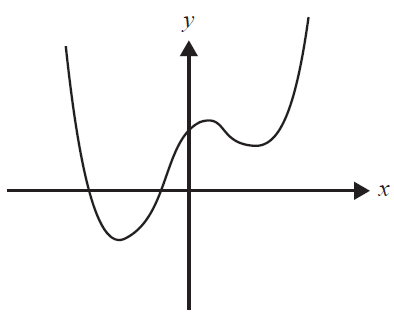
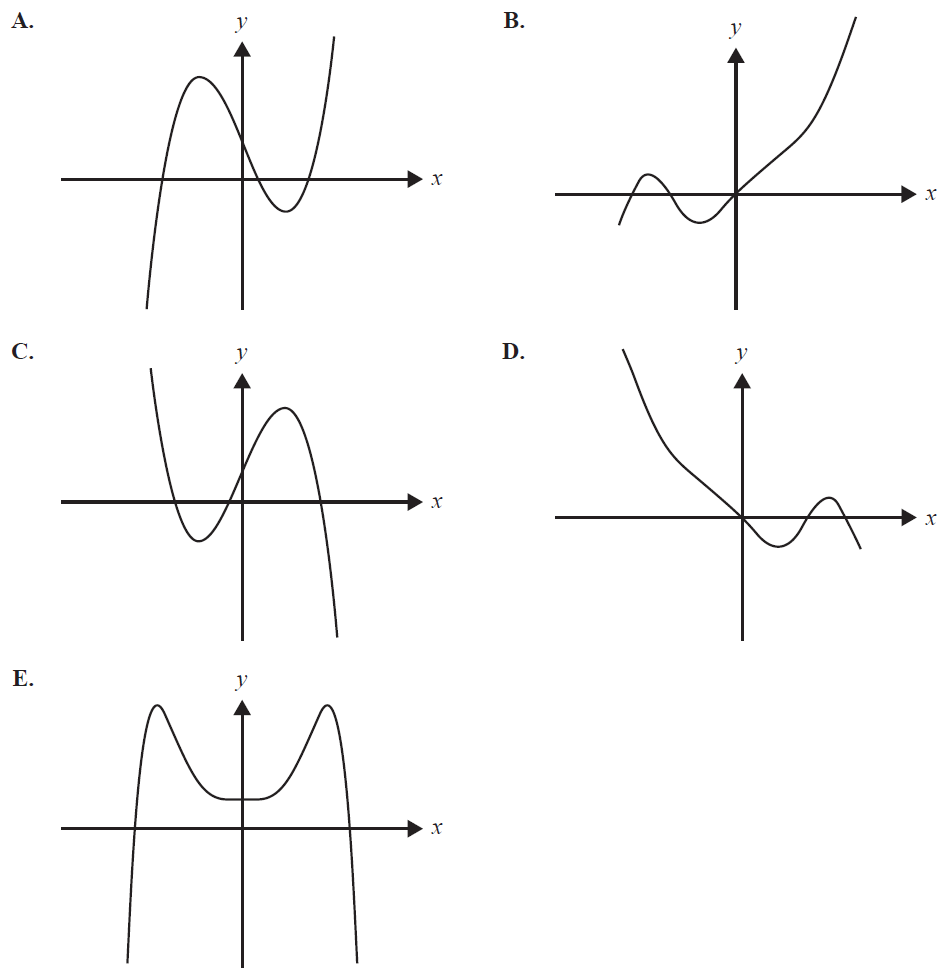
The corresponding part of the graph of \(y = f(x)\) is best represented by
If \(f(x) = e^{g(x^2)}\), where \(g\) is a differentiable function, then \(f'(x)\) is equal to
- A. \(2xe^{g(x^2)}\)
- B. \(2xg(x^2)e^{g(x^2)}\)
- C. \(2xg'(x^2)e^{g(x^2)}\)
- D. \(2xg'(2x)e^{g(x^2)}\)
- E. \(2xg'(x^2)e^{g(2x)}\)
If \(\int_1^8 f(x)dx = 5\), then \(\int_0^2 f(2(x+2))dx\) is equal to
- A. 12
- B. 10
- C. 8
- D. \(\frac{1}{2}\)
- E. \(\frac{5}{2}\)
Given that \(\log_2(n+1) = x\), the values of \(n\) for which \(x\) is a positive integer are
- A. \(n = 2k, k \in Z^+\)
- B. \(n = 2^k - 1, k \in Z^+\)
- C. \(n = 2k - 1, k \in Z^+\)
- D. \(n = 2k-1, k \in Z^+\)
- E. \(n = 2k, k \in Z^+\)
A clock has a minute hand that is 10 cm long and a clock face with a radius of 15 cm, as shown below.
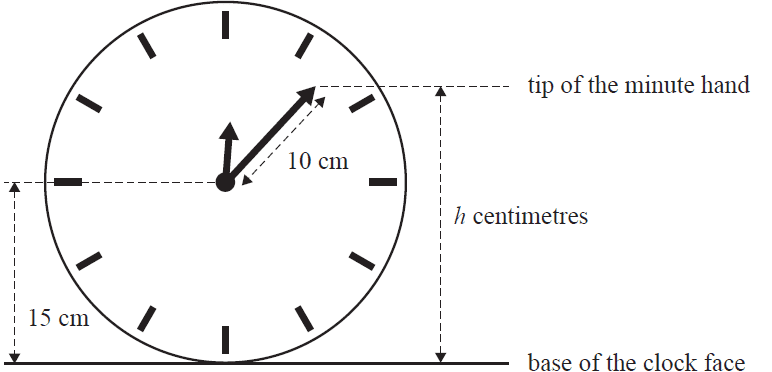
At 12.00 noon, both hands of the clock point vertically upwards and the tip of the minute hand is at its maximum distance above the base of the clock face.
The height, \(h\) centimetres, of the tip of the minute hand above the base of the clock face \(t\) minutes after 12.00 noon is given by
- A. \(h(t) = 15 + 10\sin\left(\frac{\pi t}{30}\right)\)
- B. \(h(t) = 15 - 10\sin\left(\frac{\pi t}{30}\right)\)
- C. \(h(t) = 15 + 10\sin\left(\frac{\pi t}{60}\right)\)
- D. \(h(t) = 15 + 10\cos\left(\frac{\pi t}{60}\right)\)
- E. \(h(t) = 15 + 10\cos\left(\frac{\pi t}{30}\right)\)
A right-angled triangle, \(OBC\), is formed using the horizontal axis and the point \(C(m, 9-m^2)\), where \(m \in (0, 3)\), on the parabola \(y = 9 - x^2\), as shown below.
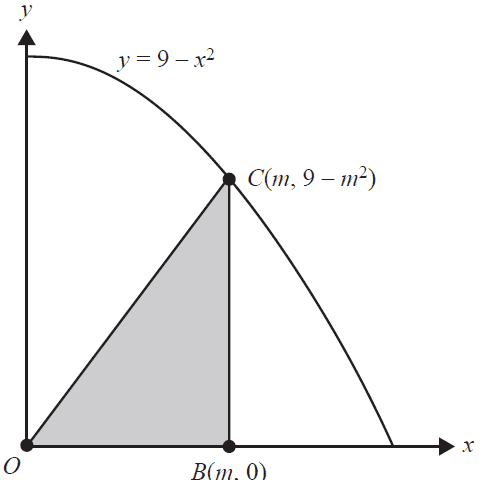
The maximum area of the triangle \(OBC\) is
- A. \(\frac{\sqrt{3}}{3}\)
- B. \(\frac{2\sqrt{3}}{3}\)
- C. \(\sqrt{3}\)
- D. \(3\sqrt{3}\)
- E. \(9\sqrt{3}\)
Let \(f(x) = -\log_e(x+2)\).
A tangent to the graph of \(f\) has a vertical axis intercept at \((0, c)\).
The maximum value of \(c\) is
- A. -1
- B. \(-1 + \log_e(2)\)
- C. \(-\log_e(2)\)
- D. \(-1 - \log_e(2)\)
- E. \(\log_e(2)\)
Let \(a \in (0, \infty)\) and \(b \in R\).
Consider the function \(h: [-a, 0) \cup (0, a] \to R, h(x) = \frac{a}{x} + b\).
The range of \(h\) is
- A. \([b-1, b+1]\)
- B. \((b-1, b+1)\)
- C. \((-\infty, b-1) \cup (b+1, \infty)\)
- D. \((-\infty, b-1] \cup [b+1, \infty)\)
- E. \([b-1, \infty)\)
Shown below is the graph of \(p\), which is the probability function for the number of times, \(x\), that a '6' is rolled on a fair six-sided die in 20 trials.
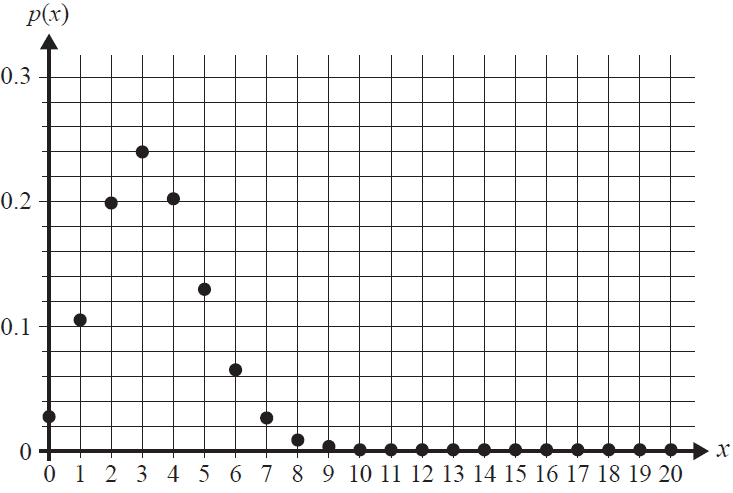
Let \(q\) be the probability function for the number of times, \(w\), that a '6' is not rolled on a fair six-sided die in 20 trials.
\(q(w)\) is given by
- A. \(p(20-w)\)
- B. \(p\left(1-\frac{w}{20}\right)\)
- C. \(p\left(\frac{w}{20}\right)\)
- D. \(p(w-20)\)
- E. \(1-p(w)\)
End of Section A
Section B
Instructions
• Answer all questions in the spaces provided.
• Write your responses in English.
• In questions where a numerical answer is required, an exact value must be given unless otherwise specified.
• In questions where more than one mark is available, appropriate working must be shown.
• Unless otherwise indicated, the diagrams in this book are not drawn to scale.
Let \(f: \mathbb{R} \to \mathbb{R}\), \(f(x) = a(x+2)^2(x-2)^2\), where \(a \in \mathbb{R}\). Part of the graph of \(f\) is shown below.
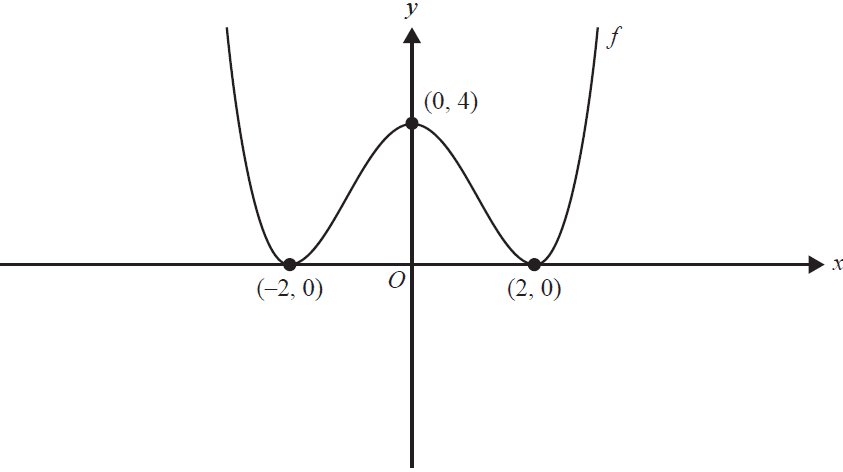
a. Show that \(a = \frac{1}{4}\). 1 mark
b. Express \(f(x) = \frac{1}{4}(x+2)^2(x-2)^2\) in the form \(f(x) = \frac{1}{4}x^4 + bx^2 + c\), where \(b\) and \(c\) are integers. 1 mark
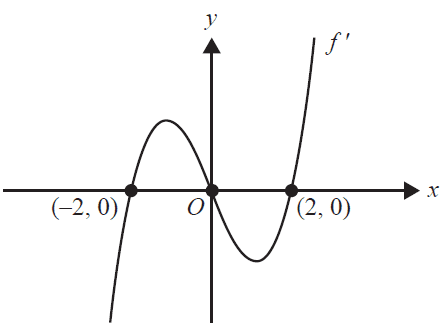
Part of the graph of the derivative function \(f'\) is shown below.
c.
i. Write the rule for \(f'\) in terms of \(x\). 1 mark
ii. Find the minimum value of the graph of \(f'\) on the interval \(x \in (0, 2)\). 2 marks
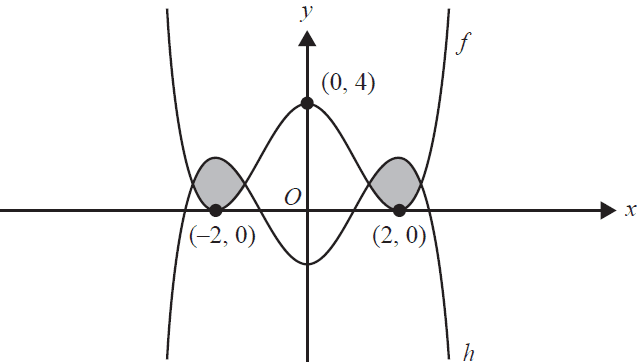
Let \(h: \mathbb{R} \to \mathbb{R}\), \(h(x) = -\frac{1}{4}(x+2)^2(x-2)^2 + 2\). Parts of the graphs of \(f\) and \(h\) are shown below.
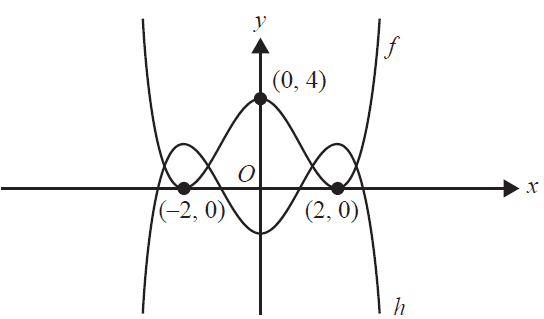
d. Write a sequence of two transformations that map the graph of \(f\) onto the graph of \(h\). 1 mark
e.
i. State the values of \(x\) for which the graphs of \(f\) and \(h\) intersect. 1 mark
ii. Write down a definite integral that will give the total area of the shaded regions in the graph above. 1 mark
iii. Find the total area of the shaded regions in the graph above. Give your answer correct to two decimal places. 1 mark
f. Let \(D\) be the vertical distance between the graphs of \(f\) and \(h\).
Find all values of \(x\) for which \(D\) is at most 2 units. Give your answers correct to two decimal places. 2 marks
An area of parkland has a river running through it, as shown below. The river is shown shaded.
The north bank of the river is modelled by the function \(f_1: [0, 200] \to \mathbb{R}\), \(f_1(x) = 20\cos\left(\frac{\pi x}{100}\right) + 40\).
The south bank of the river is modelled by the function \(f_2: [0, 200] \to \mathbb{R}\), \(f_2(x) = 20\cos\left(\frac{\pi x}{100}\right) + 30\).
The horizontal axis points east and the vertical axis points north.
All distances are measured in metres.
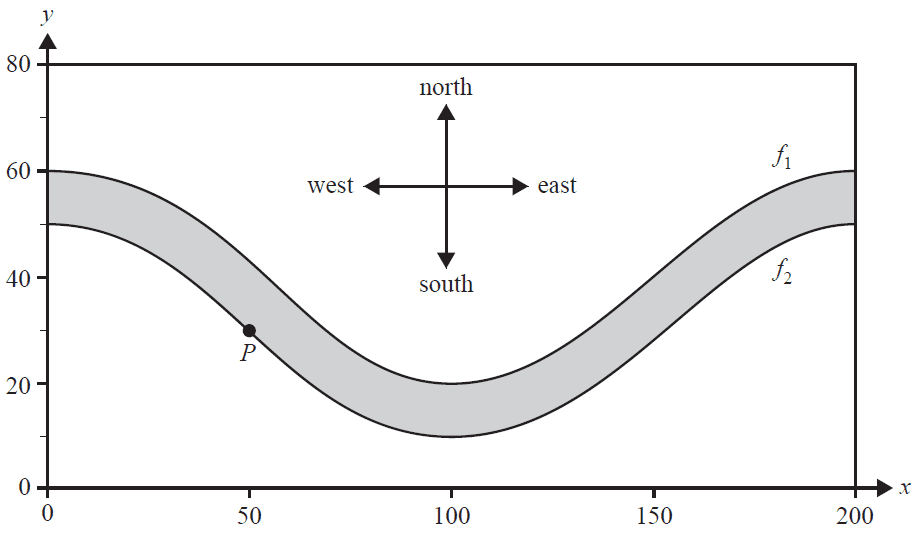
A swimmer always starts at point \(P\), which has coordinates \((50, 30)\).
Assume that no movement of water in the river affects the motion or path of the swimmer, which is always a straight line.
a. The swimmer swims north from point \(P\).
Find the distance, in metres, that the swimmer needs to swim to get to the north bank of the river. 1 mark
b. The swimmer swims east from point \(P\).
Find the distance, in metres, that the swimmer needs to swim to get to the north bank of the river. 2 marks
c. On another occasion, the swimmer swims the minimum distance from point \(P\) to the north bank of the river.
Find this minimum distance. Give your answer in metres, correct to one decimal place. 2 marks
d. Calculate the surface area of the section of the river shown on the graph on page 16, in square metres. 1 mark
e. A horizontal line is drawn through point \(P\). The section of the river that is south of the line is declared a ‘no swimming’ zone.
Find the area of the ‘no swimming’ zone, correct to the nearest square metre. 3 marks
f. Scientists observe that the north bank of the river is changing over time. It is moving further north from its current position. They model its predicted new location using the function with rule \(y = kf_1(x)\), where \(k \ge 1\).
Find the values of \(k\) for which the distance north across the river, for all parts of the river, is strictly less than 20 m. 2 marks
The graph of the function \(f(x) = 2xe^{1-x^2}\), where \(0 \le x \le 3\), is shown below.
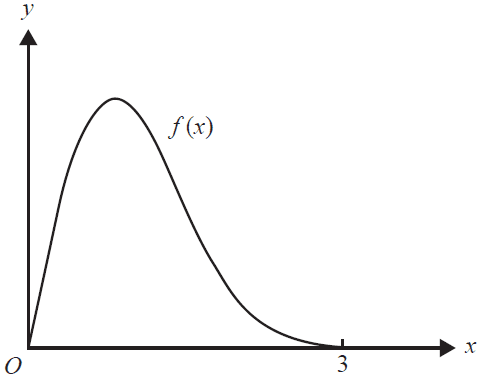
a. Find the slope of the tangent to \(f\) at \(x=1\). 1 mark
b. Find the obtuse angle that the tangent to \(f\) at \(x=1\) makes with the positive direction of the horizontal axis. Give your answer correct to the nearest degree. 1 mark
c. Find the slope of the tangent to \(f\) at a point \(x=p\). Give your answer in terms of \(p\). 1 mark
d.
i. Find the value of \(p\) for which the tangent to \(f\) at \(x=1\) and the tangent to \(f\) at \(x=p\) are perpendicular to each other. Give your answer correct to three decimal places. 2 marks
ii. Hence, find the coordinates of the point where the tangents to the graph of \(f\) at \(x=1\) and \(x=p\) intersect when they are perpendicular. Give your answer correct to two decimal places. 3 marks
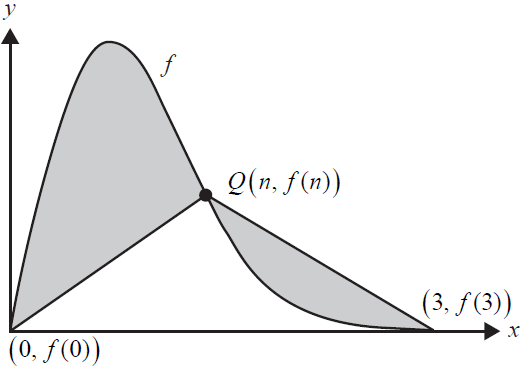
Two line segments connect the points \((0, f(0))\) and \((3, f(3))\) to a single point \(Q(n, f(n))\), where \(1 < n < 3\), as shown in the graph below.
e.
i. The first line segment connects the point \((0, f(0))\) and the point \(Q(n, f(n))\), where \(1 < n < 3\).
Find the equation of this line segment in terms of \(n\). 1 mark
ii. The second line segment connects the point \(Q(n, f(n))\) and the point \((3, f(3))\), where \(1 < n < 3\).
Find the equation of this line segment in terms of \(n\). 1 mark
iii. Find the value of \(n\), where \(1 < n < 3\), if there are equal areas between the function \(f\) and each line segment. Give your answer correct to three decimal places. 3 marks
Let \(f: \mathbb{R} \to \mathbb{R}\), \(f(x) = x^3 - x\).
Let \(g_a: \mathbb{R} \to \mathbb{R}\) be the function representing the tangent to the graph of \(f\) at \(x=a\), where \(a \in \mathbb{R}\).
Let \((b, 0)\) be the \(x\)-intercept of the graph of \(g_a\).
a. Show that \(b = \frac{2a^3}{3a^2-1}\). 3 marks
b. State the values of \(a\) for which \(b\) does not exist. 1 mark
c. State the nature of the graph of \(g_a\) when \(b\) does not exist. 1 mark
d.
i. State all values of \(a\) for which \(b = 1.1\). Give your answers correct to four decimal places. 1 mark
ii. The graph of \(f\) has an \(x\)-intercept at \((1, 0)\).
State the values of \(a\) for which \(1 \le b < 1.1\). Give your answers correct to three decimal places. 1 mark
The coordinate \((b, 0)\) is the horizontal axis intercept of \(g_a\).
Let \(g_b\) be the function representing the tangent to the graph of \(f\) at \(x=b\), as shown in the graph below.
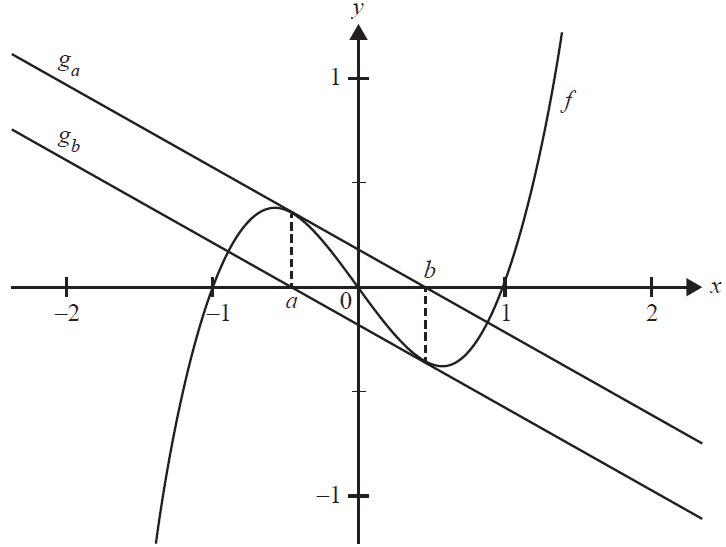
e. Find the values of \(a\) for which the graphs of \(g_a\) and \(g_b\), where \(b\) exists, are parallel and where \(b \ne a\). 3 marks
Let \(p: \mathbb{R} \to \mathbb{R}\), \(p(x) = x^3 + wx\), where \(w \in \mathbb{R}\).
f. Show that \(p(-x) = -p(x)\) for all \(w \in \mathbb{R}\). 1 mark
A property of the graphs of \(p\) is that two distinct parallel tangents will always occur at \((t, p(t))\) and \((-t, p(-t))\) for all \(t \ne 0\).
g. Find all values of \(w\) such that a tangent to the graph of \(p\) at \((t, p(t))\), for some \(t > 0\), will have an \(x\)-intercept at \((-t, 0)\). 1 mark
h. Let \(T: \mathbb{R}^2 \to \mathbb{R}^2\), \(T\begin{pmatrix} x \\ y \end{pmatrix} = \begin{pmatrix} m & 0 \\ 0 & n \end{pmatrix} \begin{pmatrix} x \\ y \end{pmatrix} + \begin{pmatrix} h \\ k \end{pmatrix}\), where \(m, n \in \mathbb{R}\setminus\{0\}\) and \(h, k \in \mathbb{R}\).
State any restrictions on the values of \(m, n, h\) and \(k\), given that the image of \(p\) under the transformation \(T\) always has the property that parallel tangents occur at \(x=-t\) and \(x=t\) for all \(t \ne 0\). 1 mark
End of examination questions
VCE is a registered trademark of the VCAA. The VCAA does not endorse or make any warranties regarding this study resource. Past VCE exams and related content can be accessed directly at www.vcaa.vic.edu.au

