FINISHED! EVERY YEAR 11 RESOURCE IS NOW AVAILABLE.
2023 VCAA Maths Methods Exam 2
Adapted for Year 11. Unit 1 & 2.
This is the full VCE Maths Methods Exam with worked solutions. You can also try Mini-Tests, which are official VCAA exams split into short tests you can do anytime.
Number of marks: 55
Reading time: 10 minutes
Writing time: 85 minutes
Section A – Multiple-choice questions
Instructions
• Answer all questions in pencil on your Multiple-Choice Answer Sheet.
• Choose the response that is correct for the question.
• A correct answer scores 1; an incorrect answer scores 0.
• Marks will not be deducted for incorrect answers.
• No marks will be given if more than one answer is completed for any question.
• Unless otherwise indicated, the diagrams in this book are not drawn to scale.
The amplitude, \( A \), and the period, \( P \), of the function \( f(x) = -\frac{1}{2} \sin(3x + 2\pi) \) are
- A. \( A = -\frac{1}{2}, \quad P = \frac{\pi}{3} \)
- B. \( A = -\frac{1}{2}, \quad P = \frac{2\pi}{3} \)
- C. \( A = -\frac{1}{2}, \quad P = \frac{3\pi}{2} \)
- D. \( A = \frac{1}{2}, \quad P = \frac{\pi}{3} \)
- E. \( A = \frac{1}{2}, \quad P = \frac{2\pi}{3} \)
For the parabola with equation \( y = ax^2 + 2bx + c \), where \( a, b, c \in \mathbb{R} \), the equation of the axis of symmetry is
- A. \( x = -\frac{b}{a} \)
- B. \( x = -\frac{b}{2a} \)
- C. \( y = c \)
- D. \( x = \frac{b}{a} \)
- E. \( x = \frac{b}{2a} \)
Consider the system of simultaneous linear equations below containing the parameter \( k \):
\( kx + 5y = k + 5 \)
\( 4x + (k + 1)y = 0 \)
The value(s) of \( k \) for which the system of equations has infinite solutions are
- A. \( k \in \{-5, 4\} \)
- B. \( k \in \{-5\} \)
- C. \( k \in \{4\} \)
- D. \( k \in \mathbb{R} \setminus \{-5, 4\} \)
- E. \( k \in \mathbb{R} \setminus \{-5\} \)
Suppose that \( \int_3^{10} f(x)\, dx = C \) and \( \int_7^{10} f(x)\, dx = D \). The value of \( \int_3^7 f(x)\, dx \) is
- A. \( C + D \)
- B. \( C + D - 3 \)
- C. \( C - D \)
- D. \( D - C \)
- E. \( CD - 3 \)
A box contains \( n \) green balls and \( m \) red balls. A ball is selected at random, and its colour is noted. The ball is then replaced in the box. In 8 such selections, where \( n \ne m \), what is the probability that a green ball is selected at least once?
- A. \( 8 \left( \frac{n}{n + m} \right) \left( \frac{m}{n + m} \right)^7 \)
- B. \( 1 - \left( \frac{n}{n + m} \right)^8 \)
- C. \( 1 - \left( \frac{m}{n + m} \right)^8 \)
- D. \( 1 - \left( \frac{n}{n + m} \right) \left( \frac{m}{n + m} \right)^7 \)
- E. \( 1 - 8 \left( \frac{n}{n + m} \right) \left( \frac{m}{n + m} \right)^7 \)
Two functions, \( f \) and \( g \), are continuous and differentiable for all \( x \in \mathbb{R} \). It is given that
\( f(-2) = -7, \quad g(-2) = 8, \quad f'(-2) = 3, \quad g'(-2) = 2 \)
The gradient of the graph \( y = f(x) \times g(x) \) at \( x = -2 \) is
- A. −10
- B. −6
- C. 0
- D. 6
- E. 10
The following algorithm applies Newton’s method using a For loop with 3 iterations...
\[ \begin{array}{l} \textbf{Inputs:} \quad f(x), \text{ a function of } x \\ \quad\quad\quad\quad df(x), \text{ the derivative of } f(x) \\ \quad\quad\quad\quad x_0, \text{ an initial estimate} \\ \\ \textbf{Define } \texttt{newton}(f(x), df(x), x_0) \\ \quad \textbf{For } i \text{ from } 1 \text{ to } 3 \\ \quad\quad \textbf{If } df(x_0) = 0 \textbf{ Then} \\ \quad\quad\quad \textbf{Return } \text{``Error: Division by zero''} \\ \quad\quad \textbf{Else} \\ \quad\quad\quad x_0 \leftarrow x_0 - f(x_0) \div df(x_0) \\ \quad \textbf{EndFor} \\ \quad \textbf{Return } x_0 \end{array} \]The return value of the function newton(x³ + 3x − 3, 3x² + 3, 1) is closest to
- A. 0.83333
- B. 0.81785
- C. 0.81773
- D. 1
- E. 3
A polynomial has the equation \( y = x(3x - 1)(x + 3)(x + 1) \).
The number of tangents to this curve that pass through the positive x-intercept is
- A. 0
- B. 1
- C. 2
- D. 3
- E. 4
Let \( f(x) = e^{x - 1} \).
Given that the product function \( f(x) \times g(x) = e^{(x - 1)^2} \), the rule for the function \( g \) is:
- A. \( g(x) = e^{x - 1} \)
- B. \( g(x) = e^{(x - 2)(x - 1)} \)
- C. \( g(x) = e^{(x + 2)(x - 1)} \)
- D. \( g(x) = e^{x(x - 2)} \)
- E. \( g(x) = e^{x(x - 3)} \)
A cylinder of height \( h \) and radius \( r \) is formed from a rectangular metal sheet of length \( x \) and width \( y \), by cutting
along the dashed lines shown below.
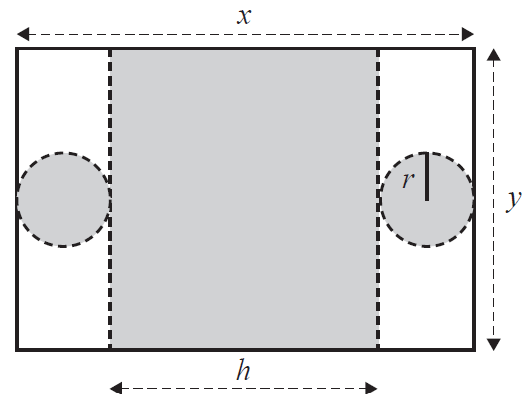
The volume of the cylinder in terms of \( x \) and \( y \) is
- A. \( \pi x^2 y \)
- B. \( \frac{\pi x y^2 - 2 y^3}{4\pi^2} \)
- C. \( \frac{2 y^3 - \pi x y^2}{4\pi^2} \)
- D. \( \frac{\pi x y - 2 y^2}{2\pi} \)
- E. \( \frac{2 y^2 - \pi x y}{2\pi} \)
Consider the function \( f : [-a\pi, a\pi] \to \mathbb{R} \), \( f(x) = \sin(ax) \), where \( a \) is a positive integer.
The number of local minima in the graph of \( y = f(x) \) is always equal to
- A. 2
- B. 4
- C. \( a \)
- D. \( 2a \)
- E. \( a^2 \)
Find all values of \( k \), such that the equation
\( x^2 + (4k + 3)x + 4k^2- \frac{9}{4} = 0 \)
has two real solutions for \( x \), one positive and one negative.
- A. \( k > -\frac{3}{4} \)
- B. \( k \geq -\frac{3}{4} \)
- C. \( k > \frac{3}{4} \)
- D. \( -\frac{3}{4} < k < \frac{3}{4} \)
- E. \( k < -\frac{3}{4} \text{ or } k > \frac{3}{4} \)
End of Section A
Section B
Instructions
• Answer all questions in the spaces provided.
• Write your responses in English.
• In questions where a numerical answer is required, an exact value must be given unless otherwise specified.
• In questions where more than one mark is available, appropriate working must be shown.
• Unless otherwise indicated, the diagrams in this book are not drawn to scale.
Let \( f : \mathbb{R} \rightarrow \mathbb{R} \), \( f(x) = x(x - 2)(x + 1) \). Part of the graph of \( f \) is shown below.
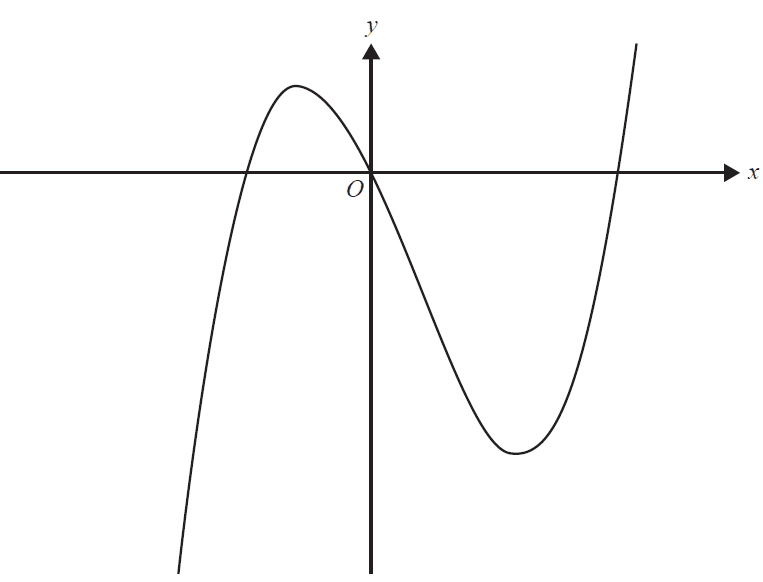
a. State the coordinates of all axial intercepts of \( f \). 1 mark
b. Find the coordinates of the stationary points of \( f \). 2 marks
c. i. Let \( g : \mathbb{R} \rightarrow \mathbb{R} \), \( g(x) = x - 2 \). Find the values of \( x \) for which \( f(x) = g(x) \). 1 mark
ii. Write down an expression using definite integrals that gives the area of the regions bound by \( f \) and \( g \). 2 marks
iii. Hence, find the total area of the regions bound by \( f \) and \( g \), correct to two decimal places. 1 mark
d. Let \( h : \mathbb{R} \rightarrow \mathbb{R} \), \( h(x) = (x - a)(x - b)^2 \), where \( h(x) = f(x) + k \) and \( a, b, k \in \mathbb{R} \). Find the possible values of \( a \) and \( b \). 4 marks
The following diagram represents an observation wheel, with its centre at point P. Passengers are seated in pods, which are carried around as the wheel turns. The wheel moves anticlockwise with constant speed and completes one full rotation every 30 minutes. When a pod is at the lowest point of the wheel (point A), it is 15 metres above the ground. The wheel has a radius of 60 metres.
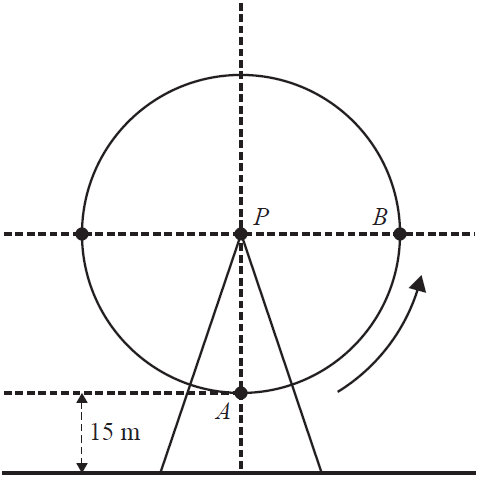
Consider the function \( h(t) = -60 \cos(bt) + c \) for some \( b, c \in \mathbb{R} \), which models the height above the ground of a pod originally situated at point A, after time \( t \) minutes.
a. Show that \( b = \frac{\pi}{15} \) and \( c = 75 \). 2 marks
b. Not applicable for Year 11 students. 2 marks
c. Find the average rate of change, in metres per minute, of the height of a pod on the wheel as it travels from point A to point B. 1 mark
After 15 minutes, the wheel stops moving and remains stationary for 5 minutes. After this, it continues moving at double its previous speed for another 7.5 minutes. The height above the ground of a pod that was initially at point A, after \( t \) minutes, can be modelled by the piecewise function \( w \):
\[ w(t) = \begin{cases} h(t) & 0 \leq t < 15 \\ k & 15 \leq t < 20 \\ h(mt + n) & 20 \leq t \leq 27.5 \end{cases} \] where \( k \geq 0 \), \( m \geq 0 \) and \( n \in \mathbb{R} \).
d. i. State the values of \( k \) and \( m \). 1 mark
ii. Find all possible values of \( n \). 2 marks
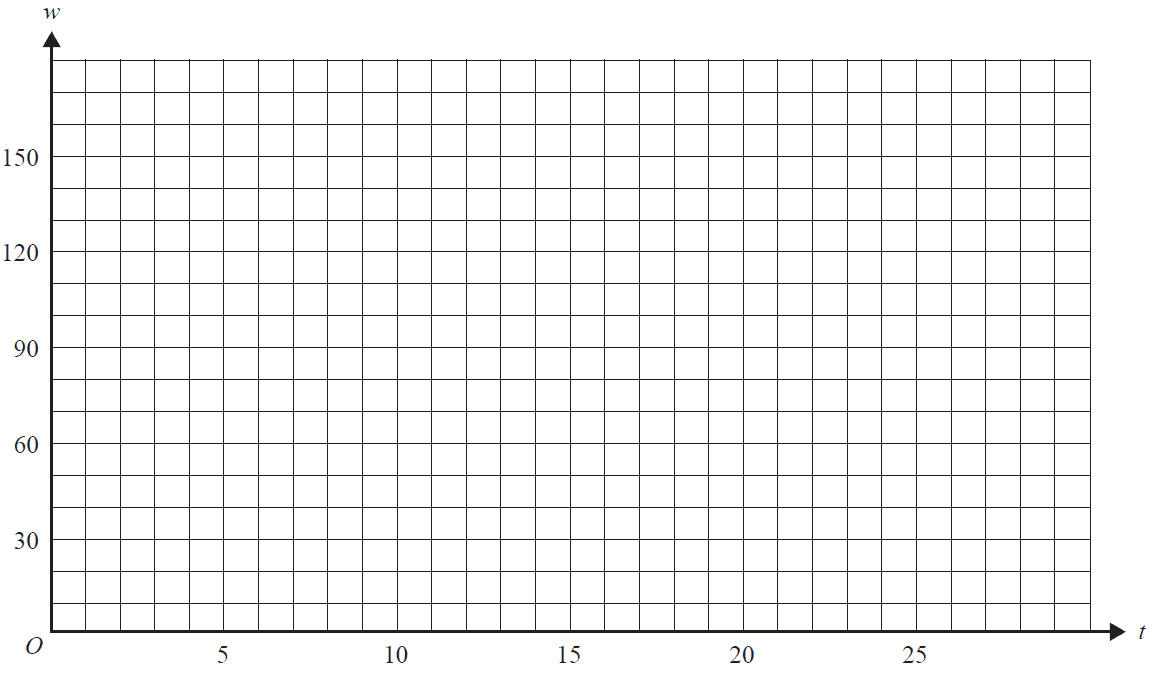
iii. Sketch the graph of the piecewise function \( w \) on the axes below, showing the coordinates of the endpoints. 3 marks
Consider the function \( g : \mathbb{R} \rightarrow \mathbb{R} \), \( g(x) = 2^x + 5 \).
a. State the value of \( \lim_{x \to -\infty} g(x) \). 1 mark
b. The derivative, \( g'(x) \), can be expressed in the form \( g'(x) = k \times 2^x \). Find the real number \( k \). 1 mark
c. i. Let \( a \) be a real number. Find, in terms of \( a \), the equation of the tangent to \( g \) at the point \( (a, g(a)) \). 1 mark
ii. Hence, or otherwise, find the equation of the tangent to \( g \) that passes through the origin, correct to three decimal places. 2 marks
Let \( h : \mathbb{R} \rightarrow \mathbb{R} \), \( h(x) = 2^x - x^2 \).
d. Find the coordinates of the point of inflection for \( h \), correct to two decimal places. 1 mark
e. Find the largest interval of \( x \) values for which \( h \) is strictly decreasing. Give your answer correct to two decimal places. 1 mark
f. Apply Newton’s method, with an initial estimate of \( x_0 = 0 \), to find an approximate x-intercept of \( h \). Write the estimates \( x_1 \), \( x_2 \) and \( x_3 \) in the table below, correct to three decimal places. 2 marks
| \( x_0 \) | 0 |
| \( x_1 \) | |
| \( x_2 \) | |
| \( x_3 \) |
g. For the function \( h \), explain why a solution to the equation \( \log_e(2) \times 2^x - 2x = 0 \) should not be used as an initial estimate \( x_0 \) in Newton’s method. 1 mark
h. There is a positive real number \( n \) for which the function \( f(x) = n^x - x^n \) has a local minimum on the x-axis. Find this value of \( n \). 2 marks
Let \( f : \mathbb{R} \rightarrow \mathbb{R} \), \( f(x) = e^x + e^{-x} \) and \( g : \mathbb{R} \rightarrow \mathbb{R} \), \( g(x) = \frac{1}{2} f(2-x) \).
a. Complete a possible sequence of transformations to map \( f \) to \( g \). 2 marks
- • Dilation of factor \( \frac{1}{2} \) from the x-axis.
- •
- •
Two functions \( g_1 \) and \( g_2 \) are created, both with the same rule as \( g \) but with distinct domains, such that \( g_1 \) is strictly increasing and \( g_2 \) is strictly decreasing.
b. Give the domain and range for the inverse of \( g_1 \). 2 marks
Shown below is the graph of \( g \), the inverses of \( g_1 \) and \( g_2 \), and the line \( y = x \).
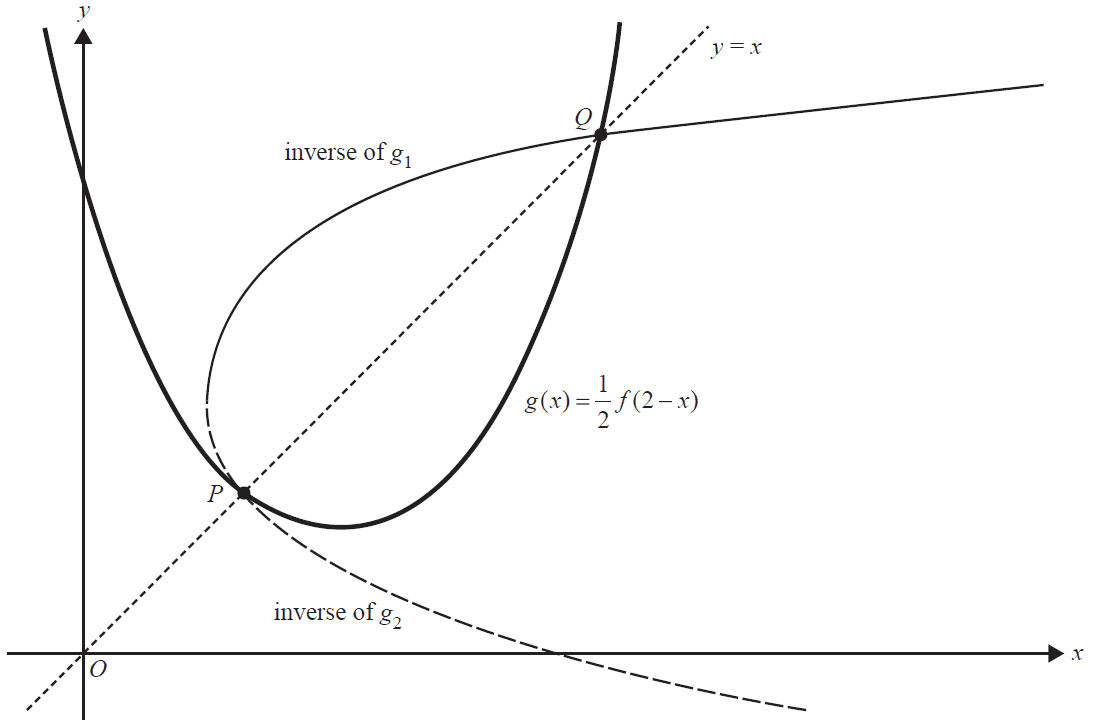
The intersection points between the graphs of \( y = x \), \( y = g(x) \) and the inverses of \( g_1 \) and \( g_2 \), are labelled P and Q.
c. i. Find the coordinates of \( P \) and \( Q \), correct to two decimal places. 1 mark
ii. Find the area of the region bound by the graphs of \( g \), the inverse of \( g_1 \) and the inverse of \( g_2 \). Give your answer correct to two decimal places. 2 marks
Let \( h : \mathbb{R} \rightarrow \mathbb{R} \), \( h(x) = \frac{1}{k} f(k-x) \), where \( k \in (0, \infty) \).
d. The turning point of \( h \) always lies on the graph of the function \( y = 2x^n \), where \( n \) is an integer. Find the value of \( n \). 1 mark
Let \( h_1 : [k, \infty) \rightarrow \mathbb{R} \), \( h_1(x) = h(x) \). The rule for the inverse of \( h_1 \) is \( y = \log_e\left( \frac{k}{2}x + \frac{1}{2} \sqrt{k^2 x^2 - 4} \right) + k \).
e. What is the smallest value of \( k \) such that \( h \) will intersect with the inverse of \( h_1 \)? Give your answer correct to two decimal places. 1 mark
It is possible for the graphs of \( h \) and the inverse of \( h_1 \) to intersect twice. This occurs when \( k = 5 \).
f. Find the area of the region bound by the graphs of \( h \) and the inverse of \( h_1 \), when \( k = 5 \). Give your answer correct to two decimal places. 2 marks
End of examination questions
VCE is a registered trademark of the VCAA. The VCAA does not endorse or make any warranties regarding this study resource. Past VCE exams and related content can be accessed directly at www.vcaa.vic.edu.au