FINISHED! EVERY YEAR 11 RESOURCE IS NOW AVAILABLE.
Join thousands OF Methods students!
Boost your confidence and marks with Cheatsheets, Exam Qs, Video Tutorials & more, delivered to your inbox for free.
Join thousands OF Methods students!
Boost your confidence & marks with Cheatsheets, Exam Qs, Video Tutorials & more, delivered to your inbox for free.
2024 VCAA Maths Methods Exam 2
Adapted for Year 11. Unit 1 & 2.
This is the full VCE Maths Methods Exam with worked solutions. You can also try Mini-Tests, which are official VCAA exams split into short tests you can do anytime.
Number of marks: 48
Reading time: 10 minutes
Writing time: 75 minutes
Section A – Multiple-choice questions
Instructions
• Answer all questions in pencil on your Multiple-Choice Answer Sheet.
• Choose the response that is correct for the question.
• A correct answer scores 1; an incorrect answer scores 0.
• Marks will not be deducted for incorrect answers.
• No marks will be given if more than one answer is completed for any question.
• Unless otherwise indicated, the diagrams in this book are not drawn to scale.
The asymptote(s) of the graph of \( y = \log_3(x + 1) - 3 \) are
- A. \( x = -1\) only
- B. \( x = 1\) only
- C. \( y = -3\) only
- D. \( x = -1\) and \( y = -3 \)
A function \( g: \mathbb{R} \to \mathbb{R} \) has the derivative \( g'(x) = x^3 - x \).
Given that \( g(0) = 5 \), the value of \( g(2) \) is
- A. 2
- B. 3
- C. 5
- D. 7
A discrete random variable \( X \) is defined using the probability distribution below, where \( k \) is a positive real number.
| x | 0 | 1 | 2 | 3 | 4 |
|---|---|---|---|---|---|
| Pr(X = x) | 2k | 3k | 5k | 3k | 2k |
Find \( \Pr(X < 4 \mid X > 1) \).
- A. \(\frac{13}{15}\)
- B. \(\frac{11}{13}\)
- C. \(\frac{4}{5}\)
- D. \(\frac{8}{15}\)
If \( \int_a^b f(x)\,dx = -5 \) and \( \int_a^c f(x)\,dx = 3 \), where \( a < b < c \), then \( \int_b^c 2f(x)\,dx \) is equal to
- A. -16
- B. 16
- C. -4
- D. 4
Consider the function \( f(x) = \frac{2x+1}{3-x} \), with domain \( x \in \mathbb{R} \setminus \{3\} \).
The inverse of \( f \) is
- A. \( f^{-1}(x) = \frac{3x - 1}{x + 2} \) with domain \( x \in \mathbb{R} \setminus \{3\} \)
- B. \( f^{-1}(x) = 3 - \frac{7}{x + 2} \) with domain \( x \in \mathbb{R} \setminus \{-2\} \)
- C. \( f^{-1}(x) = 3 + \frac{5}{x + 2} \) with domain \( x \in \mathbb{R} \setminus \{-2\} \)
- D. \( f^{-1}(x) = \frac{1 - 3x}{x + 2} \) with domain \( x \in \mathbb{R} \setminus \{-2\} \)
Some values of the functions \( f: \mathbb{R} \to \mathbb{R} \) and \( g: \mathbb{R} \to \mathbb{R} \) are shown below.
| x | 1 | 2 | 3 |
|---|---|---|---|
| f(x) | 0 | 4 | 5 |
| g(x) | 3 | 4 | -5 |
The graph of the function \( h(x) = f(x) - g(x) \) must have an x-intercept at
- A. (2, 0)
- B. (3, 0)
- C. (4, 0)
- D. (5, 0)
At a Year 12 formal, 45% of the students travelled to the event in a hired limousine, while the remaining 55% were driven by a parent.
Of the students who travelled in a hired limousine, 30% had a professional photo taken.
Of the students who were driven by a parent, 60% had a professional photo taken.
Given that a student had a professional photo taken, what is the probability that the student travelled in a hired limousine?
- A. \(\frac{1}{8}\)
- B. \(\frac{27}{200}\)
- C. \(\frac{9}{31}\)
- D. \(\frac{22}{31}\)
Suppose a function \( f: [0, 5] \to \mathbb{R} \) and its derivative \( f': [0, 5] \to \mathbb{R} \) are defined and continuous on their domains.
If \( f'(2) < 0 \) and \( f'(4) > 0 \), which one of these statements must be true?
- A. f is strictly decreasing on [0, 2]
- B. f does not have an inverse function
- C. f is positive on [4, 5]
- D. f has a local minimum at x = 3
Twelve students sit in a classroom, with seven students in the first row and five in the second row. Three students are chosen randomly from the class.
The probability that exactly two of the three students chosen are in the first row is
- A. \(\frac{7}{44}\)
- B. \(\frac{21}{44}\)
- C. \(\frac{5}{22}\)
- D. \(\frac{245}{576}\)
The graph of \( y = f(x) \) is shown below
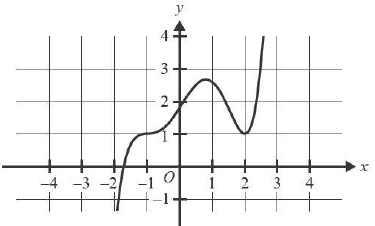
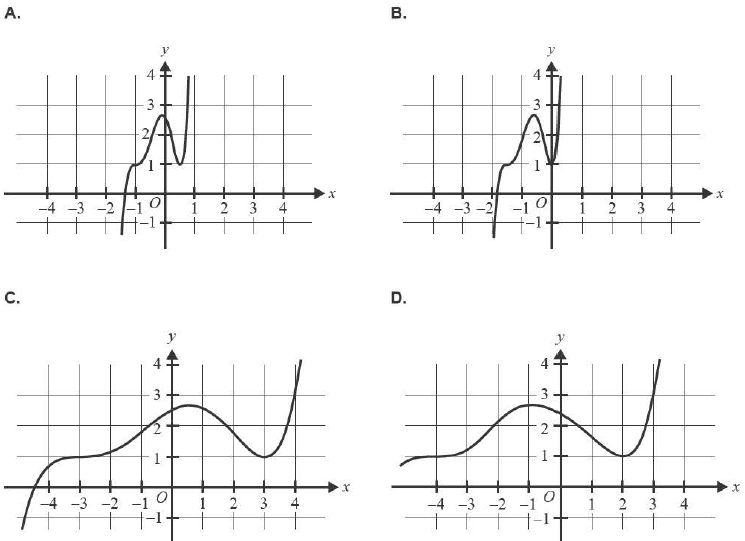
Which of the following options best represents the graph of \( y = f(2x + 1) \)?
The function \( f: (0, \infty) \to \mathbb{R}, f(x) = \frac{x}{2}+\frac{2}{x} \) is mapped to a function \( g \) by:
1. dilation by a factor of 3 from the y-axis
2. translation by 1 unit in the negative y-direction
The function \( g \) has a local minimum at
- A. (6, 1)
- B. \((\frac{2}{3}, 1)\)
- C. (2, 5)
- D. \((2, -\frac{1}{3})\)
The points of inflection of the graph of \( y = 2 - \tan(\pi(x - \tfrac{1}{4})) \) are
- A. \((k + \tfrac{1}{4}, 2), k \in \mathbb{Z}\)
- B. \((k - \tfrac{1}{4}, 2), k \in \mathbb{Z}\)
- C. \((k + \tfrac{1}{4}, -2), k \in \mathbb{Z}\)
- D. \((k - \tfrac{3}{4}, -2), k \in \mathbb{Z}\)
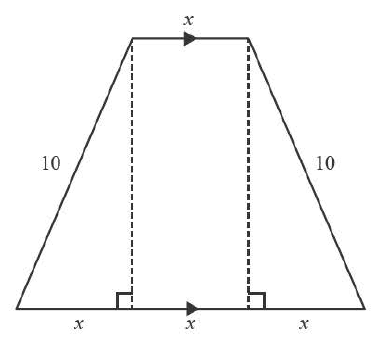
Find the value of \( x \) which maximises the area of the trapezium shown below.
- A. 10
- B. 5\(\sqrt{2}\)
- C. 7
- D. \(\sqrt{10}\)
End of Section A
Section B
Instructions
• Answer all questions in the spaces provided.
• Write your responses in English.
• In questions where a numerical answer is required, an exact value must be given unless otherwise specified.
• In questions where more than one mark is available, appropriate working must be shown.
• Unless otherwise indicated, the diagrams in this book are not drawn to scale.
Consider the function \( f: \mathbb{R} \rightarrow \mathbb{R},\ f(x) = (x + 1)(x + a)(x - 2)(x - 2a) \) where \( a \in \mathbb{R} \).
a. State, in terms of \( a \) where required, the values of \( x \) for which \( f(x) = 0 \). 1 mark
b. Find the values of \( a \) for which the graph of \( y = f(x) \) has
i. exactly three x-intercepts. 2 marks
ii. exactly four x-intercepts. 1 mark
c. Let \( g \) be the function \( g: \mathbb{R} \rightarrow \mathbb{R},\ g(x) = (x + 1)^2(x - 2)^2 \), which is the function \( f \) where \( a = 1 \).
i. Find \( g'(x) \). 1 mark
ii. Find the coordinates of the local maximum of \( g \). 1 mark
iii. Find the values of \( x \) for which \( g'(x) > 0 \). 1 mark
iv. Consider the two tangent lines to the graph of \( y = g(x) \) at the points where \( x =\frac{-\sqrt{3} + 1}{2} \) and \( x = \frac{\sqrt{3} + 1}{2} \). Determine the coordinates of the point of intersection of these two tangent lines. 2 marks
d. Let \( g \) remain as the function \( g: \mathbb{R} \rightarrow \mathbb{R},\ g(x) = (x + 1)^2(x - 2)^2 \), which is the function \( f \) where \( a = 1 \).
Let \( h \) be the function \( h: \mathbb{R} \rightarrow \mathbb{R},h(x) = (x + 1)(x - 1)(x + 2)(x - 2) \), which is the function \( f \) where \( a = -1 \).
i. Using translations only, describe a sequence of transformations of \( h \), for which its image would have a local maximum at the same coordinates as that of \( g \). 1 mark
ii. Using a dilation and translations, describe a different sequence of transformations of \( h \), for which its image would have both local minimums at the same coordinates as that of \( g \). 2 marks
A model for the temperature in a room, in degrees Celsius, is given by
a. Express the derivative \( f'(t) \) as a hybrid function. 2 marks
b. Find the average rate of change in temperature predicted by the model between \( t = 0 \) and \( t = \frac{1}{2} \). Give your answer in degrees Celsius per hour. 1 mark
c. Another model for the temperature in the room is given by \( g(t) = 22 - 10e^{-6t},\ t \geq 0 \).
i. Find the derivative \( g'(t) \). 1 mark
ii. Find the value of \( t \) for which \( g'(t) = 10 \). Give your answer correct to three decimal places. 1 mark
d. Find the time \( t \in (0, 1) \) when the temperatures predicted by the models \( f \) and \( g \) are equal. Give your answer correct to two decimal places. 1 mark
e. Find the time \( t \in (0, 1) \) when the difference between the temperatures predicted by the two models is the greatest. Give your answer correct to two decimal places. 1 mark
f. The amount of power, in kilowatts, used by the heater \( t \) hours after it is switched on, can be modelled by the continuous function \( p \), whose graph is shown below.
The amount of energy used by the heater, in kilowatt hours, can be estimated by evaluating the area between the graph of \( y = p(t) \) and the \( t \)-axis.
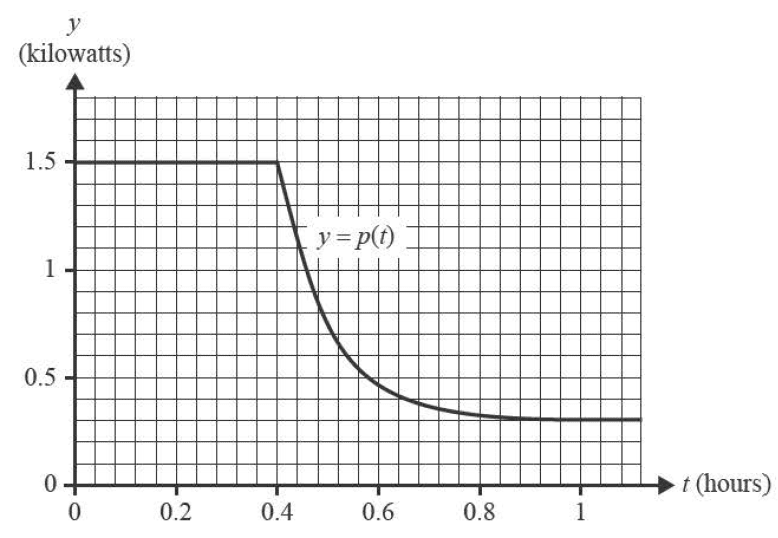
i. Given that \( p(t) \) is continuous for \( t \geq 0 \), show that \( A = 1.2e^4 \). 1 mark
ii. Find how long it takes, after the heater is switched on, until the heater has used 0.5 kilowatt hours of energy. Give your answer in hours. 1 mark
iii. Find how long it takes, after the heater is switched on, until the heater has used 1 kilowatt hour of energy. Give your answer in hours, correct to two decimal places. 2 marks
The points shown on the chart below represent monthly online sales in Australia.
The variable \( y \) represents sales in millions of dollars.
The variable \( t \) represents the month when the sales were made, where \( t = 1 \) corresponds to January 2021, \( t = 2 \) corresponds to February 2021 and so on.
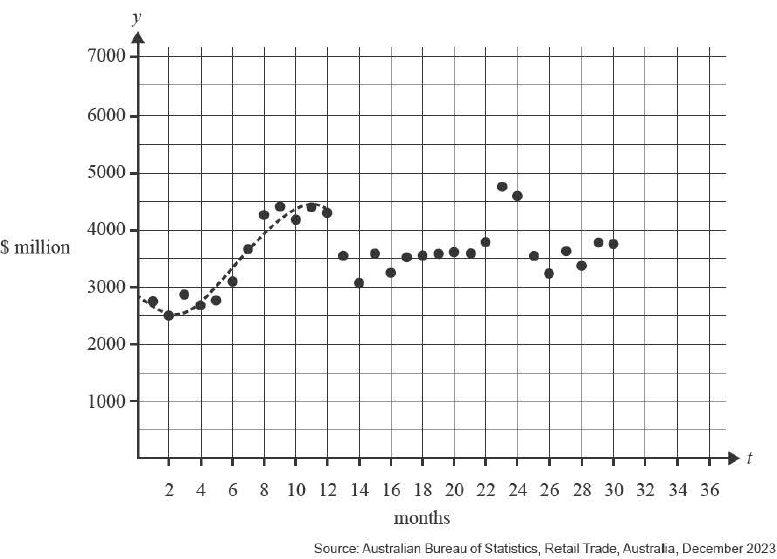
a. A cubic polynomial \( p : (0, 12] \rightarrow \mathbb{R}, \, p(t) = at^3 + bt^2 + ct + d \) can be used to model monthly online sales in 2021.
The graph of \( y = p(t) \) is shown as a dashed curve on the set of axes above.
It has a local minimum at (2, 2500) and a local maximum at (11, 4400).
i. Find, correct to two decimal places, the values of \( a \), \( b \), \( c \) and \( d \). 3 marks
ii. Let \( q : (12, 24] \rightarrow \mathbb{R}, \, q(t) = p(t - h) + k \) be a cubic function obtained by translating \( p \), which can be used to model monthly online sales in 2022.
Find the values of \( h \) and \( k \) such that the graph of \( y = q(t) \) has a local maximum at (23, 4750). 2 marks
b. Another function \( f \) can be used to model monthly online sales, where
\( f : (0, 36] \rightarrow \mathbb{R}, \quad f(t) = 3000 + 30t + 700\cos\left(\frac{\pi t}{6}\right) + 400\cos\left(\frac{\pi t}{3}\right) \)
Part of the graph of \( f \) is shown on the axes below.
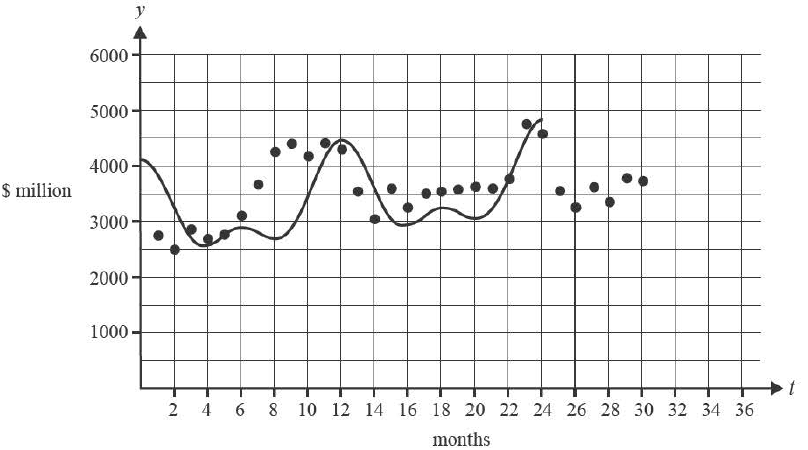
i. Complete the graph of \( f \) on the set of axes above until December 2023, that is, for \( t \in (24, 36] \).
Label the endpoint at \( t = 36 \) with its coordinates. 2 marks
ii. The function \( f \) predicts that every 12 months, monthly online sales increase by \( n \) million dollars.
Find the value of \( n \). 1 mark
iii. Find the derivative \( f'(t) \). 1 mark
iv. Hence, find the maximum instantaneous rate of change for the function \( f \), correct to the nearest million dollars per month, and the values of \( t \) in the interval \( (0, 36] \) when this maximum rate occurs, correct to one decimal place. 2 marks
End of examination questions
VCE is a registered trademark of the VCAA. The VCAA does not endorse or make any warranties regarding this study resource. Past VCE exams and related content can be accessed directly at www.vcaa.vic.edu.au

