2025 VCE Maths Methods Mini Test 9
Number of marks: 8
Reading time: 2 minutes
Writing time: 12 minutes
Section A – Calculator Allowed
Instructions
• Answer all questions in pencil on your Multiple-Choice Answer Sheet.
• Choose the response that is correct for the question.
• A correct answer scores 1; an incorrect answer scores 0.
• Marks will not be deducted for incorrect answers.
• No marks will be given if more than one answer is completed for any question.
• Unless otherwise indicated, the diagrams in this book are not drawn to scale.
Let \(A\) be a point on the line \(y = x + c\) and \(B\) be a point on the curve \(y = \log_{e}(x-1)\).
If \(A\) and \(B\) are placed such that the line segment \(AB\) has the minimum possible length, and this length is \(\sqrt{2}\), the value of \(c\) must be
- A. \(\sqrt{2}-2\)
- B. \(\sqrt{2}\)
- C. \(1\)
- D. \(0\)
Let \(a > 1\), and consider the functions \(f\) and \(g\) defined below.
\(f:\mathbb{R} \rightarrow \mathbb{R}, \quad f(x)=a^{x}\)
\(g:\mathbb{R} \rightarrow \mathbb{R}, \quad g(x)=a^{2x+2}\)
Which one of the following sequences of transformations, when applied to \(f(x)\), does not produce \(g(x)\)?
- A. dilation by a factor of \(\frac{1}{2}\) from the \(y\)-axis, then translation by 1 unit in the negative direction of the \(x\)-axis
- B. dilation by a factor of \(\frac{1}{2}\) from the \(y\)-axis, then dilation by a factor of \(a^{2}\) from the \(x\)-axis
- C. dilation by a factor of \(a\) from the \(x\)-axis, then dilation by a factor of \(\frac{1}{2}\) from the \(y\)-axis, then translation by 1 unit in the positive direction of the \(x\)-axis
- D. dilation by a factor of \(a^{3}\) from the \(x\)-axis, then translation by 1 unit in the positive direction of the \(x\)-axis, then dilation by a factor of \(\frac{1}{2}\) from the \(y\)-axis
End of Section A
Section B – No Calculator
Instructions
• Answer all questions in the spaces provided.
• Write your responses in English.
• In questions where a numerical answer is required, an exact value must be given unless otherwise specified.
• In questions where more than one mark is available, appropriate working must be shown.
• Unless otherwise indicated, the diagrams in this book are not drawn to scale.
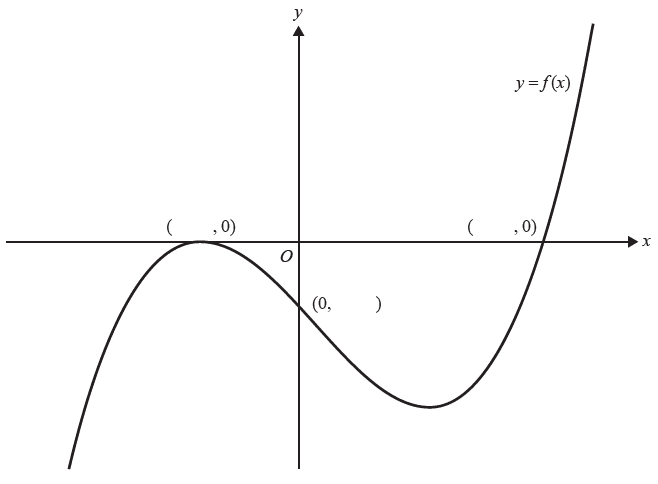
Let \( f : \mathbb{R} \rightarrow \mathbb{R}, f(x) = x^3 - x^2 - 16x - 20 \).
a. Verify that \( x = 5 \) is a solution of \( f(x) = 0 \). 1 mark
b. Express \( f(x) \) in the form \( (x+d)^2(x-5) \) where \( d \in \mathbb{R} \). 2 marks
c. Consider the graph of \( y = f(x) \), as shown below. Complete the coordinate pairs of all axial intercepts of \( y = f(x) \). 1 mark
d. Let \( g : \mathbb{R} \rightarrow \mathbb{R}, g(x) = x + 2 \).
i. State the coordinates of the stationary point of inflection for the graph of \( y = f(x)g(x) \). 1 mark
ii. Write down the values of \( x \) for which \( f(x)g(x) \ge 0 \). 1 mark
End of examination questions
VCE is a registered trademark of the VCAA. The VCAA does not endorse or make any warranties regarding this study resource. Past VCE exams and related content can be accessed directly at www.vcaa.vic.edu.au