2025 VCAA Maths Methods Exam 2
This is the full VCE Maths Methods Exam with worked solutions. You can also try Mini-Tests, which are official VCAA exams split into short tests you can do anytime.
Number of marks: 80
Reading time: 15 minutes
Writing time: 2 hours
Section A – Multiple-choice questions
Instructions
• Answer all questions in pencil on your Multiple-Choice Answer Sheet.
• Choose the response that is correct for the question.
• A correct answer scores 1; an incorrect answer scores 0.
• Marks will not be deducted for incorrect answers.
• No marks will be given if more than one answer is completed for any question.
• Unless otherwise indicated, the diagrams in this book are not drawn to scale.
A function that has a range of \([6, 12]\) is
- A. \(f:\mathbb{R}\rightarrow \mathbb{R}\), \(f(x)=6+3\cos(9x)\)
- B. \(f:\mathbb{R}\rightarrow \mathbb{R}\), \(f(x)=6+6\cos(3x)\)
- C. \(f:\mathbb{R}\rightarrow \mathbb{R}\), \(f(x)=9-3\cos(6x)\)
- D. \(f:\mathbb{R}\rightarrow \mathbb{R}\), \(f(x)=9-6\cos(3x)\)
All asymptotes of the graph of \(y=2\tan\left(\pi\left(x+\frac{1}{2}\right)\right)\) are given by
- A. \(x=k\), \(k\in \mathbb{Z}\)
- B. \(x=2k\), \(k\in \mathbb{Z}\)
- C. \(x=2k+1\), \(k\in \mathbb{Z}\)
- D. \(x=\frac{4k+1}{2}\), \(k\in \mathbb{Z}\)
The graph of \(y=f(x)\) is shown below.
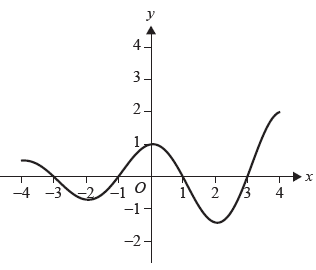
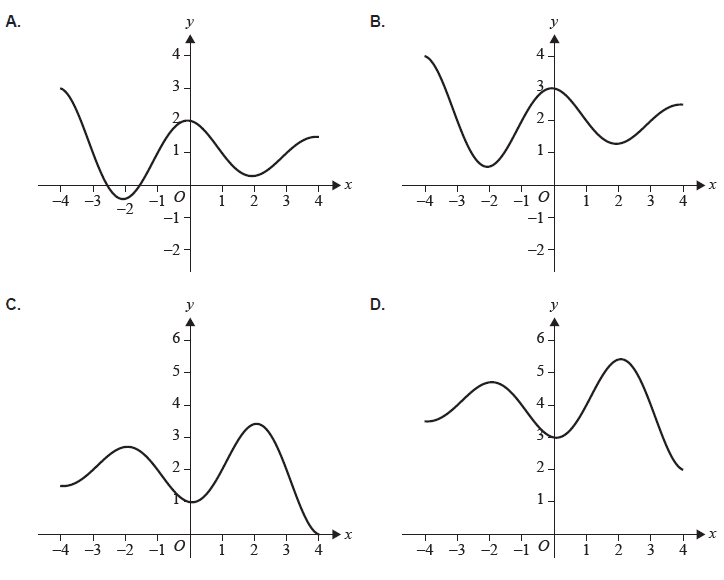
Which one of the following options best represents the graph of \(y=f(-x)+2\)?
Consider the system of equations below containing the parameter \(k\), where \(k\in \mathbb{R}\)
\(kx+3y=k^{2}\)
\(2x+(2k+1)y=6-2k\)
Find the value(s) of \(k\) for which this system has no real solutions.
- A. \(k=-2\) only
- B. \(k=\frac{3}{2}\) only
- C. \(k=-2\) or \(\frac{3}{2}\)
- D. \(k\in \mathbb{R}\backslash\{-2,\frac{3}{2}\}\)
Which of the following sets represents a function that has an inverse function?
- A. \(\{(1, 3), (2, 0), (2, 1)\}\)
- B. \(\{(-1, 3), (2, 2), (3, 1)\}\)
- C. \(\{(-1, 3), (0, 1), (1, 3)\}\)
- D. \(\{(1, 0), (2, 3), (1, 3)\}\)
The trapezium rule is used, with two trapeziums, to estimate the area bounded by the graph of \(y=f(x)\) the \(x\)-axis and the lines \(x=0\) and \(x=1\).
For which function will the trapezium rule estimate be larger than the exact area?
- A. \(f(x)=3-e^{x}\)
- B. \(f(x)=x^{3}+1\)
- C. \(f(x)=3\sin(x)+1\)
- D. \(f(x)=\log_{e}(x+3)\)
Consider the algorithm below.
In order, the values printed by the algorithm are
- A. 12
- B. 12, 7
- C. 12, 7, 2
- D. 12, 7, 2, \(-3\)
A random sample of \(n\) Victorian households is taken to estimate the proportion of all Victorian households that have vegetable gardens.
The approximate 95% confidence interval calculated using this sample is \((0.248, 0.552)\), correct to three decimal places.
The number of households, \(n\), in the sample is
- A. 10
- B. 28
- C. 40
- D. 49
One day, at a particular school, \(m\) students walked to school and the remaining \(n\) students travelled to school using a different form of transport.
Of the \(m\) students who walked, 20% took at least 30 minutes to get to school.
Of the \(n\) students who used a different form of transport, 40% took at least 30 minutes to get to school.
Given that a randomly selected student took at least 30 minutes to get to school, the probability that they walked to school is given by
- A. \(\frac{m}{m+2n}\)
- B. \(\frac{2n}{m+2n}\)
- C. \(\frac{m}{5(m+n)}\)
- D. \(\frac{1}{3}\)
Consider \(f:\mathbb{R}\rightarrow \mathbb{R}\), \(f(x)=2x^{2}+x-1\) and \(g:\mathbb{R}\rightarrow \mathbb{R}\), \(g(x)=\sin(x)\).
The inequality \((f\circ g)(x)>0\) is satisfied when
- A. \(\sin(x)\le-1\)
- B. \(-1<\sin(x)<0\)
- C. \(\frac{1}{2}<\sin(x)\le1\)
- D. \(0<\sin(x)<\frac{1}{2}\)
The chart below shows the daily price of a stock market share over a 30-day period.
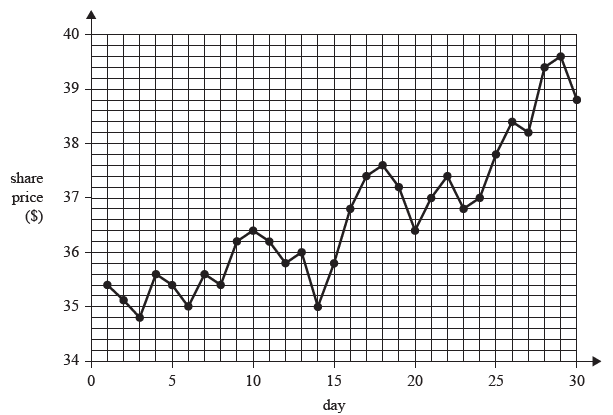
Over which of the following time intervals did the daily price undergo the greatest average rate of change?
- A. day 3 to day 10
- B. day 3 to day 17
- C. day 14 to day 21
- D. day 14 to day 28
For a normal random variable \(X\), it is known that \(\Pr(X>200)=0.325\) and \(\Pr(180<X<200)=0.589\).
The mean and standard deviation of \(X\) are closest to
- A. 190 and 10
- B. 190 and 11
- C. 195 and 10
- D. 195 and 11
The graphs of \(y=f(x)\) and \(y=g(x)\) are sketched on the same set of axes below.
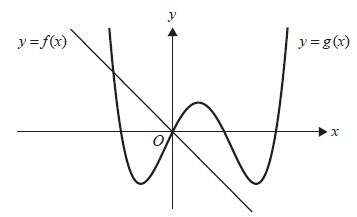
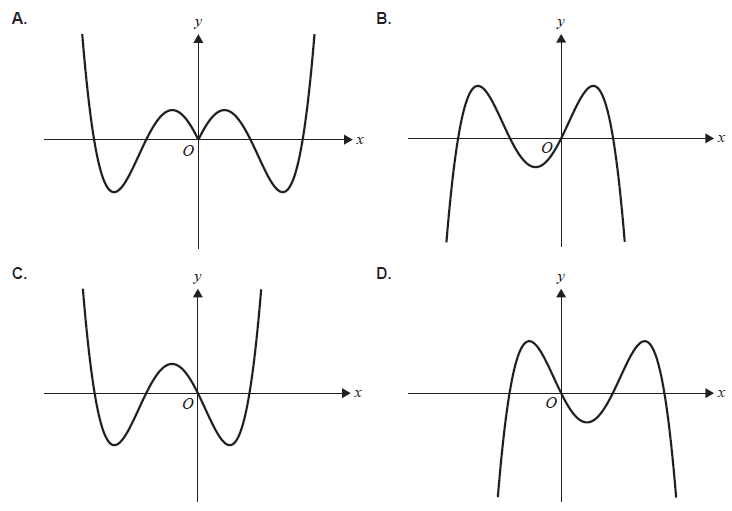
Which of the following could be the graph of \(y=(g\circ f)(x)\)?
Let \(f\) be the probability density function for a continuous random variable \(X\), where
\[ f(x) = \begin{cases} k\sin(x) & 0 \le x < \frac{\pi}{4} \\ k\cos(x) & \frac{\pi}{4} \le x \le \frac{\pi}{2} \\ 0 & \text{otherwise} \end{cases} \]
and \(k\) is a positive real number.
The value of \(k\) is
- A. \(\frac{1}{\sqrt{2}}\)
- B. \(\frac{1}{2-\sqrt{2}}\)
- C. \(\sqrt{2}+2\)
- D. \(2-\sqrt{2}\)
The graph of \(y=g(x)\) passes through the point \((1, 3)\).
The graph of \(y=1-g(2x-3)\) must pass through the point
- A. \((-1,-2)\)
- B. \((2,-2)\)
- C. \((-1,2)\)
- D. \((2,2)\)
Consider the function \(h(x)=a\log_{e}(bx)\), where \(a, b\in \mathbb{R}\backslash\{0\}\).
Given that its derivative \(h^{\prime}(x)\) has range \((0,\infty)\), which of the following must be true?
- A. \(a>0\) only
- B. \(a>0\) and \(b<0\)
- C. \(a>0\) and \(b>0\)
- D. \(ab>0\)
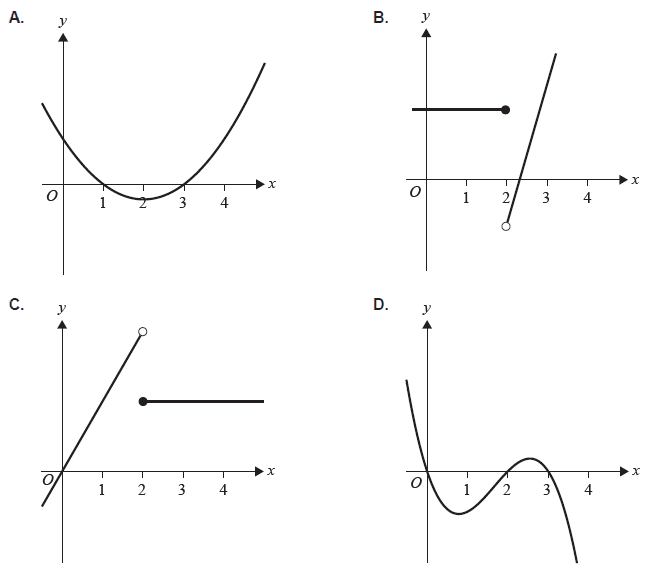
Given that \(f:\mathbb{R}\rightarrow \mathbb{R}\) satisfies
\(\int_{1}^{2}f(x)dx>\int_{1}^{3}f(x)dx\)
the graph of \(y=f(x)\) could be
Consider the following graphs, which represent probability mass functions.
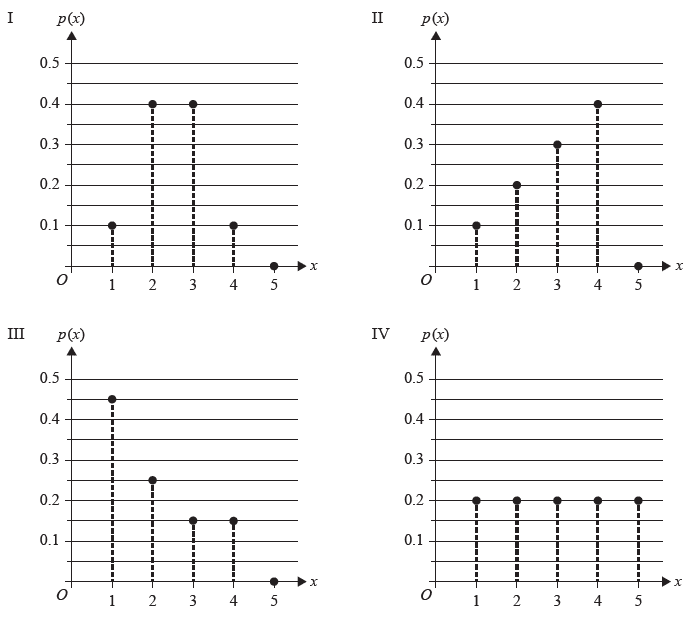
Which pair of these probability mass functions has the same mean?
- A. I and II
- B. I and IV
- C. II and III
- D. II and IV
Let \(A\) be a point on the line \(y = x + c\) and \(B\) be a point on the curve \(y = \log_{e}(x-1)\).
If \(A\) and \(B\) are placed such that the line segment \(AB\) has the minimum possible length, and this length is \(\sqrt{2}\), the value of \(c\) must be
- A. \(\sqrt{2}-2\)
- B. \(\sqrt{2}\)
- C. \(1\)
- D. \(0\)
Let \(a > 1\), and consider the functions \(f\) and \(g\) defined below.
\(f:\mathbb{R} \rightarrow \mathbb{R}, \quad f(x)=a^{x}\)
\(g:\mathbb{R} \rightarrow \mathbb{R}, \quad g(x)=a^{2x+2}\)
Which one of the following sequences of transformations, when applied to \(f(x)\), does not produce \(g(x)\)?
- A. dilation by a factor of \(\frac{1}{2}\) from the \(y\)-axis, then translation by 1 unit in the negative direction of the \(x\)-axis
- B. dilation by a factor of \(\frac{1}{2}\) from the \(y\)-axis, then dilation by a factor of \(a^{2}\) from the \(x\)-axis
- C. dilation by a factor of \(a\) from the \(x\)-axis, then dilation by a factor of \(\frac{1}{2}\) from the \(y\)-axis, then translation by 1 unit in the positive direction of the \(x\)-axis
- D. dilation by a factor of \(a^{3}\) from the \(x\)-axis, then translation by 1 unit in the positive direction of the \(x\)-axis, then dilation by a factor of \(\frac{1}{2}\) from the \(y\)-axis
End of Section A
Section B
Instructions
• Answer all questions in the spaces provided.
• Write your responses in English.
• In questions where a numerical answer is required, an exact value must be given unless otherwise specified.
• In questions where more than one mark is available, appropriate working must be shown.
• Unless otherwise indicated, the diagrams in this book are not drawn to scale.
Let \( g : \mathbb{R} \rightarrow \mathbb{R} \) be defined by \( g(x) = 4x^3 - 3x^4 \).
a. Find the coordinates of both stationary points of \( g \). 2 marks
b. Sketch the graph of \( y = g(x) \) on the axes below, labelling the stationary points and axial intercepts with their coordinates. 2 marks
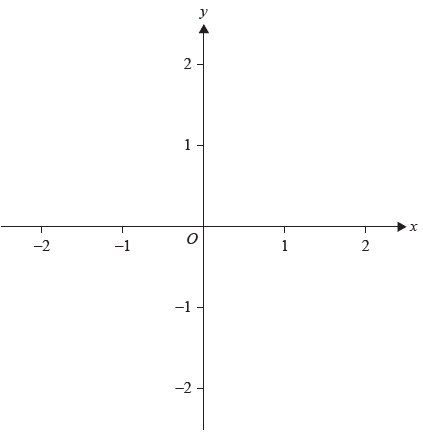
c. Complete the following gradient table with appropriate values of \( x \) and \( g'(x) \) to show that \( g \) has a stationary point of inflection. 2 marks

d. Find the average value of \( g \) between \( x = 0 \) and \( x = 2 \). 2 marks
e. Let \( h \) be the result after applying a sequence of transformations to \( g \), such that \( h \) has a stationary point of inflection at \( (1, 0) \) and a local maximum at \( (-1, 1) \). Write down a possible sequence of three transformations to map from \( g \) to \( h \). 3 marks
1.
2.
3.
f. Let \( X \sim \text{Bi}(4, p) \) be a binomial random variable. Show that \( \Pr(X \ge 3) = g(p) \) for all \( p \in [0, 1] \). 2 marks
Let \( f : \mathbb{R} \rightarrow \mathbb{R}, f(x) = \frac{x}{2}+7 \) and \( g : \mathbb{R} \rightarrow \mathbb{R}, g(x) = A e^{kx} \), where \( A, k \in \mathbb{R} \).
The graphs of \( y = f(x) \) and \( y = g(x) \) intersect at the points \( (-12, 1) \) and \( (2, 8) \), as shown below.
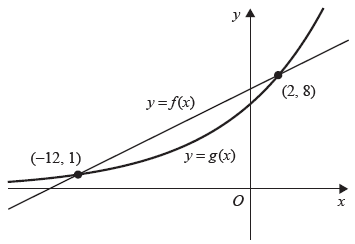
a. Write down two simultaneous equations in terms of \( A \) and \( k \). Solve them, using algebra, to show that \(A = 2^{\frac{18}{7}}\) and \( k = \frac{3}{14} \log_e(2) \). 3 marks
b. Find the value of \( b \), where \( b \in \mathbb{R} \), such that \( g(x) \) can be expressed in the form \( g(x) = A \times 2^{bx} \). 1 mark
c. Use a definite integral to evaluate the area bounded by the graphs of \( y = f(x) \) and \( y = g(x) \), where \( x \in [-12, 2] \). Give the area correct to two decimal places. 2 marks
d. Let \( h(x) = f(x) - g(x) \).
i. Write down an expression for the derivative of \( h(x) \). 1 mark
d. ii. Find the maximum value of \( h(x) \), where \( x \in [-12, 2] \). Give your answer correct to two decimal places. (1 mark)
e. Let \(g^{-1}\) be the inverse of \(g\).
Find the points where the graph of \(y = g^{-1}(x)\) intersects with the graph of \(y = 2(x - 7)\). 2 marks
f. Let \(F\) be an anti-derivative of \(f\) that passes through \((0, c)\), where \(c \in \mathbb{R}\).
i. Show that it is not possible for the graph of \(y = F(x)\) to pass through both \((-12, 1)\) and \((2, 8)\). 2 marks
ii. The graph of \(y = F(x)\) can be dilated by a factor of \(m\) from the \(x\)-axis such that its image passes through both \((-12, 1)\) and \((2, 8)\).
Find the values of \(m\) and \(c\). 2 marks
(14 marks)
The time taken for a driver to travel to work each day, in minutes, is modelled by a continuous random variable \(T\) with probability density function
\[ f(t) = \begin{cases} \dfrac{12}{1215000}(t - 29)(59 - t)^3 & 29 \leq t \leq 59 \\ 0 & \text{otherwise} \end{cases} \]
a.
i. Find the mean time taken, in minutes, for the driver to travel to work each day. 1 mark
ii. Find the standard deviation of the time taken, in minutes, for the driver to travel to work each day. 2 marks
b. The driver allows \(k\) minutes to travel to work each day. If the journey takes longer than \(k\) minutes, the driver will be late. Whether the driver is late on a particular day is independent of whether they are late on any other day.
i. If \(k = 47\), write a definite integral to show that the probability of the driver being late is 0.08704. 1 mark
ii. If \(k = 47\), find the probability that the driver will be late on at least one day in a five-day working week. Give your answer correct to four decimal places. 2 marks
iii. For \(k = 47\), let \( \hat{P} \) be the proportion of days the driver is late in any five-day working week. Find \(\Pr(0.4 \leq \hat{P} \leq 0.6)\) correct to four decimal places. 2 marks
iv. Find the integer \(k\) such that the probability, correct to one decimal place, of the driver being late at least once in any five-day working week is 0.2. 2 marks
c. At a given traffic light, the wait time is modelled by a normal distribution with a mean of 2.5 minutes and a standard deviation of \(\sigma\) minutes.
i. If \(\sigma = 0.6\), find the probability that the wait time will be less than 3.5 minutes. Give your answer correct to two decimal places. 1 mark
ii. Find the value of \(\sigma\) such that there is a 2% chance of a wait time longer than 3.5 minutes. Give your answer correct to two decimal places. 1 mark
d. The driver passes through three traffic lights (\(A\), \(B\) and \(C\)) on their journey to work.
The probability of each traffic light being red is shown in the table below.

Let \(Y\) be the random variable representing the number of traffic lights that are red on the driver's journey to work. Assume that each traffic light being red is independent of any other traffic light being red.
Complete the following table for the probability distribution of \(Y\). 2 marks

(19 marks)
Consider the function \(f : \left[0, \dfrac{5\pi}{2}\right] \rightarrow \mathbb{R}\), \(f(x) = \sin(x) + 1\).
The graph of \(y = f(x)\) is shown below.
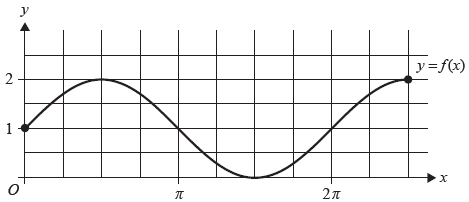
a. Evaluate \(f\left(\dfrac{2\pi}{3}\right)\). 1 mark
b. Find the exact values of \(x\) for which \(f(x) = \dfrac{3}{2}\). 1 mark
c. There exist real numbers \(a\) and \(k\) in the interval \(\left[0, \dfrac{5\pi}{2}\right]\), such that \(f(x+k) = f(x)\) for all \(x \in [0, a]\). Find the value of \(k\) and the largest possible value of \(a\). 2 marks
d. Consider the tangent to the graph of \(y = f(x)\) at the point \(A\), where \(x = \dfrac{2\pi}{3}\), as shown on the axes below.
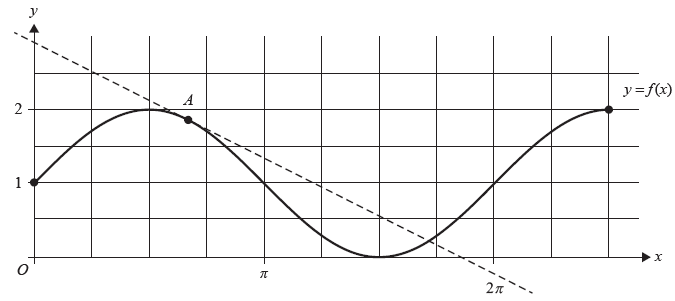
Find the equation of the tangent to the graph of \(y = f(x)\) at the point where \(x = \dfrac{2\pi}{3}\). 1 mark
e. Apply two iterations of Newton's method to \(f\) with \(x_0 = \dfrac{2\pi}{3}\).
i. Write down \(x_2\), correct to one decimal place. 1 mark
ii. On the axes in part d, draw the tangent to the graph of \(y = f(x)\) at the point where \(x = x_1\). 1 mark
(Answer on the graph in part d.)
f. Now consider the line \(y = t(x)\), which is the tangent to the graph of \(y = f(x)\) at the point \(\left(p, f(p)\right)\), where \(p \in \left(0, \dfrac{5\pi}{2}\right)\).
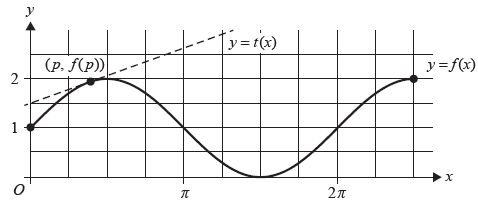
i. Show that \(t(x) = \cos(p)(x - p) + \sin(p) + 1\). 2 marks
ii. Determine the minimum and maximum possible values for the \(y\)-intercept of \(y = t(x)\), for \(p \in \left(0, \dfrac{5\pi}{2}\right)\). 2 marks
iii. Determine the values of \(p\) for which \(y = t(x)\) has a unique \(x\)-intercept that is equal to the \(x\)-intercept of \(y = f(x)\). Give your answers correct to two decimal places. 2 marks
g. Let \(g : \left[0, \frac{5\pi}{2}\right] \rightarrow \mathbb{R}\), \(g(x) = ax^3 + bx^2 + cx + d\) be a polynomial function, where \(a, b, c, d \in \mathbb{R}\).
Suppose \(g(f(0)) = 0\) and \(g'(f(0)) = 0\).
i. Show that \(c = 1\) and \(d = 1\). 2 marks
ii. If \(g(2\pi) = f(2\pi)\) and \(g'(2\pi) = f'(2\pi)\), determine the area bounded by the graphs of \(y = f(x)\) and \(y = g(x)\), for \(x \in [0, 2\pi]\). Give your answer correct to two decimal places. 2 marks
iii. Let \(a = 0\), \(c = 1\), \(d = 1\). Find \(b\) and \(r\), such that \(g(r) = f(r)\) and \(g'(r) = f'(r)\), where \(b \in \mathbb{R}\) and \(r \in \left(0, \dfrac{5\pi}{2}\right)\). 2 marks
End of examination questions
VCE is a registered trademark of the VCAA. The VCAA does not endorse or make any warranties regarding this study resource. Past VCE exams and related content can be accessed directly at www.vcaa.vic.edu.au