2025 VCE Maths Methods Mini Test 8
Number of marks: 19
Reading time: 3 minutes
Writing time: 29 minutes
Section B – Calculator Allowed
Instructions
• Answer all questions in the spaces provided.
• Write your responses in English.
• In questions where a numerical answer is required, an exact value must be given unless otherwise specified.
• In questions where more than one mark is available, appropriate working must be shown.
• Unless otherwise indicated, the diagrams in this book are not drawn to scale.
(19 marks)
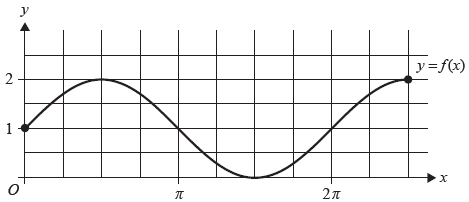
Consider the function \(f : \left[0, \dfrac{5\pi}{2}\right] \rightarrow \mathbb{R}\), \(f(x) = \sin(x) + 1\).
The graph of \(y = f(x)\) is shown below.
a. Evaluate \(f\left(\dfrac{2\pi}{3}\right)\). 1 mark
b. Find the exact values of \(x\) for which \(f(x) = \dfrac{3}{2}\). 1 mark
c. There exist real numbers \(a\) and \(k\) in the interval \(\left[0, \dfrac{5\pi}{2}\right]\), such that \(f(x+k) = f(x)\) for all \(x \in [0, a]\). Find the value of \(k\) and the largest possible value of \(a\). 2 marks
d. Consider the tangent to the graph of \(y = f(x)\) at the point \(A\), where \(x = \dfrac{2\pi}{3}\), as shown on the axes below.
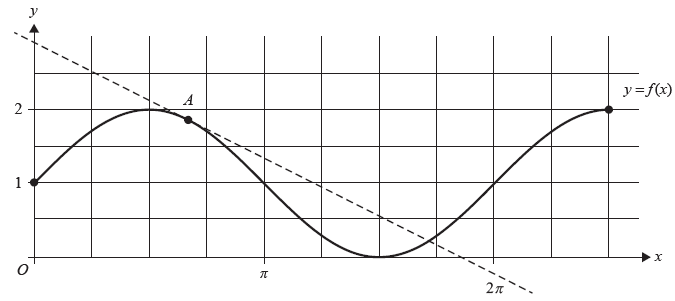
Find the equation of the tangent to the graph of \(y = f(x)\) at the point where \(x = \dfrac{2\pi}{3}\). 1 mark
e. Apply two iterations of Newton's method to \(f\) with \(x_0 = \dfrac{2\pi}{3}\).
i. Write down \(x_2\), correct to one decimal place. 1 mark
ii. On the axes in part d, draw the tangent to the graph of \(y = f(x)\) at the point where \(x = x_1\). 1 mark
(Answer on the graph in part d.)
f. Now consider the line \(y = t(x)\), which is the tangent to the graph of \(y = f(x)\) at the point \(\left(p, f(p)\right)\), where \(p \in \left(0, \dfrac{5\pi}{2}\right)\).
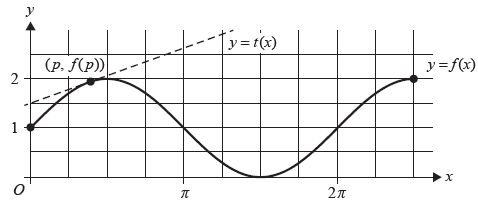
i. Show that \(t(x) = \cos(p)(x - p) + \sin(p) + 1\). 2 marks
ii. Determine the minimum and maximum possible values for the \(y\)-intercept of \(y = t(x)\), for \(p \in \left(0, \dfrac{5\pi}{2}\right)\). 2 marks
iii. Determine the values of \(p\) for which \(y = t(x)\) has a unique \(x\)-intercept that is equal to the \(x\)-intercept of \(y = f(x)\). Give your answers correct to two decimal places. 2 marks
g. Let \(g : \left[0, \frac{5\pi}{2}\right] \rightarrow \mathbb{R}\), \(g(x) = ax^3 + bx^2 + cx + d\) be a polynomial function, where \(a, b, c, d \in \mathbb{R}\).
Suppose \(g(f(0)) = 0\) and \(g'(f(0)) = 0\).
i. Show that \(c = 1\) and \(d = 1\). 2 marks
ii. If \(g(2\pi) = f(2\pi)\) and \(g'(2\pi) = f'(2\pi)\), determine the area bounded by the graphs of \(y = f(x)\) and \(y = g(x)\), for \(x \in [0, 2\pi]\). Give your answer correct to two decimal places. 2 marks
iii. Let \(a = 0\), \(c = 1\), \(d = 1\). Find \(b\) and \(r\), such that \(g(r) = f(r)\) and \(g'(r) = f'(r)\), where \(b \in \mathbb{R}\) and \(r \in \left(0, \dfrac{5\pi}{2}\right)\). 2 marks
End of examination questions
VCE is a registered trademark of the VCAA. The VCAA does not endorse or make any warranties regarding this study resource. Past VCE exams and related content can be accessed directly at www.vcaa.vic.edu.au