2025 VCE Maths Methods Mini Test 5
Number of marks: 10
Reading time: 2 minutes
Writing time: 15 minutes
Section A – Calculator Allowed
Instructions
• Answer all questions in pencil on your Multiple-Choice Answer Sheet.
• Choose the response that is correct for the question.
• A correct answer scores 1; an incorrect answer scores 0.
• Marks will not be deducted for incorrect answers.
• No marks will be given if more than one answer is completed for any question.
• Unless otherwise indicated, the diagrams in this book are not drawn to scale.
Consider \(f:\mathbb{R}\rightarrow \mathbb{R}\), \(f(x)=2x^{2}+x-1\) and \(g:\mathbb{R}\rightarrow \mathbb{R}\), \(g(x)=\sin(x)\).
The inequality \((f\circ g)(x)>0\) is satisfied when
- A. \(\sin(x)\le-1\)
- B. \(-1<\sin(x)<0\)
- C. \(\frac{1}{2}<\sin(x)\le1\)
- D. \(0<\sin(x)<\frac{1}{2}\)
The chart below shows the daily price of a stock market share over a 30-day period.
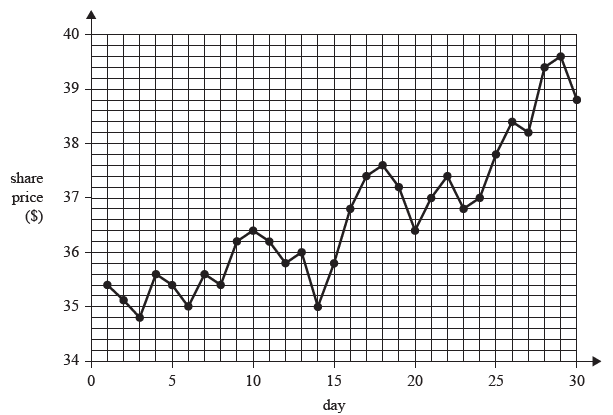
Over which of the following time intervals did the daily price undergo the greatest average rate of change?
- A. day 3 to day 10
- B. day 3 to day 17
- C. day 14 to day 21
- D. day 14 to day 28
For a normal random variable \(X\), it is known that \(\Pr(X>200)=0.325\) and \(\Pr(180<X<200)=0.589\).
The mean and standard deviation of \(X\) are closest to
- A. 190 and 10
- B. 190 and 11
- C. 195 and 10
- D. 195 and 11
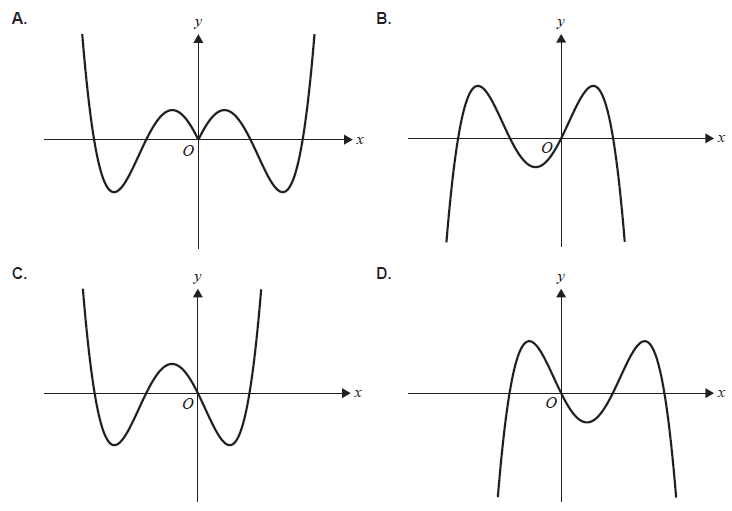
The graphs of \(y=f(x)\) and \(y=g(x)\) are sketched on the same set of axes below.
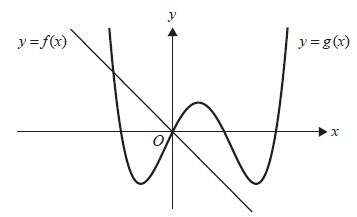
Which of the following could be the graph of \(y=(g\circ f)(x)\)?
Let \(f\) be the probability density function for a continuous random variable \(X\), where
\[ f(x) = \begin{cases} k\sin(x) & 0 \le x < \frac{\pi}{4} \\ k\cos(x) & \frac{\pi}{4} \le x \le \frac{\pi}{2} \\ 0 & \text{otherwise} \end{cases} \]
and \(k\) is a positive real number.
The value of \(k\) is
- A. \(\frac{1}{\sqrt{2}}\)
- B. \(\frac{1}{2-\sqrt{2}}\)
- C. \(\sqrt{2}+2\)
- D. \(2-\sqrt{2}\)
The graph of \(y=g(x)\) passes through the point \((1, 3)\).
The graph of \(y=1-g(2x-3)\) must pass through the point
- A. \((-1,-2)\)
- B. \((2,-2)\)
- C. \((-1,2)\)
- D. \((2,2)\)
End of Section A
Section B – No Calculator
Instructions
• Answer all questions in the spaces provided.
• Write your responses in English.
• In questions where a numerical answer is required, an exact value must be given unless otherwise specified.
• In questions where more than one mark is available, appropriate working must be shown.
• Unless otherwise indicated, the diagrams in this book are not drawn to scale.
The probability distribution for the discrete random variable \( X \) is given in the table below, where \( k \) is a positive real number.
| \( X \) | 0 | 1 | 2 | 3 |
|---|---|---|---|---|
| \( \Pr(X=x) \) | \( \frac{4}{k} \) | \( \frac{2k}{75} \) | \( \frac{k}{75} \) | \( \frac{2}{k} \) |
a. Show that \( k = 10 \) or \( k = 15 \). 2 marks
b. Let \( k = 15 \).
i. Find \( \Pr(X > 1) \). 1 mark
ii. Find \( E(X) \). 1 mark
End of examination questions
VCE is a registered trademark of the VCAA. The VCAA does not endorse or make any warranties regarding this study resource. Past VCE exams and related content can be accessed directly at www.vcaa.vic.edu.au