2025 VCE Maths Methods Mini Test 3
Number of marks: 10
Reading time: 2 minutes
Writing time: 15 minutes
Section A – Calculator Allowed
Instructions
• Answer all questions in pencil on your Multiple-Choice Answer Sheet.
• Choose the response that is correct for the question.
• A correct answer scores 1; an incorrect answer scores 0.
• Marks will not be deducted for incorrect answers.
• No marks will be given if more than one answer is completed for any question.
• Unless otherwise indicated, the diagrams in this book are not drawn to scale.
The trapezium rule is used, with two trapeziums, to estimate the area bounded by the graph of \(y=f(x)\) the \(x\)-axis and the lines \(x=0\) and \(x=1\).
For which function will the trapezium rule estimate be larger than the exact area?
- A. \(f(x)=3-e^{x}\)
- B. \(f(x)=x^{3}+1\)
- C. \(f(x)=3\sin(x)+1\)
- D. \(f(x)=\log_{e}(x+3)\)
Consider the algorithm below.
In order, the values printed by the algorithm are
- A. 12
- B. 12, 7
- C. 12, 7, 2
- D. 12, 7, 2, \(-3\)
A random sample of \(n\) Victorian households is taken to estimate the proportion of all Victorian households that have vegetable gardens.
The approximate 95% confidence interval calculated using this sample is \((0.248, 0.552)\), correct to three decimal places.
The number of households, \(n\), in the sample is
- A. 10
- B. 28
- C. 40
- D. 49
One day, at a particular school, \(m\) students walked to school and the remaining \(n\) students travelled to school using a different form of transport.
Of the \(m\) students who walked, 20% took at least 30 minutes to get to school.
Of the \(n\) students who used a different form of transport, 40% took at least 30 minutes to get to school.
Given that a randomly selected student took at least 30 minutes to get to school, the probability that they walked to school is given by
- A. \(\frac{m}{m+2n}\)
- B. \(\frac{2n}{m+2n}\)
- C. \(\frac{m}{5(m+n)}\)
- D. \(\frac{1}{3}\)
End of Section A
Section B – No Calculator
Instructions
• Answer all questions in the spaces provided.
• Write your responses in English.
• In questions where a numerical answer is required, an exact value must be given unless otherwise specified.
• In questions where more than one mark is available, appropriate working must be shown.
• Unless otherwise indicated, the diagrams in this book are not drawn to scale.
Let \( f : [0, 2\pi] \rightarrow \mathbb{R}, f(x) = 2 \cos(2x) + 1 \).
a. State the range of \( f \). 1 mark
b. Solve \( f(x) = 0 \) for \( x \). 3 marks
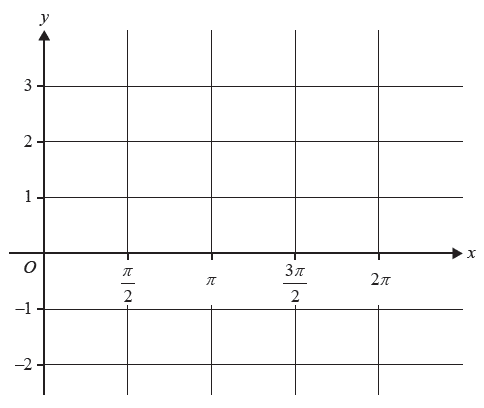
c. Sketch the graph of \( y = f(x) \) for \( x \in \left[\frac{\pi}{2}, \frac{3\pi}{2}\right] \) on the axes below. Label the endpoints with their coordinates. 2 marks
End of examination questions
VCE is a registered trademark of the VCAA. The VCAA does not endorse or make any warranties regarding this study resource. Past VCE exams and related content can be accessed directly at www.vcaa.vic.edu.au