WACE Maths Methods ATAR Section 2 Topic Tests
Normal Distribution Test 1
Section Two: Technology-active
Number of marks: 12
Reading time: 1 minute
Writing time: 12 minutes
Section Two:
Answer all questions. Write your answers in the spaces provided.
Supplementary pages for planning/continuing your answers to questions are provided at the end of this Question/Answer booklet. If you use these pages to continue an answer, indicate at the original answer where the answer is continued, i.e. give the page number.
Brianna is considering buying an electric vehicle from Zaprer Motors. The manufacturer claims that, on average, a driver will be able to travel 350 km before needing to recharge the vehicle, and that the probability of travelling more than 400 km before needing to recharge is 0.2525.
Let \(X\) denote the distance, in kilometres, that a Zaprer Motors vehicle will travel before needing to recharge. Assume that \(X\) is a normally distributed random variable.
(a) Determine the standard deviation of \(X\). (2 marks)
Brianna will need to travel regularly to Albany, which is 420 km from her house.
(b) Calculate the probability that on any given day she will be able to drive to Albany without recharging the vehicle. (1 mark)
Matthew is interested in buying the same type of electric vehicle, but as he lives in England he would like to consider distances in miles (1 mile = 1.6 kilometres).
Let \(Y\) be a random variable that denotes the distance, in miles, that a Zaprer Motors vehicle will travel before needing to recharge.
(c) Determine the expected value and variance of \(Y\). (3 marks)
Brianna decides to consider an electric vehicle from a rival company, Spruky Cars, that show her the histogram below, based on 200 trials of its electric vehicle.

Let \(W\) be a random variable that denotes the distance, in kilometres, that a Spruky Cars vehicle will travel before needing to recharge.
(d) On the basis of the histogram, is it appropriate to use a normal distribution to model the distance a Spruky Cars vehicle will travel between recharges? Justify your answer. (2 marks)
(e) Assuming the distances are uniformly distributed within each interval, use the histogram to estimate the expected distance that a Spruky Cars vehicle will be able to travel before needing to recharge. (2 marks)
(f) In which company's vehicle (Zaprer or Spruky) would Brianna be more likely to drive to Albany without recharging? Justify your answer. (2 marks)
End of questions
Normal Distribution Topic Test 2
Section Two: Technology-active
Number of marks: 19
Reading time: 2 minutes
Writing time: 19 minutes
Section Two:
Answer all questions. Write your answers in the spaces provided.
Supplementary pages for planning/continuing your answers to questions are provided at the end of this Question/Answer booklet. If you use these pages to continue an answer, indicate at the original answer where the answer is continued, i.e. give the page number.
The manager of the mail distribution centre in an organisation estimates that the weight, \(x\) (kg), of parcels that are posted is normally distributed, with mean 3 kg and standard deviation 1 kg.
(a) What percentage of parcels weigh more than 3.7 kg? (2 marks)
(b) Twenty parcels are received for posting. What is the probability that at least half of them weigh more than 3.7 kg? (3 marks)
The cost of postage, ($) \(y\), depends on the weight of a parcel as follows:
- a cost of $5 for parcels 1 kg or less
- an additional variable cost of $1.50 for every kilogram or part thereof above 1 kg to a maximum of 4 kg
- a cost of $12 for parcels above 4 kg.
(c) Complete the probability distribution table for \(Y\). (4 marks)
| \(x\) | \(\le 1\) | \(1 < x \le 2\) | \(2 < x \le 3\) | \(3 < x \le 4\) | \(x > 4\) |
|---|---|---|---|---|---|
| \(y\) | $5 | ||||
| \(P(Y=y)\) |
(d) Calculate the mean cost of postage per parcel. (2 marks)
(e) Calculate the standard deviation of the cost of postage per parcel. (3 marks)
(f) If the cost of postage is increased by 20% and a surcharge of $1 is added for all parcels, what will be the mean and standard deviation of the new cost? (3 marks)
(g) Show one reason why the given normal distribution is not a good model for the weight of the parcels. (2 marks)
End of questions
Normal Distribution Topic Test 3
Section Two: Technology-active
Number of marks: 15
Reading time: 1 minute
Writing time: 15 minutes
Section Two:
Answer all questions. Write your answers in the spaces provided.
Supplementary pages for planning/continuing your answers to questions are provided at the end of this Question/Answer booklet. If you use these pages to continue an answer, indicate at the original answer where the answer is continued, i.e. give the page number.
A large refrigerator in a scientific laboratory is always required to maintain a temperature between 0 °C and 1 °C to preserve the integrity of biological samples stored inside. A scientist working in the laboratory suspects that the refrigerator is not maintaining the required temperature and decides to record the temperature every hour for seven days. Based on these measurements, the scientist concludes that the temperature, \(T\), in the refrigerator is normally distributed with a mean of 0.8 °C and a standard deviation of 0.4 °C.
(a) Temperature in degrees Fahrenheit, \(T_F\), is given by \(T_F = \frac{9}{5}T + 32\). Determine the mean and standard deviation of the refrigerator temperature in degrees Fahrenheit. (2 marks)
(b) Determine the probability that the refrigerator temperature is above 1 °C. Give your answer rounded to four decimal places. (1 mark)
The histogram of data gathered by the scientist is shown below. \(N\) denotes the number of observations in each temperature interval.
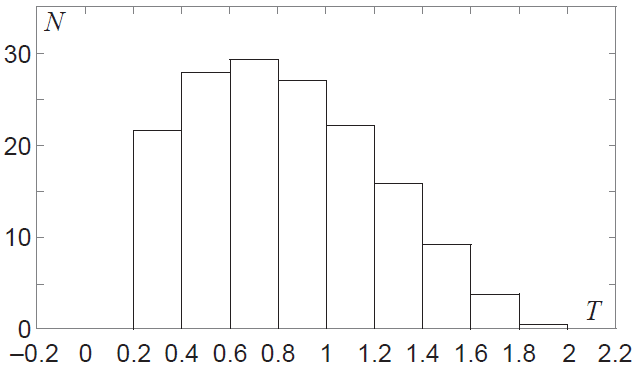
(c) Do you agree that the normal distribution was an appropriate model to use? Provide a reason to justify your response. (2 marks)
An alternative probability density function proposed to model the refrigerator temperature, in degrees Celcius, is given by:
\[ p(t) = \frac{3}{4}t^3 - 3t^2 + 3t, \quad 0 \le t \le 2 \]
(d) Determine the probability that the refrigerator temperature is above 1 °C using the new model. (2 marks)
The weight, \(X\), of chicken eggs from a farm is normally distributed with mean 60 g and standard deviation 5 g. Eggs with a weight of more than 67 g are classed as 'jumbo'.
(a) What proportion of eggs from the farm are 'jumbo'? (2 marks)
(b) What proportion of 'jumbo' eggs are less than 75 g in weight? (3 marks)
(c) The heaviest 0.05% of eggs fetch a higher price. What is the minimum weight of these eggs? (2 marks)
End of questions
Normal Distribution Topic Test 4
Section Two: Technology-active
Number of marks: 14
Reading time: 1 minute
Writing time: 14 minutes
Section Two:
Answer all questions. Write your answers in the spaces provided.
Supplementary pages for planning/continuing your answers to questions are provided at the end of this Question/Answer booklet. If you use these pages to continue an answer, indicate at the original answer where the answer is continued, i.e. give the page number.
The weights \(W\) (in grams) of carrots sold at a supermarket have been found to be normally distributed with a mean of 142.8 g and a standard deviation of 30.6 g.
(a) Determine the percentage of carrots sold at the supermarket that weigh more than 155 g. (2 marks)
Carrots sold at the supermarket are classified by weight, as shown in the table below.
| Classification | Small | Medium | Large | Extra large |
|---|---|---|---|---|
| Weight \(W\) (grams) | \(W \le 110\) | \(110 < W \le 155\) | \(155 < W \le 210\) | \(W > 210\) |
| \(P(W)\) | 0.5131 | 0.3310 |
(b) Complete the table above, providing the missing probabilities. (2 marks)
(c) Of the carrots being sold at the supermarket that are not of medium weight, what proportion is small? (2 marks)
The supermarket sells bags of mixed-weight carrots, with 12 randomly-selected carrots placed in each bag.
(d) If a customer purchases a bag of mixed-weight carrots, determine the probability that there will be at most two small carrots in the bag. (3 marks)
The weight, \(X\), of chicken eggs from a farm is normally distributed with mean 60 g and standard deviation 5 g. Eggs with a weight of more than 67 g are classed as 'jumbo'.
(a) What proportion of eggs from the farm are 'jumbo'? (2 marks)
(b) What proportion of 'jumbo' eggs are less than 75 g in weight? (3 marks)
(c) The heaviest 0.05% of eggs fetch a higher price. What is the minimum weight of these eggs? (2 marks)
End of questions
Normal Distribution Topic Test 5
Section Two: Technology-active
Number of marks: 11
Reading time: 1 minute
Writing time: 11 minutes
Section Two:
Answer all questions. Write your answers in the spaces provided.
Supplementary pages for planning/continuing your answers to questions are provided at the end of this Question/Answer booklet. If you use these pages to continue an answer, indicate at the original answer where the answer is continued, i.e. give the page number.
A small dam on an agricultural property has a length of 20 m, and a uniform cross-section shown below where \(x\) and \(y\) are in metres. The base of the dam is flat for \(0 \le x \le 5\), and the right side is given by \(y = \frac{(x-5)^2}{4}\) for \(5 < x \le 11.325\). The shaded region on the graph below represents the cross-section of a volume of water \(V\) (m\(^3\)) in the dam with water level \(h\) (m).
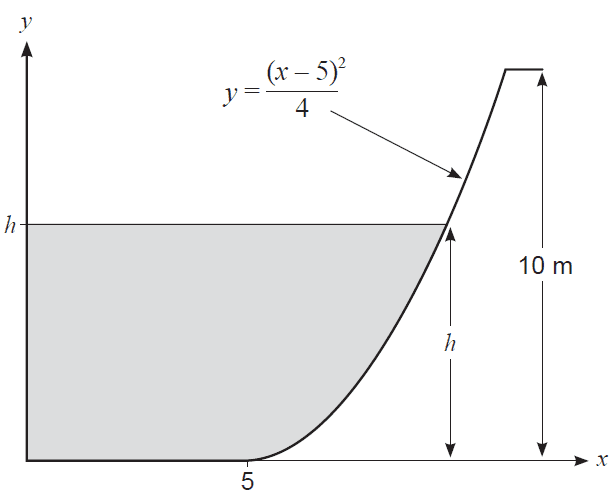
(a) Using calculus, show that the volume of water in the dam is given by \[ V(h) = 100h + \frac{80}{3}h^{\frac{3}{2}} \] (5 marks)
(b) Use the increments formula to estimate the change in water volume if the water level rises from 6 m to 6.1 m. (3 marks)
Suppose the water volume at the start of winter is 1000 m\(^3\). On the basis of rainfall data from previous years, the volume of water \(V_R\) (m\(^3\)) that will flow into the dam over winter is normally distributed with a mean of 600 m\(^3\) and a standard deviation of 200 m\(^3\).
(c) Assuming that there are no other sources of water and no losses, determine the probability that the dam will reach full capacity (i.e. depth of 10 m) during winter. (3 marks)
End of questions