QCAA Maths Methods 2022 Exam 1 with solutions
Number of marks: 55
Perusal time: 5 minute
Writing time: 90 minutes
Section 1
Instructions
• This section has 10 questions and is worth 10 marks.
• Use a 2B pencil to fill in the A, B, C or D answer bubble completely.
• Choose the best answer for Questions 1 10.
• If you change your mind or make a mistake, use an eraser to remove your response and fill in the new answer bubble completely.
Consider the graph of \(f'(x)\) for \(a \le x \le b\).
![Graph of the derivative function f'(x) on the interval [a, b]. The graph is a parabola opening upwards, with x-intercepts at some negative value and at x=0. The interval shown is from a (a negative value) to b (a positive value).](https://mathsmethods.com.au/wp-content/uploads/2025/07/2022-Paper-1-Q1.png)
Which statement describes all the local maxima and minima of the graph of \(f(x)\) over \(a \le x \le b\)?
- (A) one local minimum and one local maximum
- (B) one local minimum and two local maxima
- (C) one local minimum only
- (D) one local maximum only
A binomial random variable arises from the number of successes in \(n\) independent Bernoulli trials.
A context not suitable for modelling using a binomial random variable is recording the number of
- (A) heads when a coin is tossed 12 times.
- (B) left-handed people in a sample of 100 people.
- (C) times a player hits a target from 20 shots where each shot is independent of all other shots.
- (D) red marbles selected when three marbles are drawn without replacement from a bag containing four blue and five red marbles.
The area between the curve \(y = 9 - x^2\) and the x-axis is
- (A) 12 units\(^2\)
- (B) 18 units\(^2\)
- (C) 36 units\(^2\)
- (D) 54 units\(^2\)
The weekly amount of money a company spends on repairs is normally distributed, with a mean of $1200 and a standard deviation of $100.
Given that \(\Pr(Z \le -2.5) = 0.0062\) and \(\Pr(Z > 1) = 0.1587\), where \(Z\) is a standard normal random variable, determine the probability that the weekly repair costs will be between $950 and $1300.
- (A) 0.6525
- (B) 0.6587
- (C) 0.8351
- (D) 0.8413
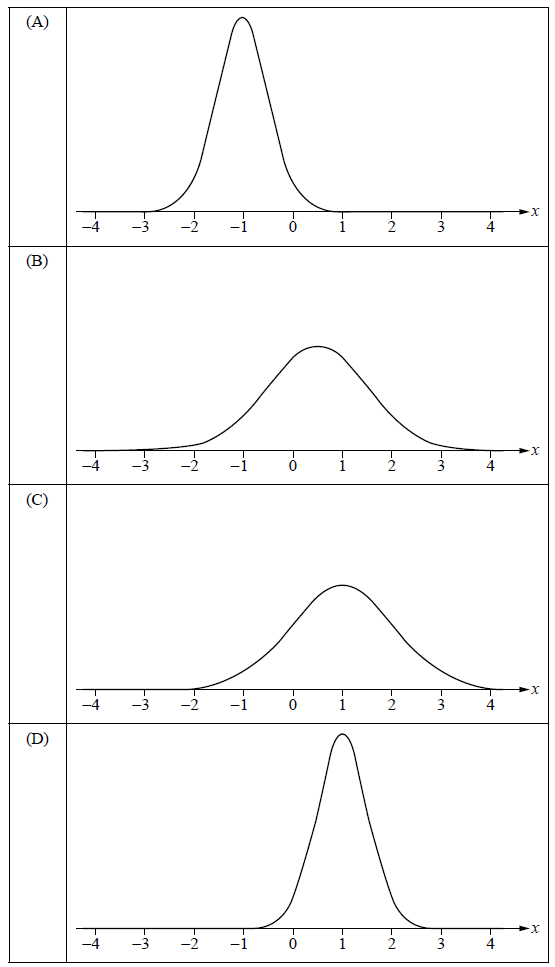
Which normal distribution curve best represents a normal distribution with a mean of 1 and a standard deviation of 0.5?
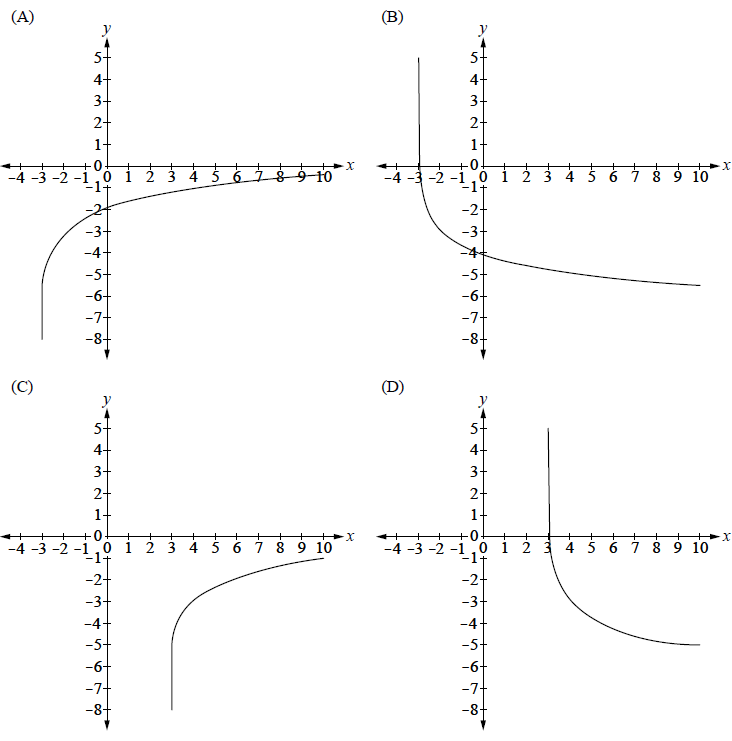
Which graph represents the function \(f(x) = -3 - \ln(x+3)\)?
A circle with radius \(r\) and internal angle \(\theta\) has a shaded segment as shown.
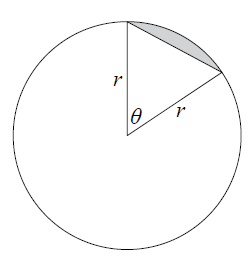
If \(\theta\) is in radians, the area of the shaded segment is
- (A) \(\frac{r^2}{2} \left( \frac{\theta\pi}{180} - \sin(\theta) \right)\)
- (B) \(\frac{r^2}{2} (\theta - \sin(\theta))\)
- (C) \(\frac{r^2}{4} \left( \frac{\theta\pi}{90} - 1 \right)\)
- (D) \(\frac{r^2}{2} (\theta - 1)\)
In a survey, 80 respondents exercised daily, while 120 did not. When calculating the approximate 95% confidence interval for the proportion of people who exercise daily, the margin of error is
- (A) \(1.96\sqrt{\frac{0.4(1-0.4)}{200}}\)
- (B) \(0.95\sqrt{\frac{0.4(1-0.4)}{200}}\)
- (C) \(1.96\sqrt{\frac{0.67(1-0.67)}{120}}\)
- (D) \(0.95\sqrt{\frac{0.67(1-0.67)}{120}}\)
The approximate area under the curve \(f(x) = \sqrt{2x+1}\) between \(x=0\) and \(x=4\) using the trapezoidal rule with four strips is
- (A) \(2+\sqrt{3}+\sqrt{5}+\sqrt{7}\)
- (B) \(2+2(\sqrt{3}+\sqrt{5}+\sqrt{7})\)
- (C) \(4+2(\sqrt{3}+\sqrt{5}+\sqrt{7})\)
- (D) \(4+\sqrt{3}+\sqrt{5}+\sqrt{7}\)
A survey plans to draw conclusions based on a random sample of 1% of Queensland's adult population. To be regarded as a random sample, every
- (A) adult in the population will be placed in an alphabetical list and every 100th person will be selected for the sample.
- (B) adult in the population can choose to participate until the sample size has been reached.
- (C) subgroup within the population will be represented in a similar proportion in the sample.
- (D) adult in the population will have an equal chance of being selected for the sample.
Section 2
Instructions
• Write using black or blue pen.
• Questions worth more than one mark require mathematical reasoning and/or working to be shown to support answers.
• If you need more space for a response, use the additional pages at the back of this book.
– On the additional pages, write the question number you are responding to.
– Cancel any incorrect response by ruling a single diagonal line through your work.
– Write the page number of your alternative/additional response, i.e. See page …
– If you do not do this, your original response will be marked.
• This section has nine questions and is worth 45 marks.
Solve for \(x\) in the following.
a) \(\ln(2x) = 5\) [2 marks]
b) \(\log_4(4x+16) - \log_4(x^2 - 2) = 1\) [3 marks]
The probability that a debating team wins a debate can be modelled as a Bernoulli distribution. Given that the probability of winning a debate is \(\frac{4}{5}\).
a) Determine the mean of this distribution. [1 mark]
b) Determine the variance of this distribution. [1 mark]
c) Determine the standard deviation of this distribution. [1 mark]
a) Determine the derivative of \(f(x) = 3e^{2x+1}\) [1 mark]
b) Given that \(g(x) = \frac{\ln(x)}{x}\), determine the simplest value of \(g'(e)\). [3 marks]
c) Determine the second derivative of \(h(x) = x\sin(x)\). (Give your answer in simplest form.) [5 marks]
The rate that water fills an empty vessel is given by \(\frac{dV}{dt} = 0.25e^{0.25t}\) (in litres per hour), \(0 \le t \le 8\ln(6)\), where \(t\) is time (in hours).
a) Determine the function that represents the volume of water in the vessel (in litres). [2 marks]
The vessel is full when \(t = 8\ln(6)\).
b) Determine the volume of water, to the nearest litre, the vessel can hold when full. [2 marks]
The table shows the approximate rate the water flows into the vessel at certain times.
| \(t\) | \(\frac{dV}{dt}\) |
| 0 | 0.25 |
| 1 | 0.32 |
| 2 | 0.41 |
| 3 | 0.53 |
c) Use information from the table and the trapezoidal rule to determine the approximate volume of water in the vessel after three hours. [2 marks]
The derivative of a function is given by \(f'(x) = e^x(x-4)\).
Determine the interval on which the graph of \(f(x)\) is both decreasing and concave up.
A section of the graphs of the first and second derivatives of a function are shown.
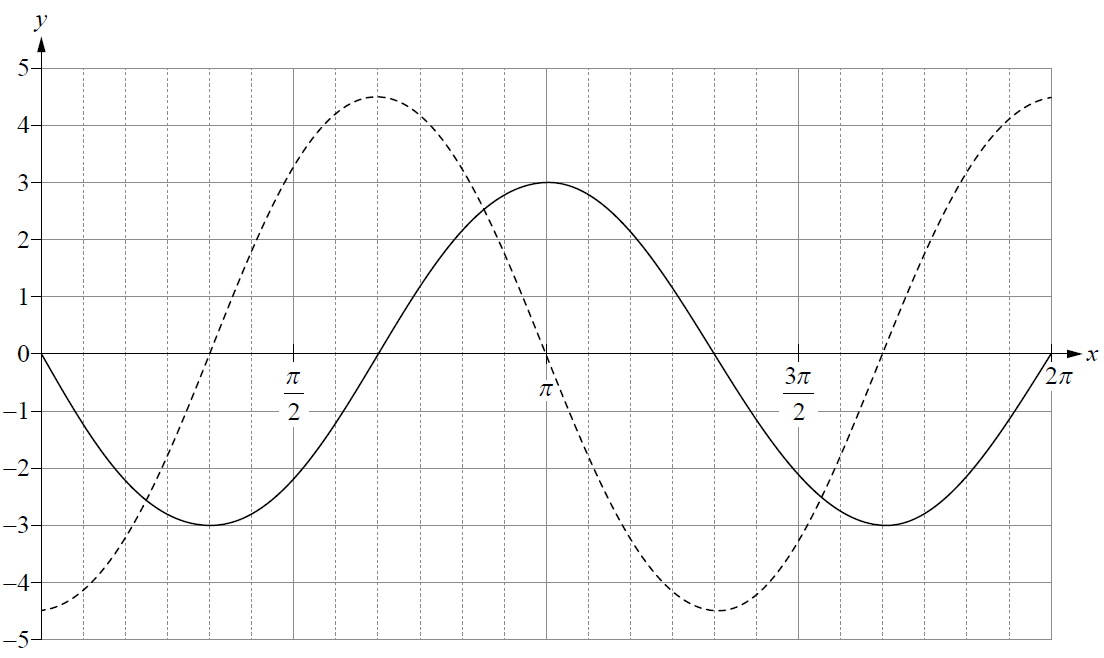
Sketch a possible graph of the function on the same axes over the domain \(0 \le x \le 2\pi\). Explain all reasoning used to produce the sketch.
Note: If you make a mistake in the graph, cancel it by ruling a single diagonal line through your work and use the additional response space on page 17 of this question and response book.
Determine the value of \(b\) given \(\int_a^b 3x^2 \,dx = 117\) and \(\int_a^{b-1} 3x^2 \,dx = 56\) for \(b > 1\).
A percentile is a measure in statistics showing the value below which a given percentage of observations occur.
The continuous random variable \(X\) has the probability density function
\[ f(x) = \begin{cases} 2x-2, & 1 \le x \le 2 \\ 0, & \text{otherwise} \end{cases} \]Determine the 36th percentile of \(X\).
Two triangles are said to be similar if their corresponding angles are congruent and the corresponding sides are in proportion, e.g. if \(\triangle UVW\) is similar to \(\triangle XYZ\) then
\(\angle U = \angle X, \angle V = \angle Y\) and \(\angle W = \angle Z\) and \[ \frac{UV}{XY} = \frac{VW}{YZ} = \frac{UW}{XZ} \]
Two parallel walls \(AB\) and \(CD\), where the northern ends are \(A\) and \(C\) respectively, are joined by a fence from \(B\) to \(C\). The wall \(AB\) is 20 metres long, the angle \(\angle ABC = 30^\circ\) and the fence \(BC\) is 10 metres long.
A new fence is being built from \(A\) to a point \(P\) somewhere along \(CD\). The new fence \(AP\) will cross the original fence \(BC\) at \(O\).
Let \(OB = x\) metres, where \(0 < x \le 10\).
Determine the value of \(x\) that minimises the total area enclosed by \(\triangle OBA\) and \(\triangle OCP\). Verify that this total area is a minimum.
END OF PAPER
QCE is a registered trademark of the QCAA. The QCAA does not endorse or make any warranties regarding this study resource. Past QCE exams and related content can be accessed directly at www.qcaa.qld.edu.au/